

 Call Us Today (732) 249-0444
 October 6, 2026

Claims against public entities are not like claims against a private person or company. The government plays by a different set of rules — and if you miss even one procedural step, your case can be thrown out forever.
Here is a quick overview of what you need to know:
These rules exist because of a legal doctrine called sovereign immunity — the idea that the government cannot be sued unless it specifically allows it by law. Every state has its own statute that defines when and how you can bring a claim. In New Jersey, that is Title 59 of the New Jersey Revised Statutes. In California, it is the Government Claims Act. At the federal level, it is the Federal Tort Claims Act (FTCA).
The bottom line: acting fast and following the correct procedure is everything when suing a public entity.
I am Frank Lazzaro, a Certified Civil Trial Attorney by the Supreme Court of New Jersey — a distinction held by roughly 2% of attorneys in the state — with extensive experience handling claims against public entities involving complex procedural hurdles and high-stakes litigation. Understanding how these strict rules apply to your specific situation is exactly what this guide is designed to help you navigate.
Sovereign immunity is an ancient legal doctrine inherited from English common law, summarized by the phrase: “The King can do no wrong.” While we thankfully do not have kings in New Jersey, our government bodies still enjoy a modern version of this protection.
By default, public entities are immune from civil lawsuits unless a specific statute explicitly waives that immunity. To sue a public school district, a municipality like Perth Amboy, or a state agency like NJ Transit, you must find a statutory “gateway” that allows your lawsuit to proceed.
For New Jersey residents, this gateway is strictly governed by the 2025 New Jersey Revised Statutes :: Title 59 – Claims Against Public Entities. Title 59 lays out the exact boundaries of government liability, detailing when a town, county, or state agency can be held responsible for negligence.
If you are looking at West Coast rules for comparison, the California Government Claims Act serves a similar purpose. Both frameworks establish that you cannot simply walk into a courthouse and file a complaint against a public entity. First, you must exhaust your administrative remedies.
The law requires you to file a formal administrative claim before launching a lawsuit to give the public entity “fair warning.” This pre-suit requirement serves several practical purposes for the government:
Filing this administrative notice is a strict condition precedent. If you skip this step and file a lawsuit directly, the court will dismiss your case. This is why consulting a legal professional early is so critical. For example, understanding Why You Need a Slip and Fall Lawyer can help you avoid these early procedural traps when municipal sidewalks are involved.
It is important to distinguish between state-level negligence claims and federal civil rights claims. If a local police officer in New Brunswick injures you through negligent driving, that is a state tort claim governed by Title 59.
However, if a government actor intentionally violates your constitutional rights — such as through excessive force, illegal search and seizure, or systemic discrimination — you may have a federal claim under 42 U.S. Code Section 1983.
The rules for Section 1983 claims are fundamentally different:
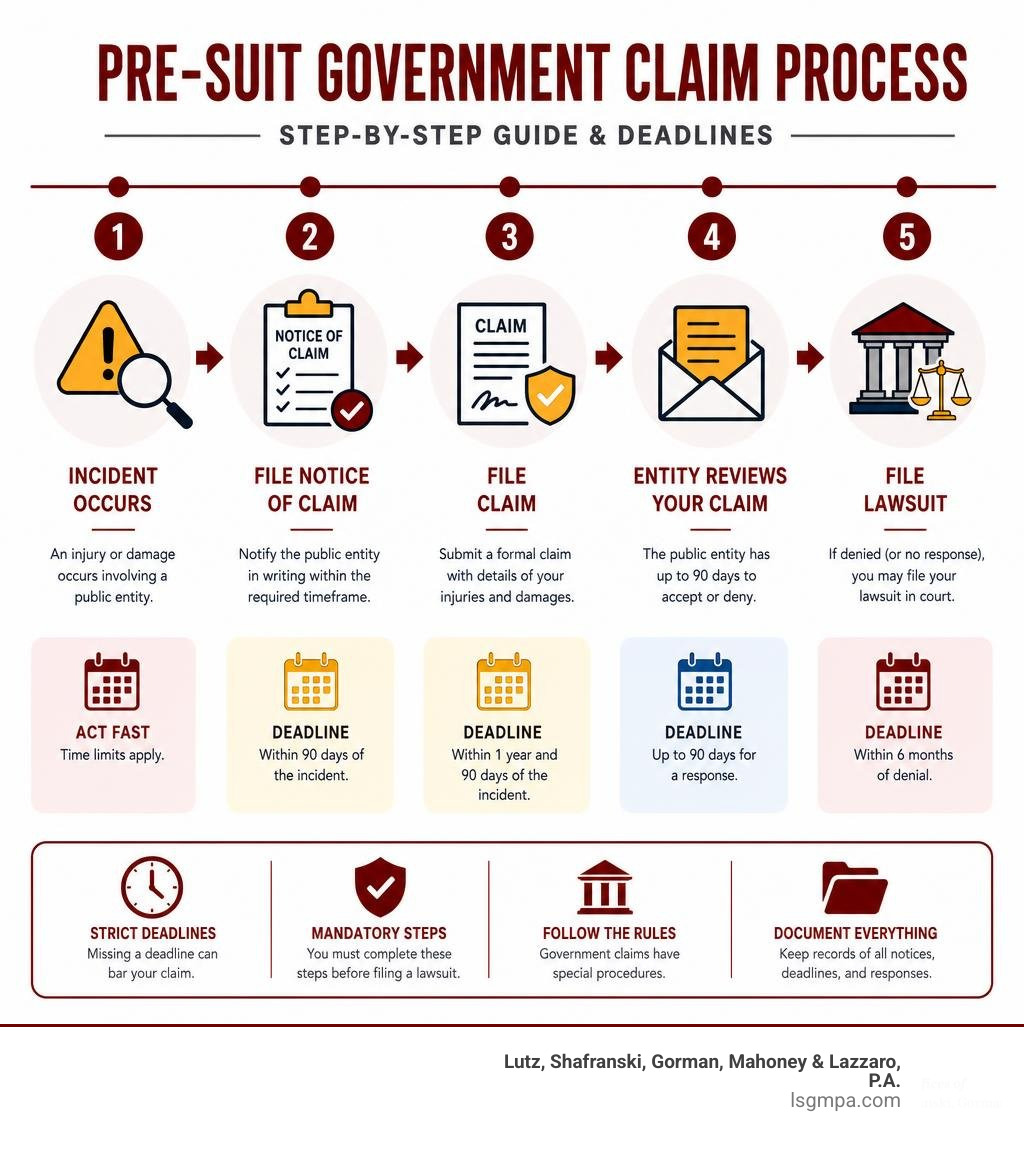
When it comes to claims against public entities, the calendar is your greatest ally or your worst enemy. The statute of limitations for a standard personal injury case against a private individual in New Jersey is generally two years from the accrual date (the date of the injury). But if the defendant is a public entity, you do not have two years to take your first step.
In New Jersey, you have a mere 90 days from the date of the accident to file a formal Notice of Claim. If you fail to file within those 90 days, your claim is barred.
Other states have different timelines. For instance, California practitioners often refer to the “Rule of Six” to navigate their statutory deadlines.
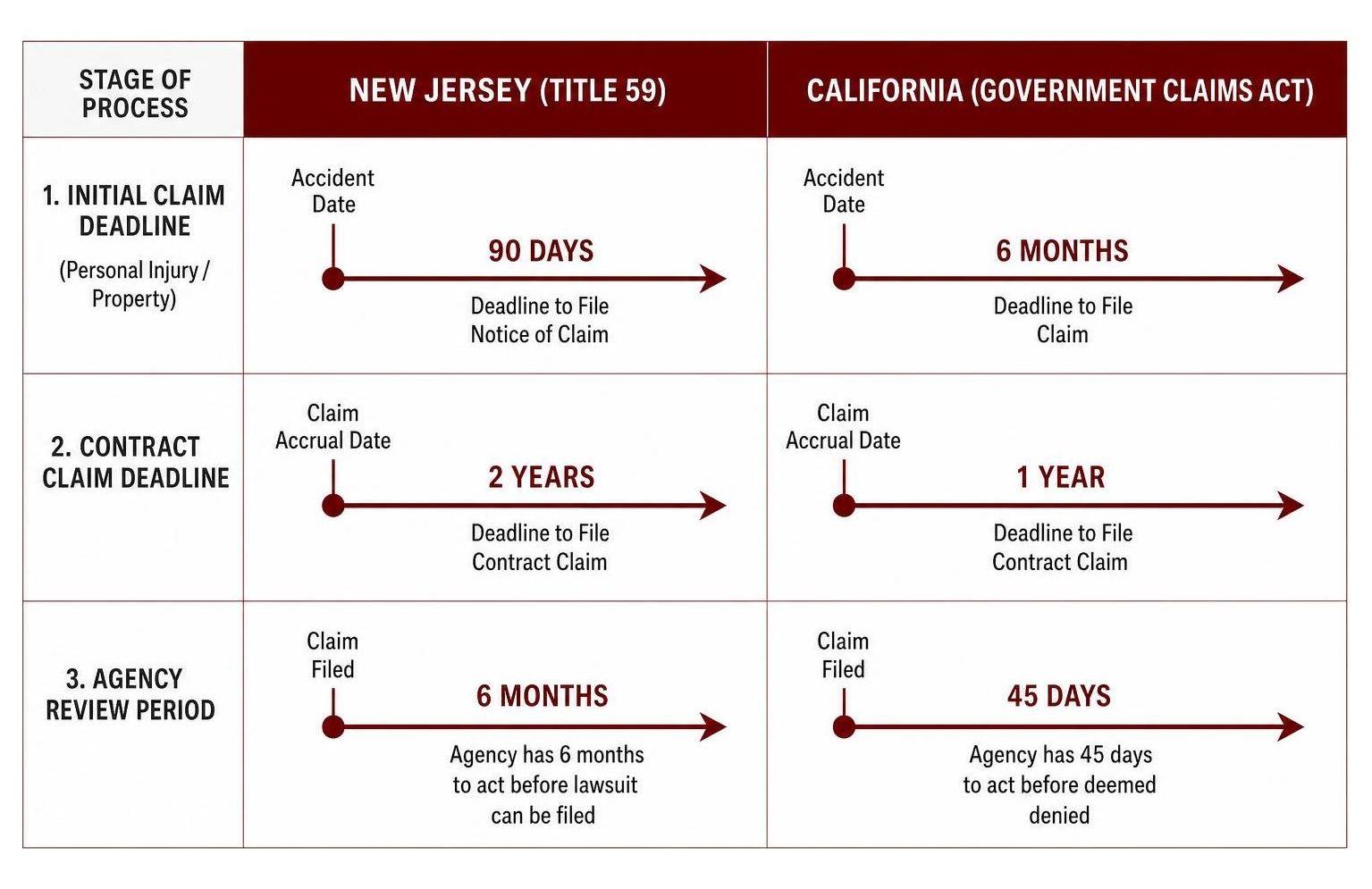
| Stage of Process | New Jersey (Title 59) | California (Government Claims Act) |
|---|---|---|
| Initial Claim Deadline | 90 Days (Personal Injury / Property) | 6 Months (Personal Injury / Property) |
| Contract Claim Deadline | 2 Years (Standard Statute of Limitations) | 1 Year |
| Agency Review Period | 6 Months (Before lawsuit can be filed) | 45 Days (Before deemed denied) |
| Lawsuit Deadline (After Rejection) | Varies (Must fit within overall 2-year limit) | 6 Months (From written rejection letter) |
| Lawsuit Deadline (No Written Rejection) | 2 Years (From date of injury accrual) | 2 Years (From date of injury accrual) |
For those dealing with West Coast claims, the “Rule of Six” is a helpful mnemonic framework:
These rules are strictly enforced. In City of Stockton v. Superior Court (City of Stockton v. Superior Court, 171 P.3d 20, 68 Cal.Rptr.3d 295, 42 Cal.4th 730 (Cal. 2007)) – vLex United States , the California Supreme Court made it clear that these pre-filing requirements apply not just to personal injury torts, but also to breach of contract claims seeking money or damages from local public entities.
Once you submit your administrative claim, the public entity has a statutory review period to evaluate the case.
In New Jersey, the public entity has six months from the receipt of the Notice of Claim to investigate and attempt to settle. You are legally barred from filing a lawsuit during this six-month waiting period. This is designed to encourage out-of-court resolutions, though in practice, many public entities simply let the clock run out.
In California, the agency has 45 days to act. If the board rejects the claim in writing, they will send a “right-to-sue” letter, giving you exactly six months to file a lawsuit. If they ignore the claim, it is “deemed denied” by operation of law after 45 days, which extends your deadline to file a lawsuit to two years from the date of the incident.
What happens if you missed the initial notice window? Perhaps you were hospitalized, or you did not realize that the utility truck that hit you was owned by a local municipality.

If you miss the 90-day deadline in New Jersey, or the six-month deadline in California, you cannot simply file a late claim. You must ask for permission.
In California, this involves filing an Application to Present a Late Claim within one year of the injury date. If the public entity denies this application, you must file a petition for court relief under Government Code Section 946.6 within six months of the denial.
In New Jersey, you must file a formal motion with the Superior Court for leave to file a late Notice of Claim. This motion must be filed within one year of the accident date. If you pass the one-year mark without filing this motion, the court has absolutely no jurisdiction to help you, and your claim is permanently dead.
Courts do not hand out late-filing relief easily. To successfully file a late claim, you must demonstrate a valid legal excuse. These typically include:
Warning: Not knowing the law or being unaware of the 90-day filing requirement is never considered a valid excuse or an “extraordinary circumstance” by New Jersey courts. The law expects you to know your rights or seek legal counsel immediately.
Drafting a notice of claim is not a casual letter-writing exercise. It is a formal legal document. Many public entities have their own customized claim forms that you can request. If they do not, your written notice must still contain specific, statutorily required information:
To protect your rights, always send the completed claim form via Certified Mail with Return Receipt Requested or hand-deliver it and get a stamped, dated receipt. This provides irrefutable proof that the agency received your claim on time. Because a single missing detail can derail your entire case, knowing How to Choose the Best Slip and Fall Personal Injury Attorney for Your Case is a vital step in ensuring your paperwork is flawless.
Not every legal action against a public entity requires an administrative pre-suit claim. The major exemptions include:
Even if you file your claim perfectly and on time, you must still overcome the formidable wall of government immunities. Public entities are shielded by law to prevent lawsuits from interfering with policy-making and day-to-day governance.
One of the most important distinctions in government liability is between discretionary acts and ministerial duties:
One of the most common ways to hold a public entity liable is by proving a “dangerous condition of public property” (governed by California Government Code Section 835, and N.J.S.A. 59:4-2 in New Jersey).
To win a dangerous condition claim, you must prove:
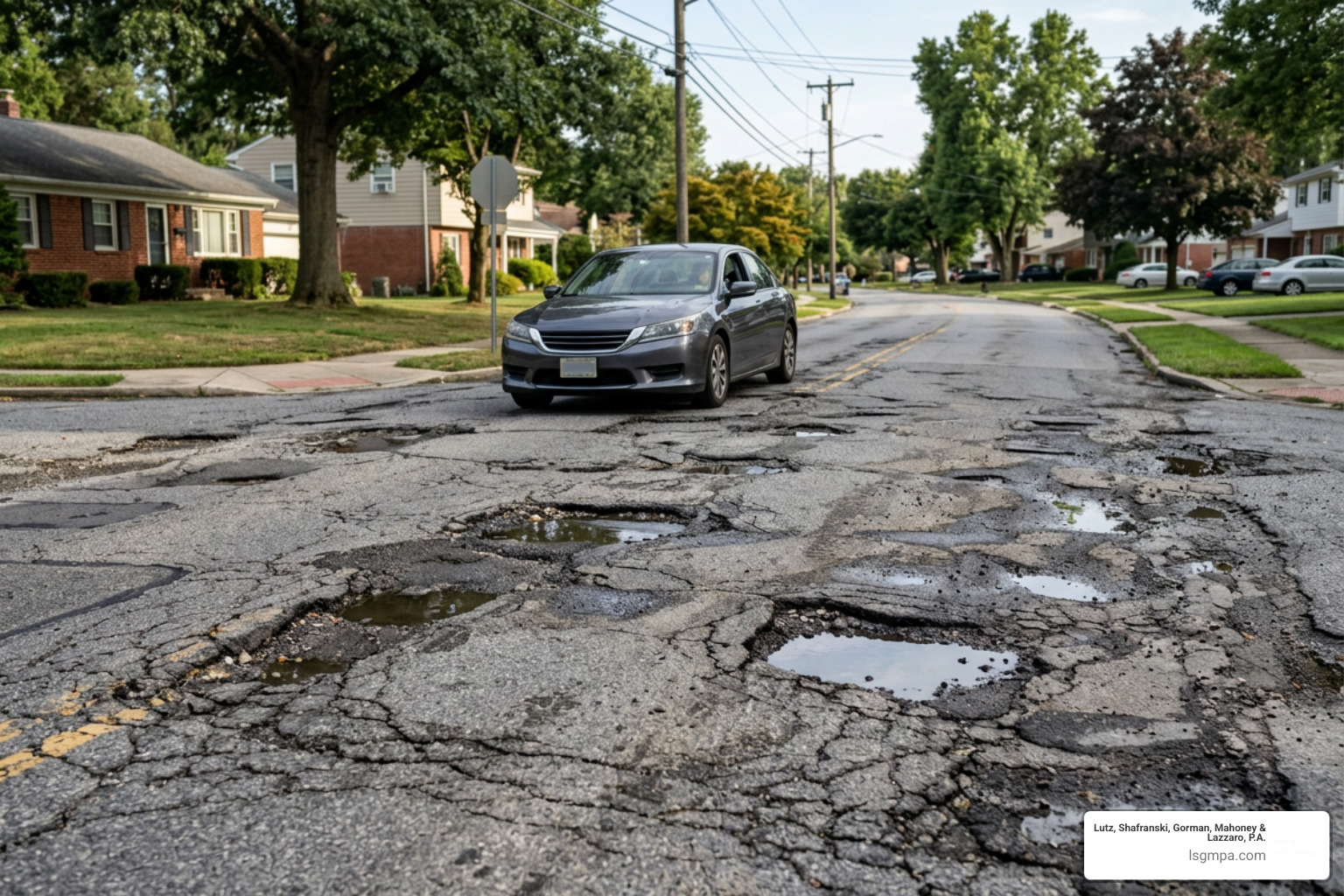
Common examples include severely cracked and uneven municipal sidewalks, poorly designed roadways lacking necessary warning signs, icy public steps that were left unsalted, or broken equipment on a school playground. If you are injured in a public transit accident, understanding the unique rules of public transportation claims is essential. You can learn more about navigating these complex transit cases in our guide, Navigating the Legal Gridlock: A Guide to Manhattan Bus Accident Lawyers.
When a government worker causes an accident, can you sue them personally?
Under standard vicarious liability rules, if an employee was acting within the scope of their employment at the time of the incident, the public entity is responsible for their negligence and will defend and indemnify them. Generally, you sue the entity, not the individual.
However, if the employee acted with bad faith, malicious purpose, or wanton and willful disregard for safety, the employee loses their immunity. In those rare cases, you can sue the employee individually, and the public entity may not be required to pay the judgment.
For comparison, it is worth looking at how other states handle these limitations. Under Florida Sovereign Immunity & § 768.28 — Suing the Government, the state waives sovereign immunity for tort claims but imposes strict statutory damage caps.
Currently, Florida caps damages at $200,000 per person and $300,000 per incident. Any judgment exceeding these caps cannot be collected unless the Florida Legislature passes a special “claim bill” — a notoriously difficult and political process where historically only about 25% of filed claim bills pass.
Pending legislation (such as HB 145) aims to raise these caps to $350,000 per person and $500,000 per incident, demonstrating how sovereign immunity laws remain a constantly evolving legal landscape.
In New Jersey, you must file a formal written Notice of Claim within 90 days of the date of the injury under 2026 NJ Statutes Title 59 – Claims Against Public Entities – Annotated. This strict rule applies to municipal, county, and state agencies, including NJ Transit. If you miss this 90-day window, you may permanently lose your right to seek compensation.
No. This is a unique and highly beneficial feature of New Jersey law. Under N.J.S.A. 59:9-2(e) and the landmark ruling in Thomas v. City of East Orange, workers’ compensation carriers and self-insured employers are barred from asserting subrogation liens (Section 40 liens) against settlements obtained from public entity tortfeasors. However, you are also barred from recovering medical bills or lost wages from the public entity if those expenses were already paid by workers’ compensation.
If a public entity takes no action on your claim within the statutory review period (45 days in California, 6 months in New Jersey), the claim is legally “deemed denied.” This automatic rejection satisfies your requirement to exhaust administrative remedies, allowing you to proceed with filing a formal lawsuit in court.
Filing a claim against a public entity is a procedural minefield. A single missed deadline, an incomplete form, or a failure to identify the correct government agency can destroy an otherwise strong case before it ever reaches a courtroom.
At Lutz, Shafranski, Gorman, Mahoney & Lazzaro, P.A., we have spent decades helping accident victims in New Brunswick, Milltown, Perth Amboy, and across New Jersey navigate the strict demands of Title 59. We understand how to investigate government negligence, file flawless administrative notices, and aggressively pursue the maximum compensation you deserve for medical bills, lost wages, and pain and suffering.
If you or a loved one has been injured on public property or by a government employee, do not let the 90-day clock run out. Contact a skilled New Brunswick Slip and Fall Lawyer at Lutz, Shafranski, Gorman, Mahoney & Lazzaro, P.A. today for a free consultation, and let us protect your rights.