

 Call Us Today (732) 249-0444
 September 24, 2026

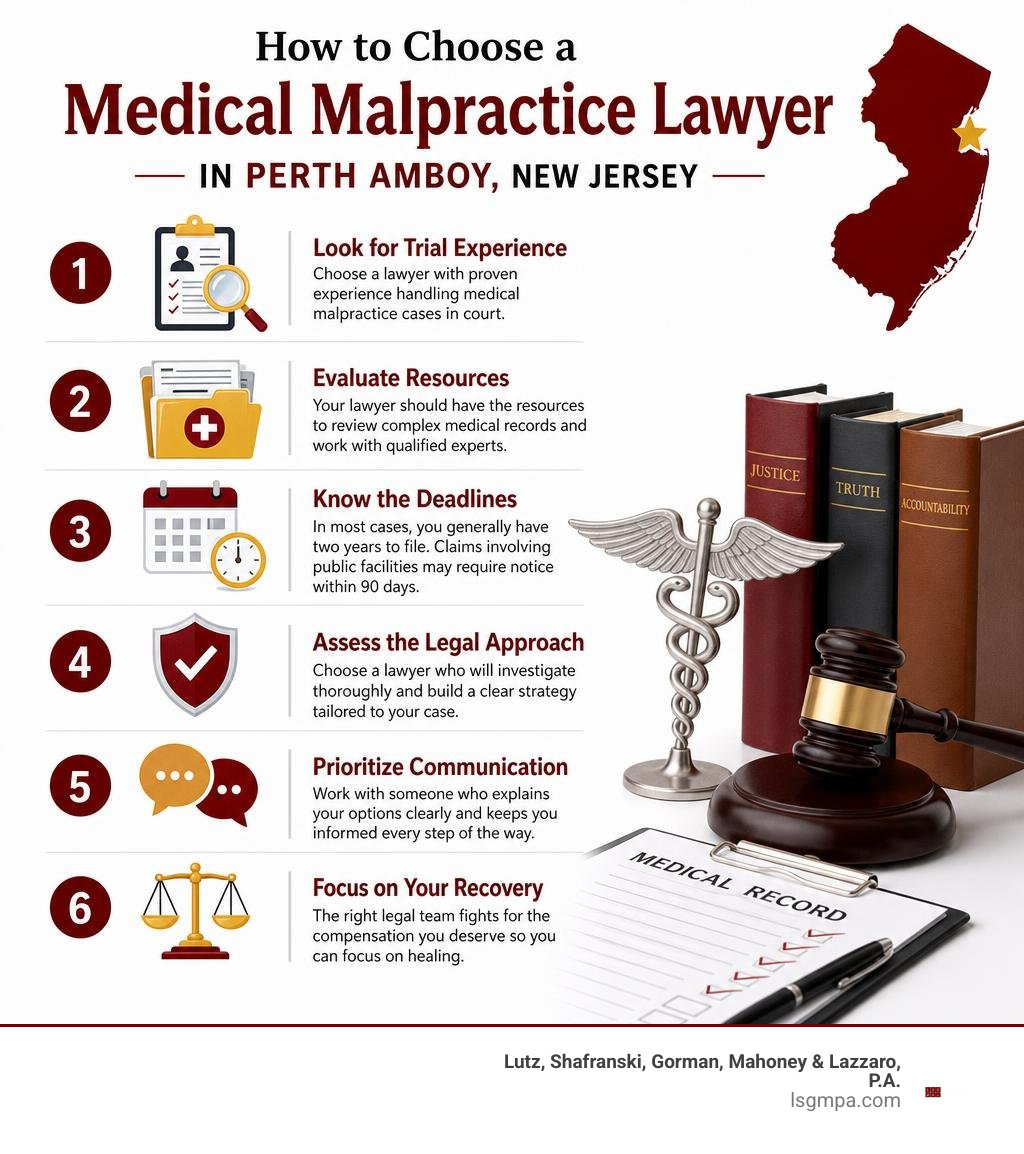
If you believe a doctor, hospital, or clinic caused preventable harm, speak with a medical malpractice lawyer in Perth Amboy as soon as possible. Choose counsel with civil trial experience, the resources to review complex medical records with qualified experts, and a clear plan for meeting New Jersey deadlines.
In most New Jersey cases, the filing deadline is generally two years from the malpractice or when the injury was reasonably discovered. Claims involving a public hospital or healthcare facility may require a formal notice much sooner, often within 90 days. Prompt legal review can help preserve records, identify the right parties, and assess whether a provider departed from the accepted standard of care.
Medical malpractice cases are not based on a bad outcome alone. A patient generally must show that a healthcare professional was negligent and that the negligence caused measurable harm, such as added medical bills, lost income, pain, or a lasting disability.
I am Frank Lazzaro, a Supreme Court of New Jersey Certified Civil Trial Attorney with experience securing significant verdicts and recoveries in injury cases. As a medical malpractice lawyer Perth Amboy residents can consult, I understand the preparation, expert review, and courtroom work serious negligence claims demand.
Medical malpractice lawyer perth amboy definitions:
When we seek treatment across Middlesex County—whether at a major medical center, an outpatient surgical clinic, or a neighborhood practice—we place our trust and well-being into professional hands. Most healthcare professionals provide dedicated, competent care. However, when a provider cuts corners, misreads diagnostic findings, or fails to follow safety protocols, the consequences can be catastrophic.
Medical malpractice is estimated to be the third leading cause of death in the United States, claiming approximately 250,000 lives each year. Furthermore, studies indicate that roughly 1 in 3 physicians in the United States face a malpractice lawsuit at some point in their careers. Under New Jersey law, medical malpractice occurs when a doctor, nurse, surgeon, or healthcare entity departs from the recognized standard of care, directly resulting in patient harm, worsening illness, or death.
The standard of care is defined as the level of skill, knowledge, and diligence that a reasonably prudent healthcare specialist in the same field would provide under similar circumstances. Simply experiencing a poor recovery or a known procedural side effect does not necessarily mean negligence took place. Understanding this distinction is essential before moving forward with a legal claim.
| Factor | Unavoidable Medical Complication | Actionable Medical Malpractice |
|---|---|---|
| Standard of Care | Provider followed all accepted clinical protocols and safety standards. | Provider deviated from recognized medical standards and best practices. |
| Predictability & Risk | Known, inherent risk documented and disclosed during informed consent. | Preventable error resulting from carelessness, inattention, or incompetence. |
| Root Cause | Natural disease progression, anatomical anomaly, or unpreventable reaction. | Diagnostic delays, surgical missteps, dosing mistakes, or chart mix-ups. |
| Legal Recourse | Generally not actionable under New Jersey personal injury law. | Legally actionable; patient may seek financial recovery for damages. |
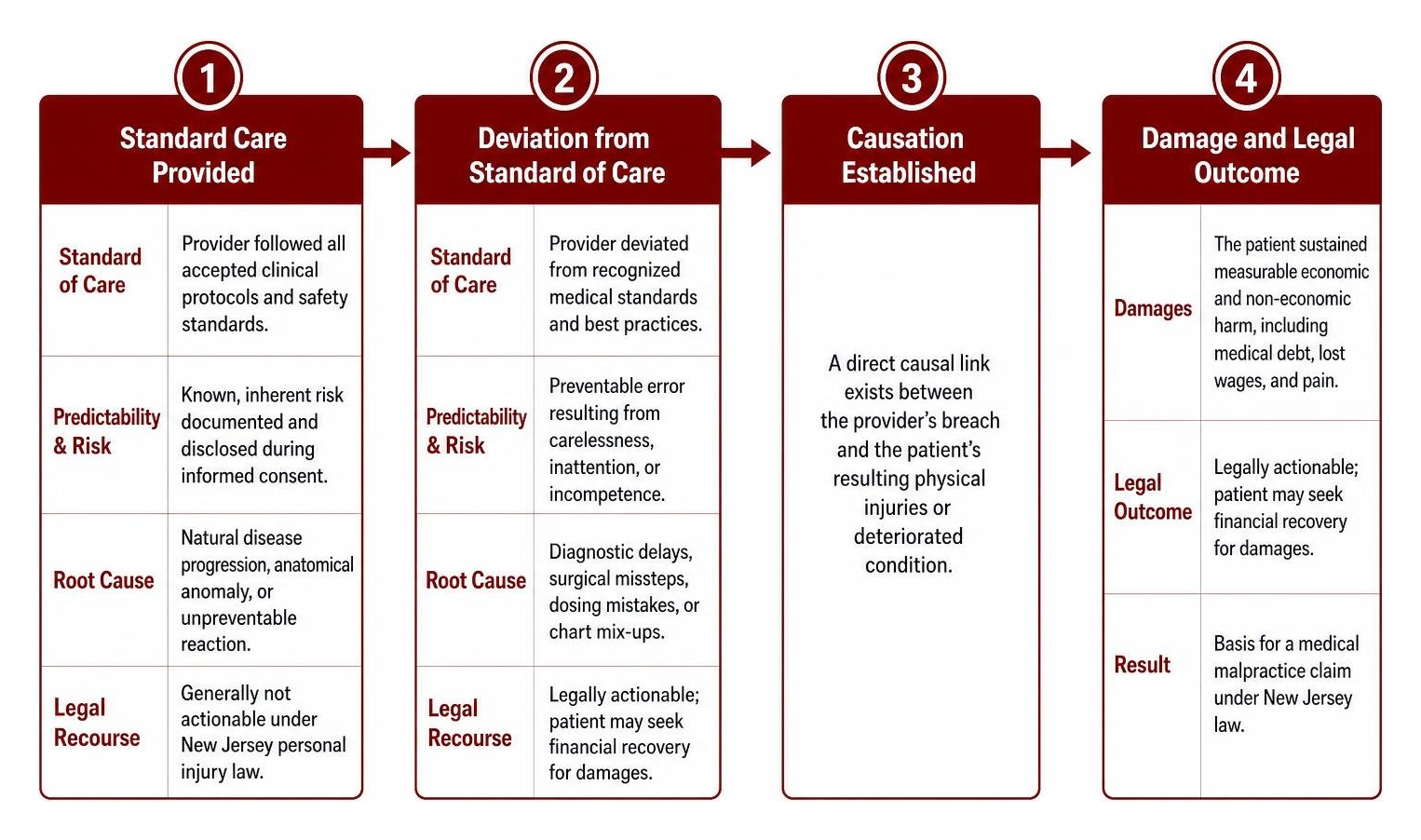
Establishing liability in a New Jersey medical malpractice claim requires demonstrating four primary legal elements:
To uphold these claims, New Jersey enforces the Affidavit of Merit statute (N.J.S.A. 2A:53A-27). This procedural requirement mandates that within 60 days of the defendant filing an answer to our complaint (with a single 60-day extension allowed for good cause), we must submit an affidavit from an appropriately credentialed, independent medical expert.
This expert must practice in the same specialty or subspecialty as the defendant and attest under oath that there exists a reasonable probability that the care delivered fell outside acceptable professional standards. If you want a deeper look at the fundamentals of personal injury claims before initiating formal litigation, accident claim lawyers explained everything you need to know before filing.
Negligence can take many forms across different clinical settings. The most common types of medical negligence claims we handle in New Jersey include:
When these medical errors lead to life-altering, permanent physical limitations, reviewing the ultimate guide to finding a catastrophic injury lawyer will give you a comprehensive understanding of long-term damages assessment.
Pursuing a medical malpractice lawsuit is an extensive legal process that typically requires between two and three years to resolve through settlement or trial verdict. Because these cases involve intricate technical evidence, aggressive defense counsel, and significant financial stakes, every stage must be handled with meticulous care.

From our initial case assessment, our legal team collects and reviews hospital charts, lab work, radiological imaging, and nursing notes. Once our expert witnesses confirm a viable breach of duty, we file the formal complaint in the Superior Court of New Jersey.
During the discovery phase, both sides exchange interrogatories, produce institutional documentation, and conduct depositions of treating physicians, nurses, and opposing expert witnesses. If the defense’s malpractice carrier refuses to offer a fair settlement during mediation or mandatory pre-trial conferences, we proceed to present our case before a jury.
Timing is critical. In New Jersey, the standard statute of limitations for personal injury and medical malpractice claims is two years from the date the negligent act occurred (N.J.S.A. 2A:14-2).
However, there are critical exceptions and qualifications to keep in mind:
In New Jersey, the median payout for medical malpractice claims sits at approximately $250,000, with substantially higher recoveries awarded in cases involving catastrophic impairment, permanent paralysis, or wrongful death.
Victims of medical negligence are entitled to seek both economic and non-economic damages:
Hospital systems and physician groups are represented by well-funded insurance carriers and specialized defense firms whose primary goal is minimizing financial payouts. When an adverse medical event occurs, risk management teams immediately work to protect the facility’s bottom line.
Defense teams frequently argue that your injuries were the natural result of an underlying pre-existing condition, that your complications were unavoidable risks you accepted during informed consent, or that another party was to blame.
Navigating these challenges requires partnering with seasoned medical malpractice lawyers in New Brunswick and Perth Amboy who understand how to challenge defense tactics and hold negligent institutions accountable.
Building a strong malpractice claim requires thorough investigation, financial investment, and technical precision. When we take on a claim at Lutz, Shafranski, Gorman, Mahoney & Lazzaro, P.A., our process includes:
Choosing the right legal advocate can significantly impact the outcome of your claim. As you review prospective representation, including resources like Justia’s directory of Perth Amboy medical malpractice attorneys, evaluate these essential qualifications:
To help you vet potential legal counsel, consult our injury lawyer Perth Amboy ultimate checklist for choosing one.
Under the New Jersey Tort Claims Act (Title 59), you must file a formal administrative Notice of Claim within 90 days of the date of injury if your claim involves a public, municipal, or state-run healthcare facility. If you miss this 90-day deadline, you may be permanently barred from pursuing compensation, regardless of the severity of the medical negligence.
An Affidavit of Merit is a mandatory legal document required under N.J.S.A. 2A:53A-27. Within 60 days of the defendant filing an answer to your lawsuit (with a potential 60-day extension), your attorney must submit a sworn statement from a qualified, independent medical professional practicing in the same specialty. This document confirms that there is a reasonable probability the defendant deviated from the accepted standard of care.
Medical malpractice cases are handled on a contingency fee basis. Under New Jersey Court Rule 1:21-7, attorney fees in tort actions are subject to statutory percentage caps. You pay no upfront retainer fees or out-of-pocket litigation expenses; legal fees are deducted only as a percentage of the financial recovery obtained through settlement or jury verdict. If no recovery is made, you owe no attorney fees.
Suffering an injury due to medical negligence can leave you facing mounting medical expenses, lost wages, and physical pain. Holding negligent healthcare providers accountable not only provides the financial support you need to recover, but it also reinforces safety standards for the entire community.
At Lutz, Shafranski, Gorman, Mahoney & Lazzaro, P.A., we bring decades of dedicated trial experience and comprehensive advocacy to serious injury claims across Middlesex County, including Perth Amboy, New Brunswick, Edison, Woodbridge, Piscataway, Sayreville, East Brunswick, North Brunswick, Milltown, Highland Park, Middlesex, and Monroe.
If you or a loved one has suffered due to substandard medical care, contact us today to schedule your free, confidential Perth Amboy injury claim consultation. We will review your medical records, explain your legal options, and fight to secure the compensation you deserve.
