

 Call Us Today (732) 249-0444
 October 1, 2026

A public entity vocational expert is a certified professional who evaluates your ability to work — and earn — after an injury or disability, specifically in cases involving government bodies, municipalities, or public agencies.
If you were injured due to the negligence of a public entity in New Jersey, here is what you need to know right away:
When a government agency or public body is defending against your claim, they will often bring in their own vocational expert to minimize or dispute your income losses. Understanding how these experts operate — and how to challenge them — is critical to protecting your recovery.
I’m Frank Lazzaro, a Certified Civil Trial Attorney with a track record of multi-million dollar verdicts in New Jersey personal injury cases, including cases where public entity vocational expert testimony played a pivotal role in determining damages. In the sections below, I’ll walk you through exactly how these experts work and how to protect yourself when facing one.
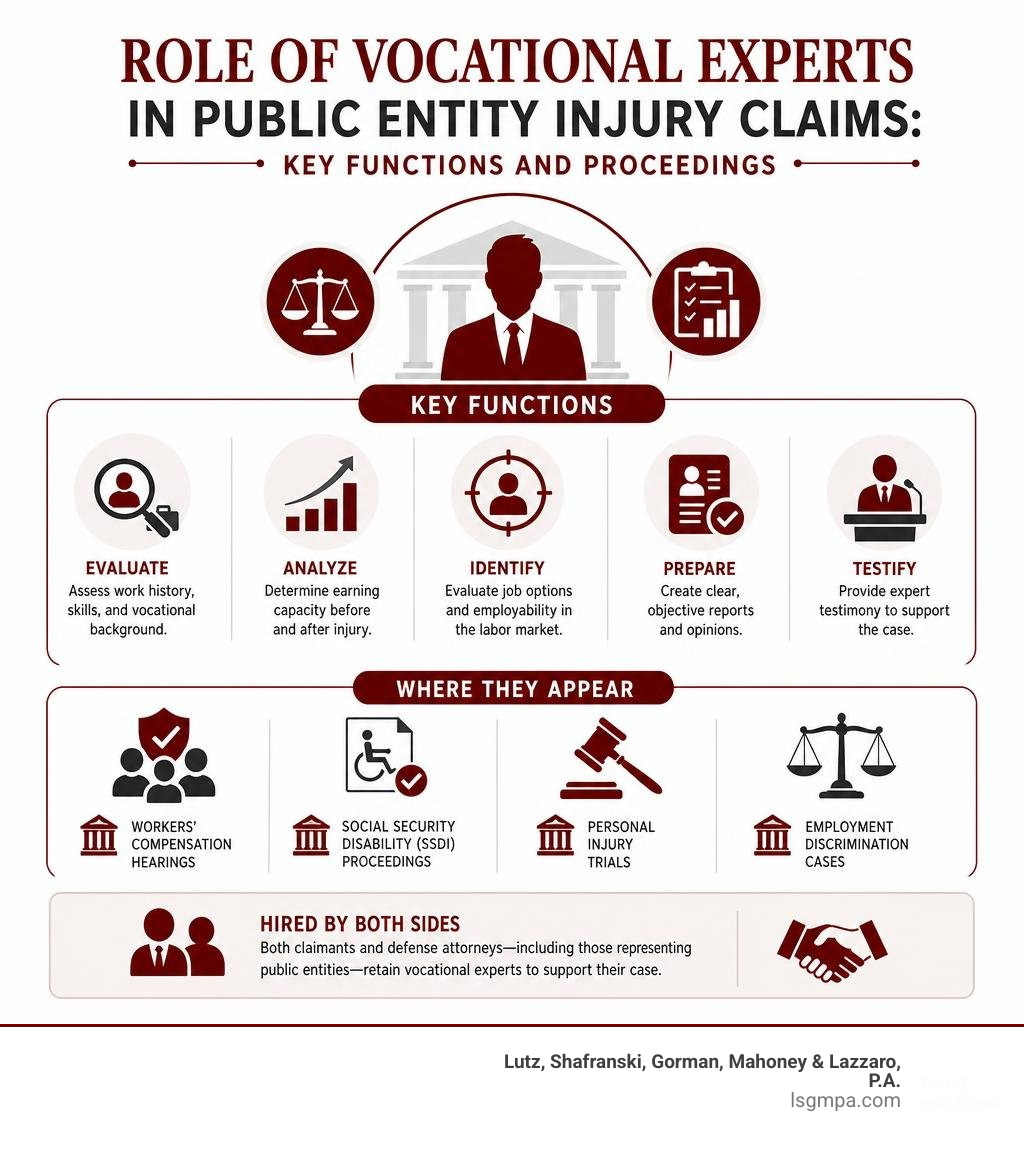

When we talk about a public entity vocational expert, we are referring to a highly specialized vocational professional who performs employment evaluations within the context of government-related claims. While a private-sector vocational expert typically evaluates cases for commercial insurance companies, private employers, or standard civil lawsuits, a public-sector expert operates under a completely different set of rules.
Public entities—such as the State of New Jersey, Middlesex County, or local municipalities like New Brunswick, Milltown, and Perth Amboy—are governed by strict statutory frameworks. For example, under the New Jersey Tort Claims Act, claims against public entities have strict notice requirements and limitations on pain and suffering damages. Because of these limitations, proving economic damages, such as lost earning capacity, becomes the most critical component of your claim.
A vocational expert working on a public entity case must understand civil service rules, public pension systems (like the Public Employees’ Retirement System or PERS), and union collective bargaining agreements. They look at how an injury affects a public worker’s specialized benefits, tenure, and step-increase salary structures, which are vastly different from the fluid, at-will private employment market.
| Feature | Public Sector Vocational Expert | Private Sector Vocational Expert |
|---|---|---|
| Primary Focus | Public employee benefits, pensions, civil service rules, municipal liability | Private employment, commercial insurance, personal injury, general labor market |
| Regulatory Framework | New Jersey Tort Claims Act, Title II/XVI (SSA), civil service regulations | ERISA, private insurance policies, standard common law torts |
| Job Analysis Scope | Defined public service structures, union scales, pension disability rules | Fluid private market, corporate ladders, nationwide remote work trends |
To hold weight in a New Jersey courtroom or administrative hearing, a public entity vocational expert must possess impeccable credentials. These experts are not simply “career counselors”—they are highly trained forensic specialists who must meet strict admissibility standards under New Jersey law.
The most widely respected credentials in this field include:
When evaluating an expert’s background, look for a graduate degree in rehabilitation counseling or a closely related field. Learn more about New Jersey vocational credentials to understand the strict educational and ethical standards these professionals must uphold.
A public entity vocational expert frequently provides critical testimony and comprehensive reports in several key legal arenas across New Jersey:
For those navigating these complex local systems, you can Explore New Brunswick vocational evaluation resources to see how experts structure their assessments for local administrative bodies. If your claim is based in southern Middlesex County, you may also find specific insights by looking into Perth Amboy Vocational Experts – Occupational Assessment Services.

How does a public entity vocational expert actually determine what you can or cannot earn after a life-altering accident? They don’t guess. They follow a highly structured, peer-reviewed scientific methodology.
The process begins by distinguishing between employability (the practical ability to secure and perform a job) and earning capacity (the maximum economic potential an individual can achieve based on their education, skills, and physical limitations).
To map out this trajectory, the expert utilizes a step-by-step diagnostic process:
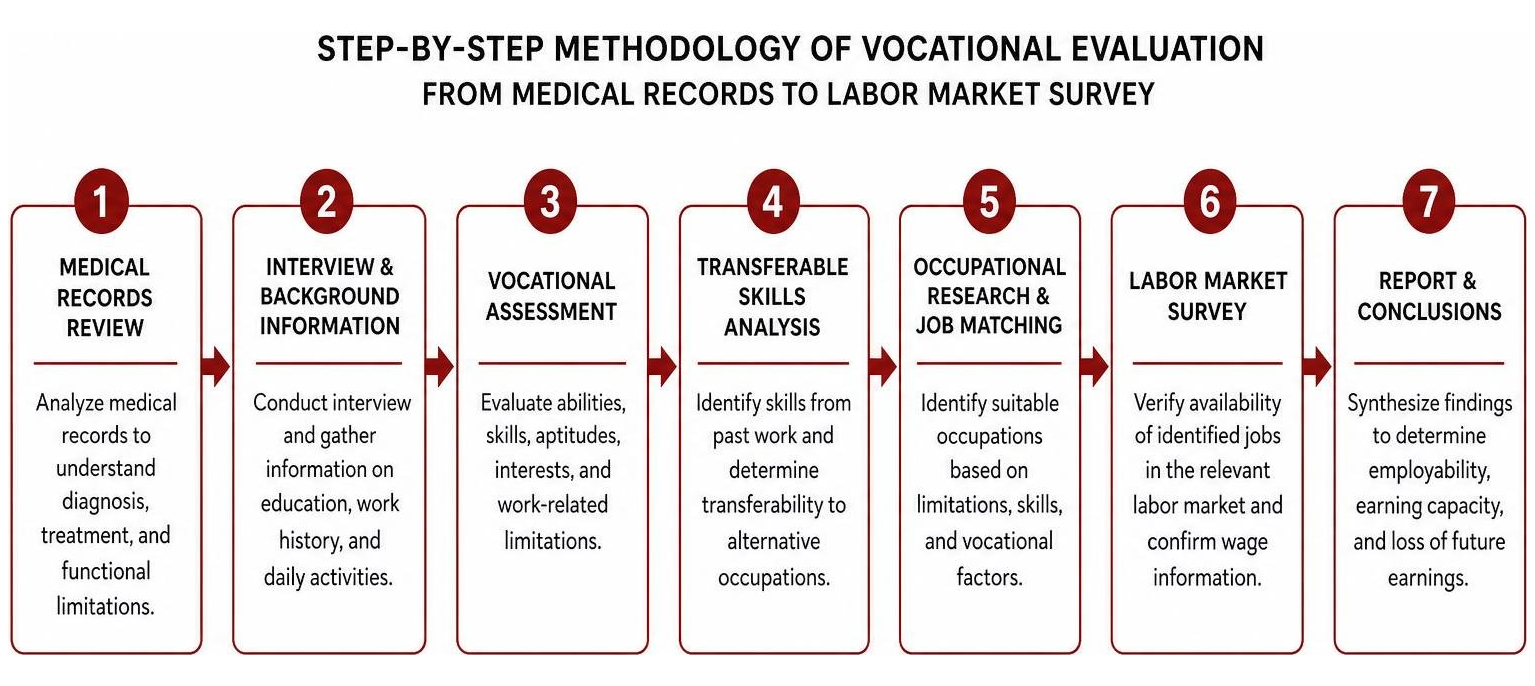
To see how these methodologies are applied to protect claimants, you can Discover expert vocational insights on employability and learn how real-world labor data is synthesized.
To ensure their opinions are objective and legally defensible, vocational experts rely on several federally and state-approved databases:
If you are applying for Social Security Disability Insurance (SSDI) or Supplemental Security Income (SSI), you will likely cross paths with a vocational expert. In federal disability hearings, the Administrative Law Judge (ALJ) routinely hires an independent vocational expert to provide impartial testimony.
The interaction between the ALJ and the vocational expert is highly structured. The ALJ will ask the expert a series of “hypothetical questions.” For example:
“Assume a hypothetical individual of the claimant’s age, education, and work experience, who is limited to light work, can only occasionally climb stairs, and must avoid concentrated exposure to extreme cold. Can such an individual perform the claimant’s past relevant work?”
If the expert answers “no,” the ALJ will then ask if there are other jobs in the national economy that this hypothetical person can perform. The expert’s answers at this stage are absolutely critical. If the expert identifies jobs that exist in significant numbers, your claim will likely be denied.
Understanding these procedures is vital. You can Read the official HALLEX guidelines on vocational experts to see the exact instructions federal judges must follow when questioning these professionals.
For professionals looking to enter this field, the Social Security Administration (SSA) recruits vocational experts through a federal procurement process. The agency utilizes a Blanket Purchase Agreement (BPA) managed by the Office of Hearings Operations (OHO).
Under recent federal updates, such as the implementation of Social Security Ruling SSR 24-3p, the SSA has modernized how vocational evidence is evaluated, emphasizing more precise occupational data. If you are a qualified rehabilitation professional interested in serving in this capacity, you can Learn about becoming an SSA vocational expert.
Because a public entity vocational expert‘s testimony can cost or save a municipality hundreds of thousands of dollars, their objectivity is often under a microscope. While experts are legally required to remain neutral, defense experts hired by public entities may naturally seek to minimize your losses by claiming you can easily transition to a sedentary “desk job.”
To counter this, a skilled personal injury attorney must hold the expert to the highest ethical and scientific standards. Agencies and professional consulting groups, such as Wolstein Putts Expert Consulting, pride themselves on maintaining strict objectivity, demonstrating that the most credible expert opinions are those rooted strictly in verifiable data rather than biased assumptions.
Cross-examining a defense vocational expert is an art form. At Lutz, Shafranski, Gorman, Mahoney & Lazzaro, P.A., we prepare for these depositions and trials by identifying the weak points in the expert’s report. Common strategies we use to challenge defense experts include:
To understand how these complex earning capacity evaluations are structured and contested in New Jersey courts, you can read more about how we Understand earning capacity assessments in New Jersey.
While the terms are often used interchangeably, a vocational consultant typically works in a clinical, non-litigation setting, helping individuals with disabilities find jobs or obtain training. A vocational expert is a forensic specialist with advanced credentials (such as CRC or ABVE) who is qualified to write legally binding reports, sit for depositions, and provide admissible expert testimony in a court of law.
The calculation is a multi-step financial and vocational formula:
Absolutely not. Vocational experts are prohibited from giving medical opinions or diagnosing conditions. They cannot testify on whether you have a herniated disc or PTSD. Instead, they must accept the medical limitations established by your treating physicians or functional capacity evaluations (FCEs) and testify solely on how those existing medical limitations impact your ability to work.
When you are pursuing a claim against a public entity in New Jersey, you are facing an opponent with vast resources. Whether it is a slip and fall on municipal property in New Brunswick, a collision with a county vehicle in Milltown, or a complex workers’ compensation claim in Perth Amboy, the defense will use every tool at their disposal—including their own vocational experts—to minimize your financial recovery.
Proving that you can no longer work, or that your earning capacity has been permanently slashed, requires aggressive, sophisticated legal advocacy.
At Lutz, Shafranski, Gorman, Mahoney & Lazzaro, P.A., we have spent decades fighting for injured workers and accident victims across Middlesex County. We know how to collaborate with top-tier vocational experts to build an airtight case for your lost earnings, and we know exactly how to dismantle a defense expert’s flawed testimony under cross-examination.
If you or a loved one has suffered a life-altering injury, do not leave your financial security to chance. Contact a New Brunswick workers’ compensation lawyer or reach out to our main office at Lutz, Shafranski, Gorman, Mahoney & Lazzaro, P.A. today for a free, confidential consultation. Let us help you protect your livelihood and secure the compensation you deserve.