

 Call Us Today (732) 249-0444
 August 18, 2026

Understanding how a law firm operates internally is essential when seeking the best car crash lawyers. Law firms in the personal injury sector generally fall into two operational models: high-volume “settlement mills” and boutique trial firms.
Settlement mills rely heavily on mass advertising to generate a constant influx of cases. To handle this massive case volume, these firms often assign primary case management to non-attorney staff, such as case managers or paralegals. Because their business model depends on speed and volume, settlement mills frequently settle claims quickly—often for less than the claim’s full potential value—to avoid the time and expense of filing lawsuits or going to trial.
In contrast, boutique trial firms focus on selective caseloads. At these firms, attorneys personally oversee claims, build comprehensive evidence, and prepare every file as if it will proceed to court. Insurance companies maintain internal databases tracking which firms regularly litigate and which settle early. When an insurer knows a law firm is fully prepared to take a case to a jury, the victim gains significant settlement leverage.
| Feature | Settlement Mills | Boutique Trial Firms |
|---|---|---|
| Case Volume | High volume; mass marketing reliance | Selective volume; focused caseloads |
| Primary Contact | Case managers, paralegals, or legal assistants | Lead trial attorney and dedicated team |
| Strategy | Rapid pre-litigation settlements | Thorough trial preparation and litigation |
| Insurance Leverage | Low; insurers know the firm avoids trial | High; insurers recognize genuine trial capability |
| Client Communication | Often automated or handled via call centers | Direct updates from attorneys and legal staff |

When evaluating a firm, it is vital to distinguish between total financial recovery claims and actual trial performance. Aggregate numbers—such as recovery totals exceeding millions of dollars—can sometimes reflect a massive volume of small settlements rather than trial success.
To determine if you are speaking with the best car crash lawyers, look directly at their history of jury verdicts. Insurance adjusters carefully analyze whether a plaintiff’s attorney actually tries cases in court. A lawyer who demonstrates a consistent record of taking complex cases to trial—and winning—forces insurance carriers to take negotiations seriously. This trial-first approach helps secure maximum compensation for past and future medical bills, lost wages, and non-economic pain and suffering.
While marketing materials present every firm in the best light, public complaint records and third-party review platforms offer vital insight into operational reality. When researching law firms on platforms like the Better Business Bureau (BBB), look beyond the overall star rating and examine specific client experiences.
Common red flags in negative reviews include:
Selecting legal counsel requires careful vetting during your initial consultation. You need clear answers regarding who will manage your file and how fees will be handled.
To ensure you receive dedicated representation, ask these critical questions before signing a retainer agreement:
Understanding how your case will be managed protects you from being shuffled through an automated system. For more guidance on choosing legal help in Middlesex County, read our guide on how to choose a car accident lawyer in Middletown without losing your mind.
Personal injury lawyers typically work on a contingency fee basis, meaning clients pay no upfront legal fees and the firm only gets paid if compensation is recovered. However, fee structures contain important nuances that crash victims must understand.
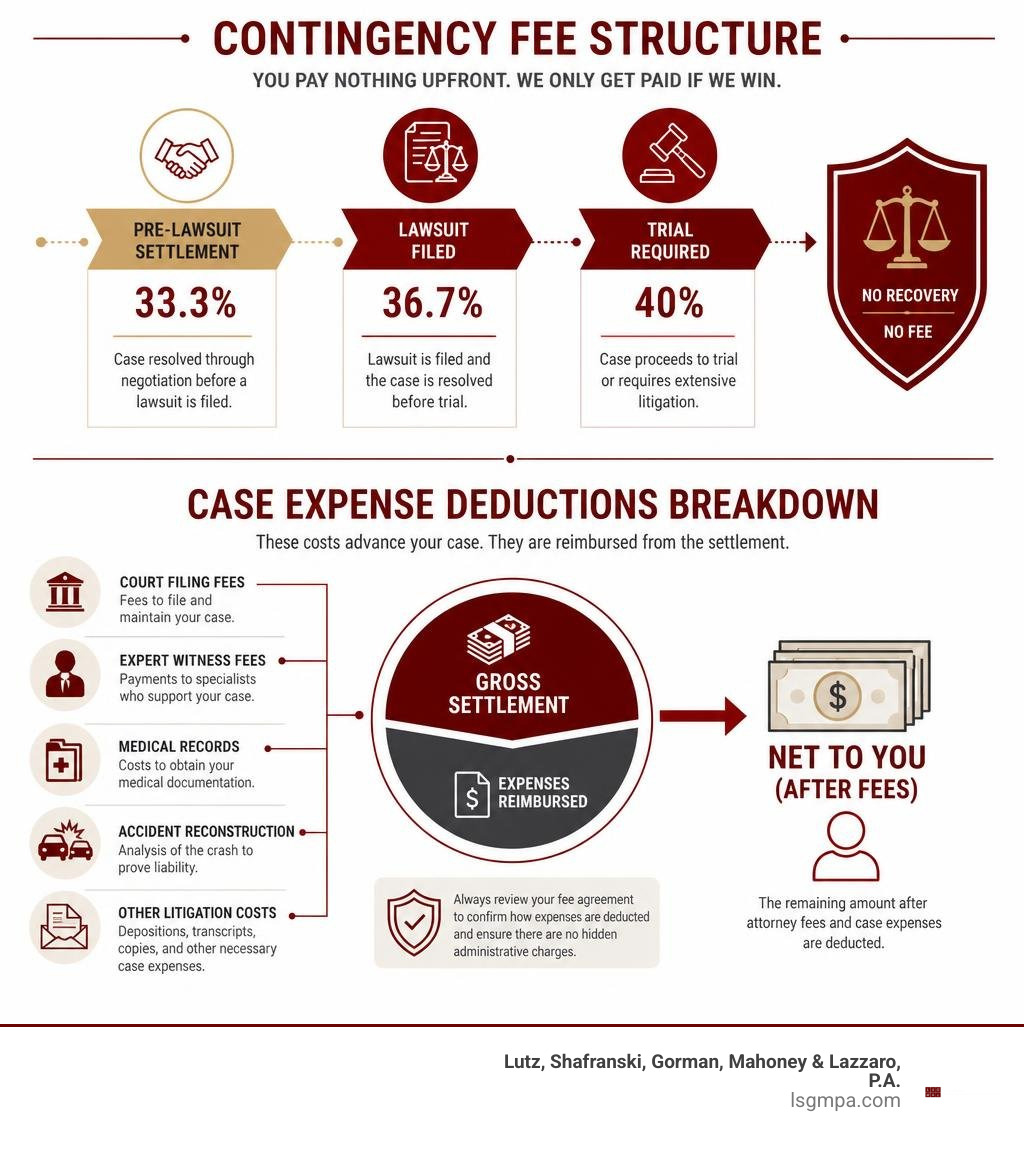
Standard contingency rates usually range from 33.3% for claims resolved prior to filing a lawsuit up to 40% if formal litigation or trial is required. Beyond the attorney’s percentage, personal injury cases incur court filing fees, expert witness costs, medical record retrieval charges, and accident reconstruction expenses.
Before hiring an attorney, review the fee agreement to confirm whether case expenses are deducted before or after the legal fee is calculated, and verify that there are no hidden administrative overhead charges. For a deeper breakdown of legal costs, see our article on how to find a car accident lawyer in New Jersey without breaking the bank.
Legal practice is deeply local. Rules, court procedures, and judicial expectations vary across different municipalities and counties throughout New Jersey, including Middlesex County communities like New Brunswick, Edison, Woodbridge, and Perth Amboy.

Local expertise matters for several key reasons:
The actions you take immediately following a motor vehicle collision directly impact the strength of your personal injury claim.
To build a strong legal foundation after an accident, follow these essential steps:
For a step-by-step checklist on managing the immediate fallout of a crash, review our detailed guide on steps to take after a Middletown car accident.
Following a crash, insurance adjusters frequently reach out with rapid settlement offers. While an early check may seem helpful when bills arrive, accepting an initial offer is rarely in your best interest.
Insurance companies design early offers to resolve claims before the full extent of your medical injuries is known. Once you accept a settlement and sign a release liability form, you give up all legal rights to demand additional compensation. If you later require surgery, extended physical therapy, or miss significant time from work, you cannot reopen the claim.
The best car crash lawyers advise waiting until you reach Maximum Medical Improvement (MMI)—the point where your medical condition has stabilized—so that all past and future care needs, lost income, and long-term impacts can be fully calculated. If your vehicle was severely damaged, consult an automobile property damage lawyer to handle vehicle replacement or repair claims separately from your injury settlement.
If you are dissatisfied with your current legal representation due to lack of communication or missed deadlines, you have the legal right to substitute counsel at any time.
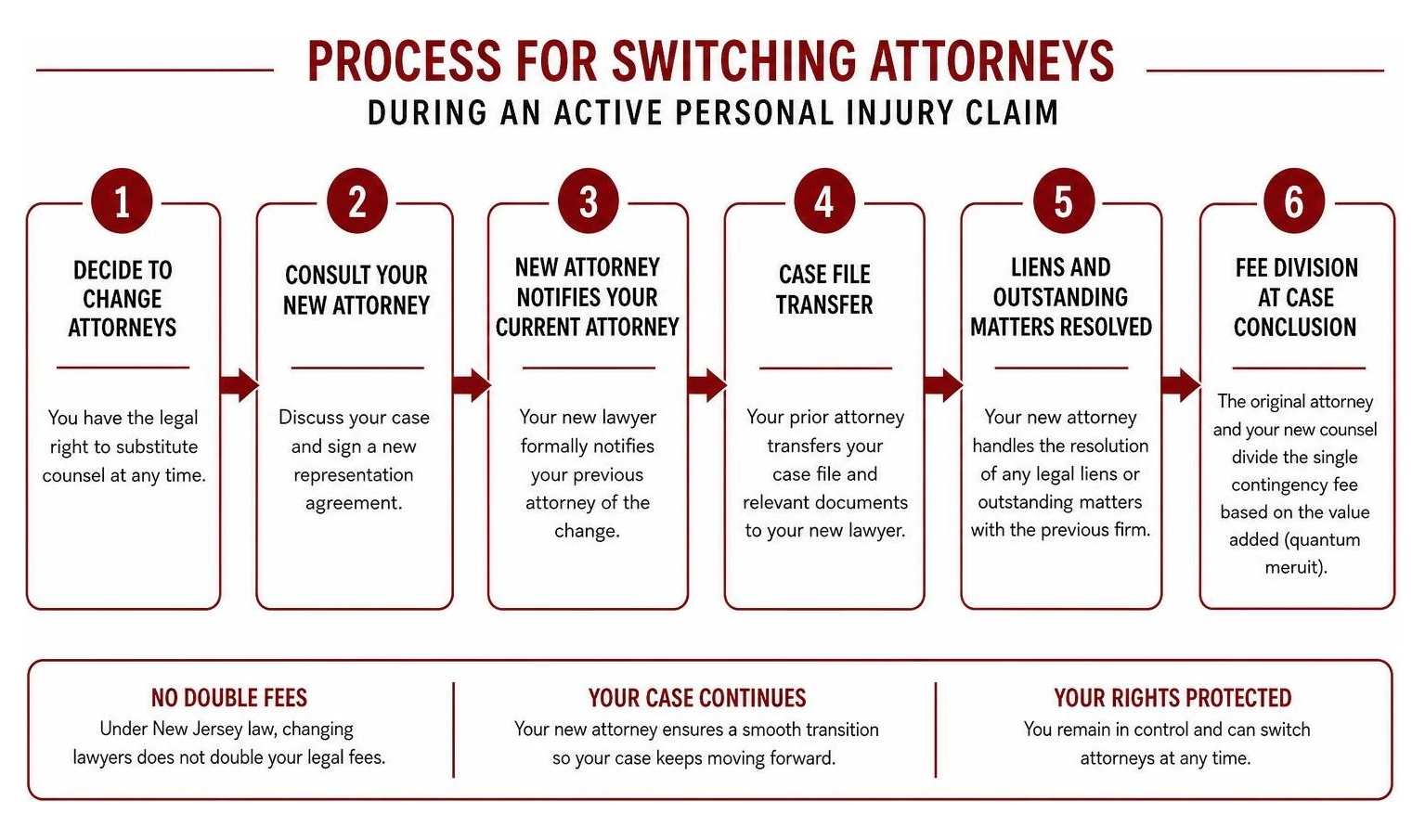
Under New Jersey law, changing lawyers does not double your legal fees. The original attorney and your new counsel divide the single contingency fee at the conclusion of the case based on the value added, governed by legal principles known as quantum meruit. Your new lawyer handles the transfer of your case file and resolves any legal liens directly with your former firm.
Furthermore, evaluating first-party insurance policies is crucial when the driver who hit you lacks sufficient coverage. Uninsured Motorist (UM) and Underinsured Motorist (UIM) coverage on your own auto policy steps in to pay medical bills, lost wages, and pain and suffering when the at-fault party has no insurance or carrying only state-minimum policy limits. Crucially, pursuing a UM/UIM claim through your own insurance provider does not increase your insurance rates when you were not at fault for the accident.
To learn more about managing complex vehicular claims, explore the ultimate guide to hiring an accident property damage lawyer.
Contingency fee structures mean you pay no upfront retainer or hourly fees. The lawyer’s fee is calculated as an agreed-upon percentage of the final financial recovery. Pre-litigation rates are typically lower than rates applied after a formal lawsuit is filed, reflecting the additional time and expense required for court litigation. Case litigation costs (such as filing fees and expert reports) are deducted in accordance with your written retainer agreement.
Yes. Clients have an absolute right to discharge their attorney and select new legal representation at any point during a personal injury case. Your new lawyer files a Notice of Substitution of Attorney, retrieves your complete case file, and handles all communication with your previous attorney. You do not pay two separate full attorney fees.
Uninsured/Underinsured Motorist (UM/UIM) coverage protects you if you are hit by an uninsured driver, a hit-and-run motorist, or a driver whose policy limits cannot cover your severe injuries. Your own insurance policy essentially steps into the shoes of the at-fault driver to compensate you up to your selected UM/UIM policy limits.
Navigating the financial, physical, and emotional impact of a motor vehicle collision requires dedicated legal representation. Finding the best car crash lawyers means choosing a team that provides personal client attention, understands local court dynamics, maintains complete fee transparency, and possesses the trial readiness necessary to maximize your recovery.
At Lutz, Shafranski, Gorman, Mahoney & Lazzaro, P.A., we represent accident victims across Middlesex County—including New Brunswick, Milltown, Perth Amboy, Edison, Woodbridge, and surrounding New Jersey communities. We stand up to insurance companies to seek full financial recovery for medical bills, lost earnings, and pain and suffering.
If you or a loved one has been injured in a collision, contact a qualified New Brunswick car accident lawyer today for a free evaluation of your legal rights.
