

 Call Us Today (732) 249-0444
 August 1, 2026

If you’re looking for a car accident lawyer in New Jersey, here’s what you need to know right away:
A car accident can upend your life in seconds. Medical bills pile up. You miss work. And almost immediately, an insurance adjuster may be calling — not to help you, but to protect their company’s bottom line.
Nearly 6.5 million car accidents happen in the United States every year. New Jersey alone recorded over 276,000 crashes in a single recent year, with nearly 60,000 resulting in injury. If you were hurt, you’re far from alone — but your situation is uniquely yours, and the decisions you make in the days after a crash can significantly affect what compensation you recover.
New Jersey’s auto insurance laws are more complex than most states. You’re dealing with a no-fault system, a potential verbal threshold on your right to sue, and comparative fault rules that can reduce or eliminate your recovery if you’re not careful.
I’m Frank Lazzaro, one of roughly 2% of attorneys in New Jersey certified by the Supreme Court as a Certified Civil Trial Attorney, and I’ve spent my career recovering six and seven-figure verdicts for injured clients — including those hurt in the exact kinds of car accidents described in this guide. As a car accident lawyer in New Jersey, I’ve seen how quickly insurance companies move to minimize valid claims, and how much difference experienced legal representation makes.
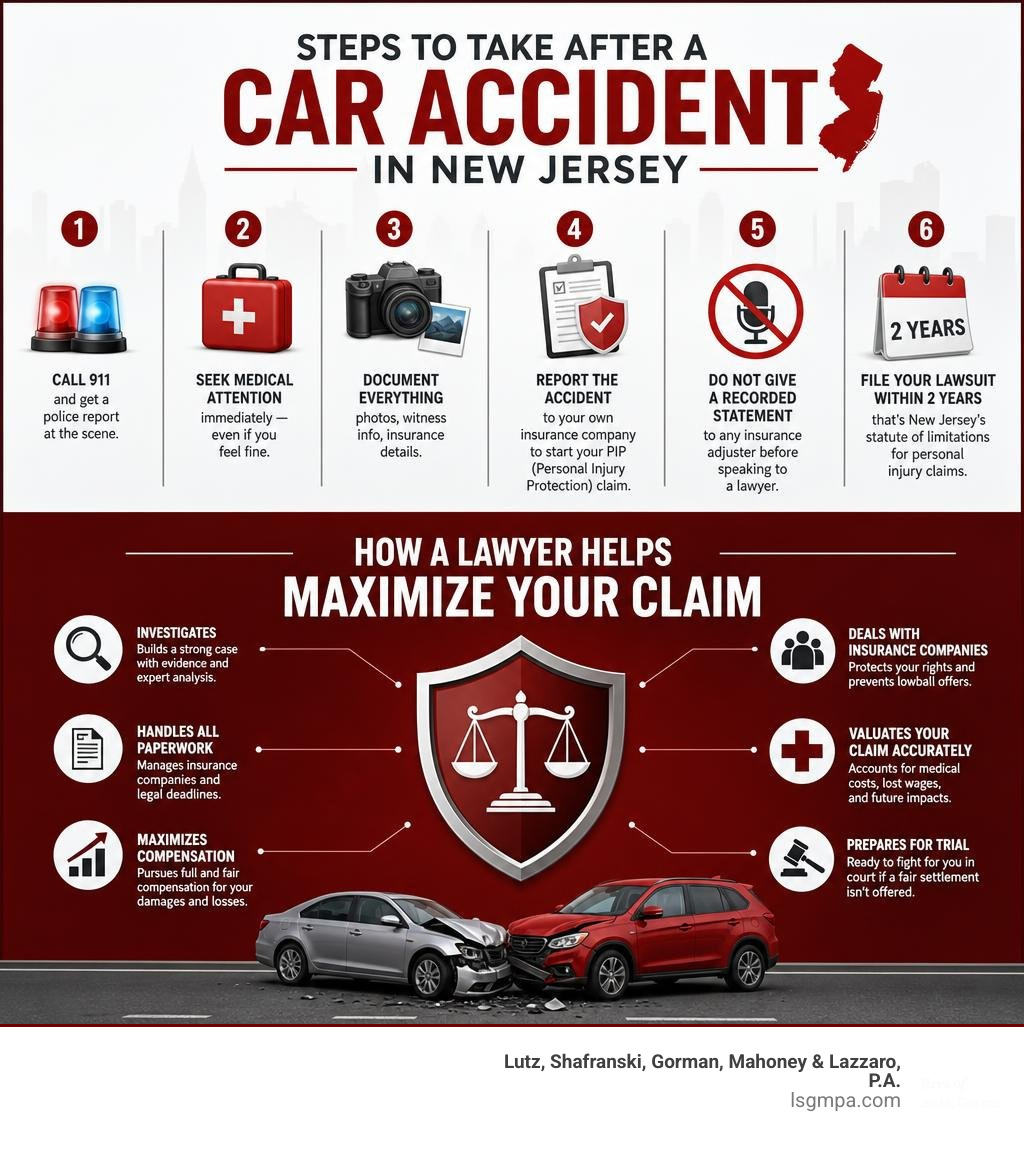
The moments directly following a crash are chaotic, stressful, and incredibly important for your physical and financial well-being. Whether you were involved in a minor collision near the local shopping centers in Milltown or a major multi-vehicle accident on the busy roads of Perth Amboy, taking the right steps immediately can protect both your health and your legal rights.

Here is exactly what you need to do at the scene and in the days that follow:
If your vehicle has suffered extensive damage, you may also need to consult a specialized attorney to handle your vehicle repairs and valuation. You can learn more about this by reading our guide on Wrecked Car: Why You Need an Automobile Property Damage Lawyer Now.
To successfully navigate a car accident claim in New Jersey, you must understand how the state’s auto insurance system is structured. New Jersey operates under a “choice no-fault” system. This means that regardless of who caused the collision, your own auto insurance policy’s Personal Injury Protection (PIP) coverage is responsible for paying your medical bills.
When purchasing auto insurance in New Jersey, drivers must choose between two primary policy types: a Standard Policy and a Basic Policy. The choice you make dramatically impacts your coverage limits and your legal right to file a lawsuit for pain and suffering.
| Policy Feature | Standard Policy | Basic Policy |
|---|---|---|
| Medical Expenses (PIP) | Up to $250,000 (standard limit) | Up to $15,000 (can go up to $250,000 for brain/spinal injuries) |
| Bodily Injury Liability | Included (typically $15,000/$30,000 up to $250,000+) | Not included (optional $10,000 limit available) |
| Property Damage Liability | Included (minimum $5,000) | Included ($5,000 limit) |
| Right to Sue Options | You choose: “Verbal Threshold” or “No Limitation” | Strictly limited to the “Verbal Threshold” (no choice) |
This system is designed to keep minor injury claims out of the court system, but it also creates massive hurdles for victims who suffer serious, long-term harm.
New Jersey follows a modified comparative negligence rule (specifically the 51% bar rule). Under this law, you can still recover financial compensation even if you were partially at fault for the accident—provided your percentage of shared fault is 50% or less.
However, your final financial recovery will be reduced proportionally by your assigned percentage of fault. For example, if a jury determines your total damages are worth $100,000, but finds you were 20% responsible for the crash because you were slightly speeding, your final payout will be reduced by 20%, leaving you with $80,000. If you are found to be 51% or more at fault, you are legally barred from recovering any compensation from the other driver.
If your auto insurance policy contains the “limitation on lawsuit” option (commonly referred to as the verbal threshold), you are legally restricted from suing the at-fault driver for non-economic damages, such as pain and suffering, unless your injuries fall into one of six specific statutory categories:
Proving that an injury is permanent requires objective medical evidence, such as MRIs, X-rays, or EMG testing, alongside a certified statement from a licensed physician. Insurance companies frequently use the verbal threshold as a shield to deny valid claims, which is why having an experienced car accident lawyer in New Jersey is vital to proving the true severity of your injuries.
It is a common misconception that insurance companies exist to help you after an accident. In reality, insurance companies are profit-driven corporations. Their adjusters are trained to use a specific playbook of “delay, deny, and defend” to pay out as little as possible.
They may call you immediately after a crash to offer a quick settlement before you even know the full extent of your injuries. They might request excessive or redundant documentation to wear you down, or try to twist your words during a recorded phone call to shift the blame onto you.

When we represent you, we handle all communications, negotiations, and legal filings so you can focus entirely on your physical recovery. We work with medical experts, accident reconstructionists, and financial analysts to accurately value your past and future medical bills, lost wages, and pain and suffering.
If you are dealing with property damage issues alongside your physical injuries, you can explore The Ultimate Guide to Hiring an Accident Property Damage Lawyer to understand how property claims are handled separately from bodily injury claims.
Some auto accidents involve complex legal frameworks that require specialized knowledge. These include:
When searching for the right legal advocate, look for the following qualifications:
In New Jersey, the standard statute of limitations for a personal injury claim is two years from the date of the accident. If you do not file a formal lawsuit in court within this two-year window, you will permanently lose your right to seek compensation.
However, if your claim involves a government vehicle or a dangerous roadway owned by a public entity, you must file a formal Notice of Claim under Title 59 within 90 days of the crash.
Yes, New Jersey’s modified comparative negligence law allows you to recover compensation as long as your share of fault is 50% or less. Your final financial recovery will be reduced by your exact percentage of fault. If you are found to be 51% or more at fault, you cannot recover any damages from the other party.
Accident victims can pursue both economic and non-economic damages, including:
A car accident can disrupt your life in an instant, leaving you to deal with physical pain, rising medical bills, and aggressive insurance adjusters. You do not have to carry this heavy financial and emotional burden alone.
At Lutz, Shafranski, Gorman, Mahoney & Lazzaro, P.A., we provide compassionate, relentless, and experienced legal advocacy for injury victims across Middlesex County, including New Brunswick, Milltown, and Perth Amboy. We are dedicated to holding negligent parties accountable and fighting for the maximum compensation you deserve.
If you or a loved one has been injured in a crash, we invite you to reach out to us today. To learn more about how we can help you navigate your claim and protect your future, Contact a New Brunswick Car Accident Lawyer for a free, no-obligation case evaluation. Let us put our decades of trial experience to work for you.