

 Call Us Today (732) 249-0444
 July 24, 2026

A public entity expert witness is a qualified professional who provides specialized testimony in cases involving government bodies — such as municipalities, transit agencies, school districts, or state departments — helping courts and juries understand complex issues that go well beyond everyday knowledge.
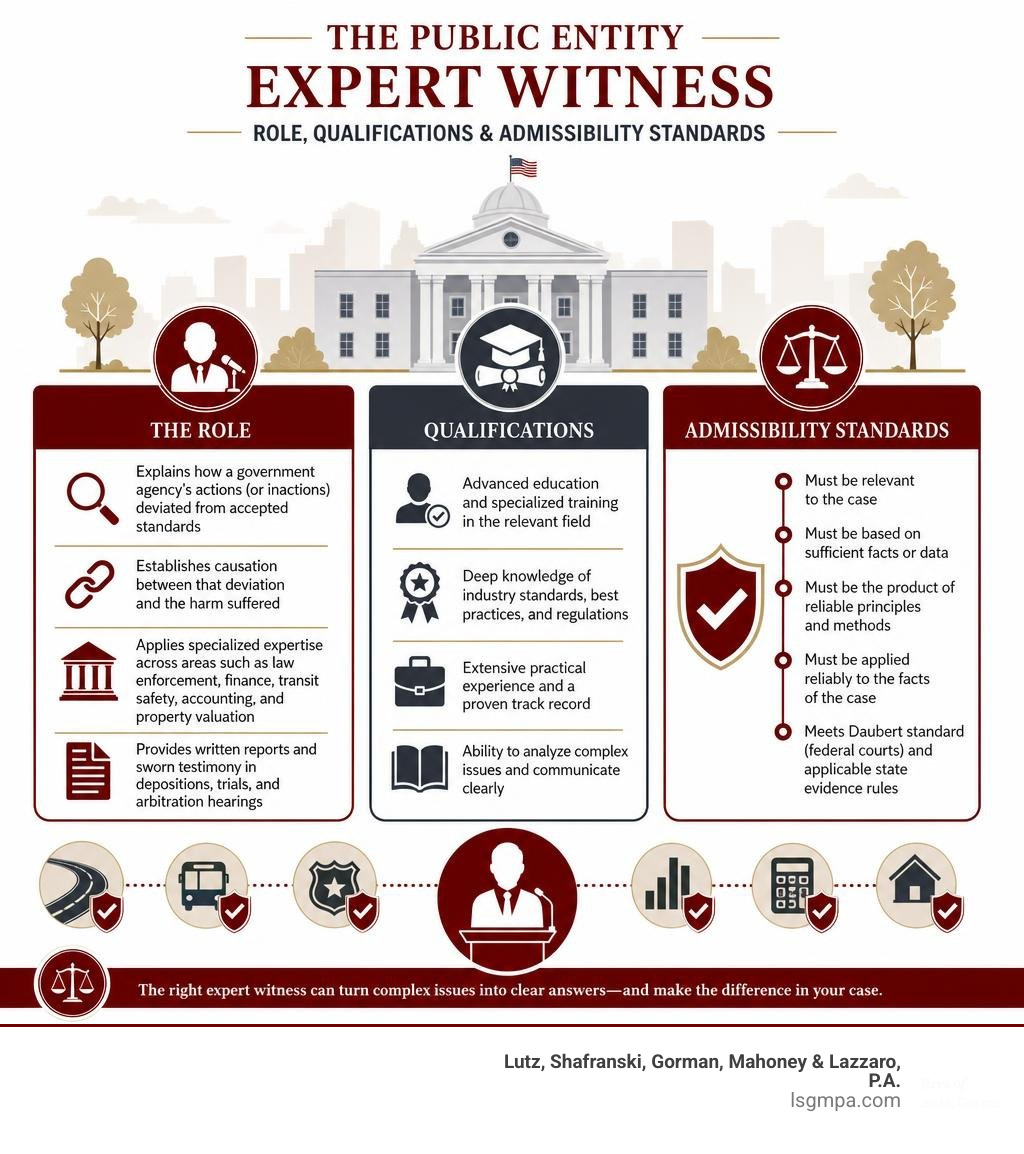
What a public entity expert witness does — at a glance:
If you were injured due to a government entity’s negligence — a poorly maintained road, a dangerous transit vehicle, a failure by a public agency — the right expert witness can be the difference between a dismissed claim and a successful recovery.
These cases are hard. Government defendants often have immunity protections, experienced defense teams, and resources to fight back. An unqualified or poorly prepared expert can sink an otherwise strong case, as seen in Townsend v. Pierre, where the New Jersey Supreme Court excluded an expert’s report for lacking factual support — resulting in summary judgment against the plaintiff.
I’m Frank Lazzaro, a Certified Civil Trial Attorney by the Supreme Court of New Jersey with a track record of multi-million-dollar verdicts and settlements, including cases involving public entity expert witness testimony where government negligence caused serious harm to my clients. In the sections below, I’ll walk you through exactly how these experts work, what qualifies them, and how to use them effectively in your case.

Litigating against a public entity is entirely different from suing a private citizen or business. In New Jersey, public entities are protected by the New Jersey Tort Claims Act (Title 59), which establishes a general rule of sovereign immunity. To win a personal injury case against a municipality or public body, you must prove that their conduct was not just negligent, but “palpably unreasonable” under specific circumstances.
This is where a public entity expert witness becomes indispensable. These specialized professionals understand the unique operational, administrative, and legal frameworks that govern public agencies. They can identify where a government unit failed to meet its ministerial duties, ignored known hazards, or violated its own standard operating procedures.
Public entities manage massive operations, meaning expert witnesses are needed across a wide variety of specialties:
Juries are made up of everyday citizens who understand what it is like to drive a car or walk through a store, but they rarely know how a municipal water treatment plant operates, how a transit authority trains its drivers, or how a county road department schedules pothole repairs.
An expert witness bridges this gap. They translate dry, technical regulations and complex data into clear, relatable concepts. By establishing the standard of care—what a reasonable public entity should have done—and showing exactly how the defendant deviated from that standard, the expert provides the jury with a logical roadmap to find liability.

Before an expert can testify in front of a jury, their credentials and methodology must pass strict judicial gatekeeping. If an expert’s testimony is deemed unreliable, the judge will exclude it, which often results in the immediate dismissal of the lawsuit.
Historically, the standard for admitting expert testimony was set by the 1923 case Frye v. United States, which required a scientific technique to be “generally accepted” in its relevant field. In 1993, the United States Supreme Court established the Daubert standard, which tasks trial judges with acting as gatekeepers to evaluate the scientific reliability and relevance of an expert’s methodology.
Under Federal Rule of Evidence (FRE) 702, which guides federal courts and has heavily influenced state standards, expert testimony must satisfy four core pillars:
In New Jersey state courts, attorneys must navigate a unique and strict evidentiary hurdle known as the Net Opinion Rule. Under New Jersey Rules of Evidence (N.J.R.E.) 702 and 703, an expert must give the “why and wherefore” of their opinion, rather than a bare conclusion.
If an expert simply states their conclusion without explaining the underlying factual basis and methodology, it is considered an inadmissible “net opinion.”
A classic example of this rule in action is the landmark New Jersey Supreme Court case Townsend v. Pierre (2015). In that case, a fatal motorcycle collision occurred at an intersection where overgrown shrubbery on a public property allegedly obstructed visibility. The plaintiff’s expert engineer concluded that the shrubbery caused the accident. However, the driver testified that the shrubs did not ultimately block her view of the oncoming motorcycle. Because the expert’s conclusion directly contradicted the actual witness testimony in the record and relied on a hypothetical scenario, the court struck the report as an inadmissible net opinion and granted summary judgment to the defendants.
This is why working with an experienced New Brunswick motorcycle accident lawyer is so critical. We ensure that our experts gather solid, unassailable evidence that directly aligns with the factual record to withstand net opinion challenges.
Finding the right expert is a meticulous process. A great academic resume is not enough; the expert must also be a compelling communicator who can withstand aggressive cross-examination.
A qualified public entity expert should possess:
Experienced trial lawyers do not select experts at random. We use highly vetted networks, professional associations, and dedicated expert directories. For specialized needs—such as measuring community sentiment or analyzing public perceptions—we may consult directories like New Jersey Public Opinion & Survey Research Expert Witnesses to find academics and researchers who can conduct scientifically valid polls.
Once potential experts are identified, we perform exhaustive background checks:
Once retained, a public entity expert witness must conduct a thorough investigation. This involves site visits, reviewing municipal maintenance logs, analyzing police reports, and examining digital forensics or database structures.
For example, in cases involving public policy or community impact, an expert might design and execute a probability-based public opinion survey. In the federal case LaFave v. County of Fairfax, documented in the LaFave v. County of Fairfax Expert Report, experts used rigorous address-based sampling to measure community safety perceptions. Even with a modest 15.2% response rate, the survey was weighted to match local demographics, demonstrating how scientific methodology can withstand intense legal scrutiny.
Experts are highly trained professionals, and their compensation reflects their specialized skills. They are typically paid an hourly rate for research and report preparation, and a flat daily fee for trial or deposition testimony.
Note: Ethical guidelines strictly prohibit expert witnesses from working on a contingency fee basis. Their compensation must never depend on the outcome of the lawsuit, ensuring their testimony remains objective and credible.
While both must be highly qualified in their fields, their focus areas and the legal standards they must apply differ significantly:
| Feature | Public Entity Expert Witness | Private Sector Expert Witness |
|---|---|---|
| Primary Focus | Government standards, Title 59 statutory immunities, ministerial vs. discretionary duties. | General commercial standards, corporate policies, ordinary negligence. |
| Legal Hurdle | Must often prove “palpable unreasonableness” (in NJ). | Must prove ordinary negligence (standard of care deviation). |
| Key Knowledge | Municipal budgets, civil service regulations, public transit safety codes. | Private corporate governance, retail safety standards, commercial insurance. |
Fees vary based on the expert’s field, geographic location, and case complexity. Eminent domain appraisers generally charge between $175 and $400 per hour. Highly specialized forensic accountants, structural engineers, or medical experts can charge anywhere from $500 to over $1,000 per hour. While this can make litigation expensive, a strong expert report frequently forces public entities to settle, saving time and trial costs.
Under the New Jersey Tort Claims Act, to hold a public entity liable for a dangerous condition on public property, a plaintiff must prove that the entity’s action or inaction to protect against the condition was “palpably unreasonable.” This is a much higher standard than ordinary negligence. It means the government’s behavior must be “manifestly and logically unjustifiable” under the circumstances.
This distinction between ordinary negligence (for everyday ministerial tasks) and the palpably unreasonable standard (for discretionary or policy-level decisions) was highlighted in Escobar v. Newark Beth Israel Medical Center. In that case, a public agency’s failure to perform basic ministerial duties led to a massive jury verdict of over $105 million, which was later reduced through remittitur to a still-substantial $64.88 million based on precise life-care expert calculations.
Suing a public entity in New Jersey is a complex legal challenge. Between sovereign immunity, the strict filing deadlines of the Tort Claims Act, and high evidentiary standards like the Net Opinion Rule, you cannot afford to make mistakes.
Securing a highly qualified public entity expert witness is one of the most important steps in building a winning claim. At Lutz, Shafranski, Gorman, Mahoney & Lazzaro, P.A., we have decades of experience handling serious injury claims in New Brunswick, Milltown, Perth Amboy, and across New Jersey. We know how to source, vet, and utilize top-tier experts to counter government defense strategies and secure the maximum compensation you deserve for medical costs, lost earnings, and pain and suffering.
If you or a loved one has been injured due to government negligence, contact us today for a free consultation. Let our family help your family navigate the legal maze and fight for your rights.