

 Call Us Today (732) 249-0444
 November 3, 2026

If you need a lawyer for personal injury in New Jersey, ask about their experience with your type of accident, how they handle medical evidence, and whether they are prepared to take a case to trial. Bring your insurance policy, medical records, bills, and proof of missed work to the first meeting.
In a car accident case, personal injury protection (PIP) may help pay medical costs regardless of fault. But New Jersey law can limit when you may sue for pain and suffering. A lawyer can review your coverage and injuries, then explain which claims you may pursue.
I’m Frank Lazzaro, a New Jersey Supreme Court Certified Civil Trial Attorney with experience in New Jersey personal injury cases. I’ve obtained multiple six- and seven-figure verdicts for injured clients, and I’ll use this guide to show you what to look for in legal counsel.
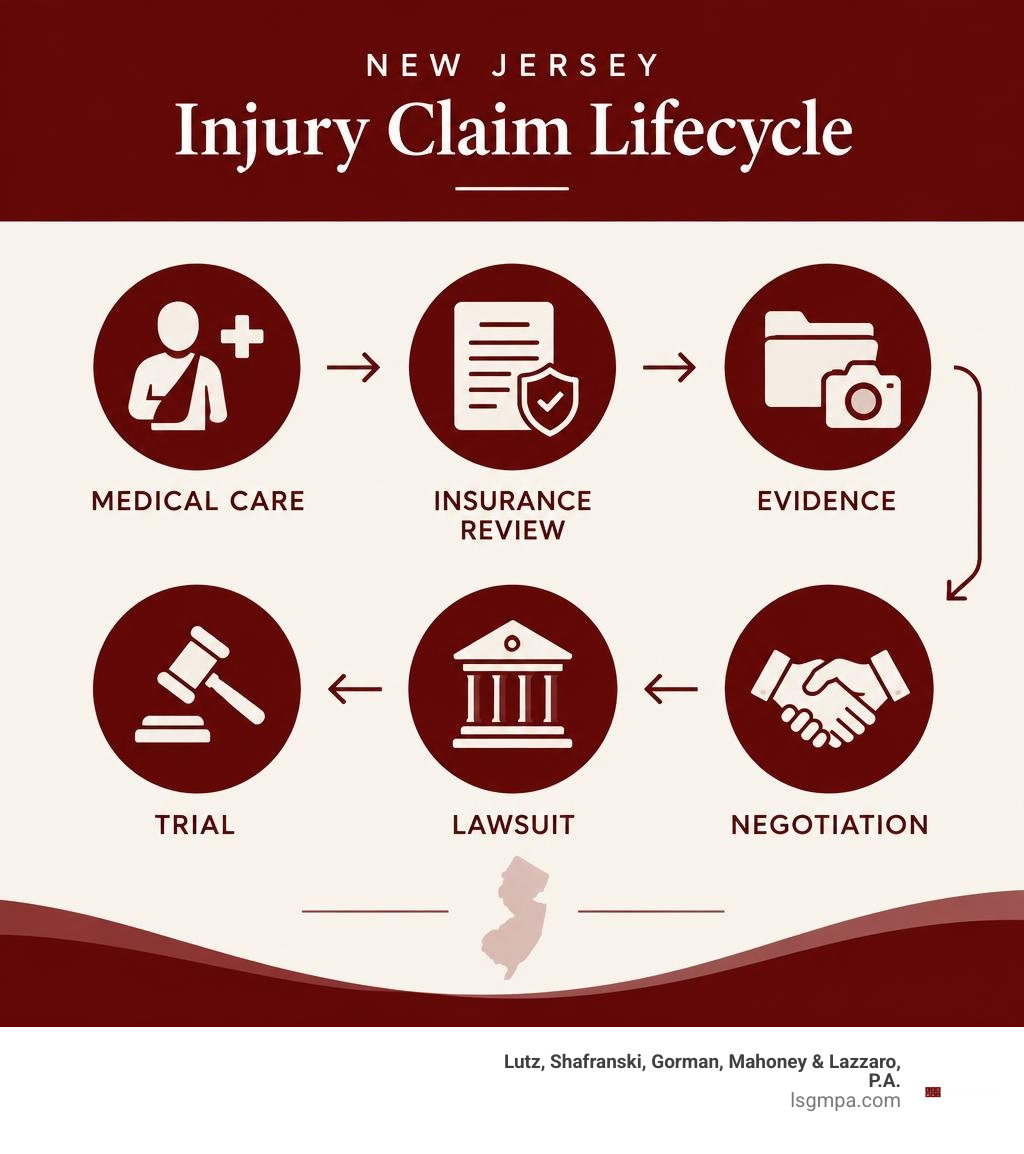

Navigating a personal injury claim in our state requires understanding specific statutory frameworks that govern liability and compensation. Under the Automobile Insurance Cost Reduction Act (AICRA), New Jersey operates as a modified no-fault insurance system. This means that if you suffer an injury in an auto accident, your own auto insurance policy covers initial medical expenses through Personal Injury Protection (PIP), regardless of who caused the crash.
These statutory PIP coverage requirements mandate basic economic protections for:
While PIP provides vital relief for medical bills and lost income, it does not compensate you for physical pain, emotional distress, or loss of enjoyment of life. Securing these noneconomic damages requires evaluating injury compensation eligibility against statutory thresholds established by New Jersey law.
When purchasing an auto policy in New Jersey, policyholders select between two tort options: the “No Limitation on Lawsuit” threshold or the “Limitation on Lawsuit” threshold (commonly known as the verbal threshold under N.J.S.A. 39:6A-8(a)). Selecting the verbal threshold lowers premium costs but restricts your right to sue a negligent driver for pain and suffering.
To recover noneconomic damages under the limitation-on-lawsuit threshold, a plaintiff must prove that their injuries satisfy one of six statutory categories:
A permanent injury means a body part or organ has not healed to function normally and will not heal even with further medical treatment. Proving permanency requires objective clinical evidence, such as MRIs, CT scans, or electromyograms (EMGs). Subjective complaints of pain are insufficient. Within 60 days of the defendant filing an answer, the plaintiff’s attorney must file a formal Physician Certification confirming the injury meets this statutory standard. When dealing with severe collisions, representation for catastrophic injuries is essential to ensure that complex medical proof meets every evidentiary hurdle.
Accidents across Middlesex County corridors like the New Jersey Turnpike or Route 1 frequently involve out-of-state motorists. In these scenarios, New Jersey’s “Deemer Statute” (N.J.S.A. 17:28-1.4) significantly alters the litigation landscape.
The Deemer Statute mandates that if an out-of-state driver is insured by a carrier authorized or licensed to write insurance in New Jersey, their policy is “deemed” to provide New Jersey PIP benefits when driving in the state. In exchange for this automatic benefit, the out-of-state plaintiff is bound by New Jersey’s limitation-on-lawsuit threshold, even if their home state policy allows unrestricted tort claims.
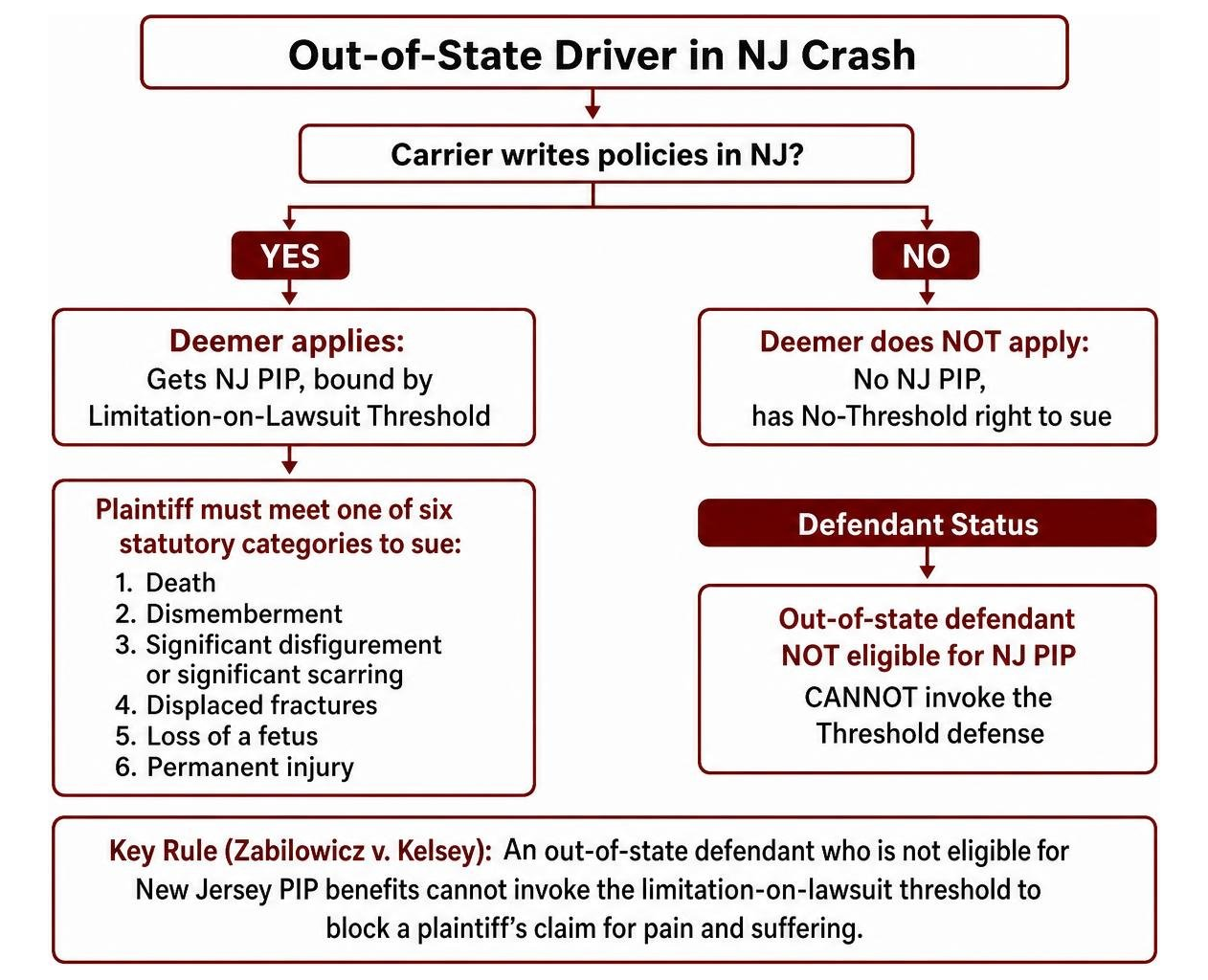
Crucially, the New Jersey Supreme Court’s ruling in Zabilowicz v. Kelsey threshold invocation limits established an asymmetric defense rule. The court held that an out-of-state defendant who is not eligible for New Jersey PIP benefits cannot invoke the limitation-on-lawsuit threshold to block a plaintiff’s claim for pain and suffering. Therefore, an out-of-state defendant driving a non-PIP-qualified vehicle cannot shield themselves behind New Jersey’s verbal threshold restrictions.
When an injury case proceeds to trial, the jury determines the financial award. However, if a verdict is completely disconnected from the trial evidence, either party may file a post-trial motion under New Jersey Court Rule 4:49-1. A trial judge can only disturb a jury verdict if it clearly and convincingly appears that there was a miscarriage of justice that “shocks the judicial conscience.”
In the landmark decision Orientale v. Jennings, the New Jersey Supreme Court overhauled how trial courts handle excessive awards (remittitur) and inadequate awards (additur). Whether preparing for trial or negotiating auto injury settlements, this framework heavily influences post-verdict strategy.
Historically, trial courts could offer a modified damages amount to only one party: a defendant could accept an additur to avoid a new trial, or a plaintiff could accept a remittitur to preserve an altered verdict.
In Orientale v. Jennings, the Supreme Court established that both parties must provide mutual consent for a court-ordered additur or remittitur to become binding. If either the plaintiff or the defendant rejects the trial judge’s proposed figure, the court must grant a new trial on damages.
This mutual consent requirement protects the constitutional right to a jury trial. Furthermore, when calculating an additur or remittitur amount, the judge cannot simply select the lowest or highest possible figure. Instead, the court must determine an amount that a reasonable, properly instructed jury would award based on the evidence.
Over the past three years, New Jersey trial courts granted only eight remittiturs and additurs, and only three were accepted. Because post-trial relief is rarely granted and even more rarely agreed upon, retaining seasoned car crash lawyers who build an airtight case for the initial jury verdict remains essential.
Understanding the procedural distinctions between these mechanisms helps clients appreciate why trial preparation must be thorough from day one.
| Legal Mechanism | Trigger Condition | Primary Purpose | Consent Requirement | Outcome if Rejected |
|---|---|---|---|---|
| Additur | Jury damages award is grossly inadequate and shocks judicial conscience | Increase the damages award to what a reasonable jury would grant | Mutual consent (both plaintiff and defendant must agree) | Full new trial ordered on damages |
| Remittitur | Jury damages award is grossly excessive and unsupported by trial proof | Decrease the damages award to what a reasonable jury would grant | Mutual consent (both plaintiff and defendant must agree) | Full new trial ordered on damages |
| New Trial (Rule 4:49-1) | Verdict represents a clear miscarriage of justice under the law | Overturn flawed verdict and seat a new jury | No party consent needed; granted by judicial order | Case retried before a new jury |
Missing a filing deadline can permanently bar an injured person from recovering compensation. Under N.J.S.A. 2A:14-2, the standard statute of limitations for personal injury actions in New Jersey is two years from the date the cause of action accrues (typically the date of the incident).
Specific claim types involve distinct legal hurdles:
Selecting an attorney is the most critical decision you will make following a serious injury. When evaluating law firms across Middlesex County—including Perth Amboy, East Brunswick, Woodbridge, Piscataway, and Sayreville—focus on these objective criteria:
To narrow down your options, consult our guide to selecting a qualified personal injury lawyer and review our advice on evaluating an injury law firm in NJ. If your incident occurred in central New Jersey, consider securing a car accident attorney in New Brunswick or reviewing our Perth Amboy injury lawyer checklist to protect your rights.
Under N.J.S.A. 39:6A-8(a), a plaintiff subject to the limitation-on-lawsuit threshold can pursue noneconomic damages for pain and suffering only if they sustain: (1) death, (2) dismemberment, (3) significant disfigurement or significant scarring, (4) displaced fractures, (5) loss of a fetus, or (6) a permanent injury verified by objective clinical diagnostic testing and supported by a timely Physician Certification.
Under the New Jersey Supreme Court’s ruling in Zabilowicz v. Kelsey, an out-of-state defendant who is not eligible for New Jersey PIP benefits cannot invoke the limitation-on-lawsuit threshold against an injured plaintiff. However, out-of-state plaintiffs whose insurance carriers do business in New Jersey are subject to the threshold under the Deemer Statute (N.J.S.A. 17:28-1.4).
A trial court will modify an award only when the jury’s verdict is so grossly excessive or inadequate that it shocks the judicial conscience and demonstrates a clear miscarriage of justice under Rule 4:49-1. Under the framework established in Orientale v. Jennings, any proposed additur or remittitur requires the mutual consent of both the plaintiff and the defendant. If either party objects to the court’s adjusted figure, the judge must schedule a new trial on damages.
New Jersey personal injury law involves intricate statutory thresholds, evolving insurance rules, and strict procedural requirements. Navigating these rules while recovering from a serious injury requires skilled legal advocacy focused on maximizing your recovery for medical costs, lost earnings, and pain and suffering.
At Lutz, Shafranski, Gorman, Mahoney & Lazzaro, P.A., we represent injured individuals and families across New Brunswick, Milltown, Perth Amboy, Edison, Woodbridge, Piscataway, East Brunswick, Sayreville, Middlesex, North Brunswick, Highland Park, Monroe, and throughout Middlesex County. When you are ready to take action, consult an experienced New Jersey personal injury legal team to review your options and protect your future.
