

 Call Us Today (732) 249-0444
 July 30, 2026

An amputation injury lawsuit is a legal claim filed by someone who lost a limb — or part of one — due to another person’s or company’s negligence. These cases can involve car accidents, workplace machinery, defective products, or medical malpractice.
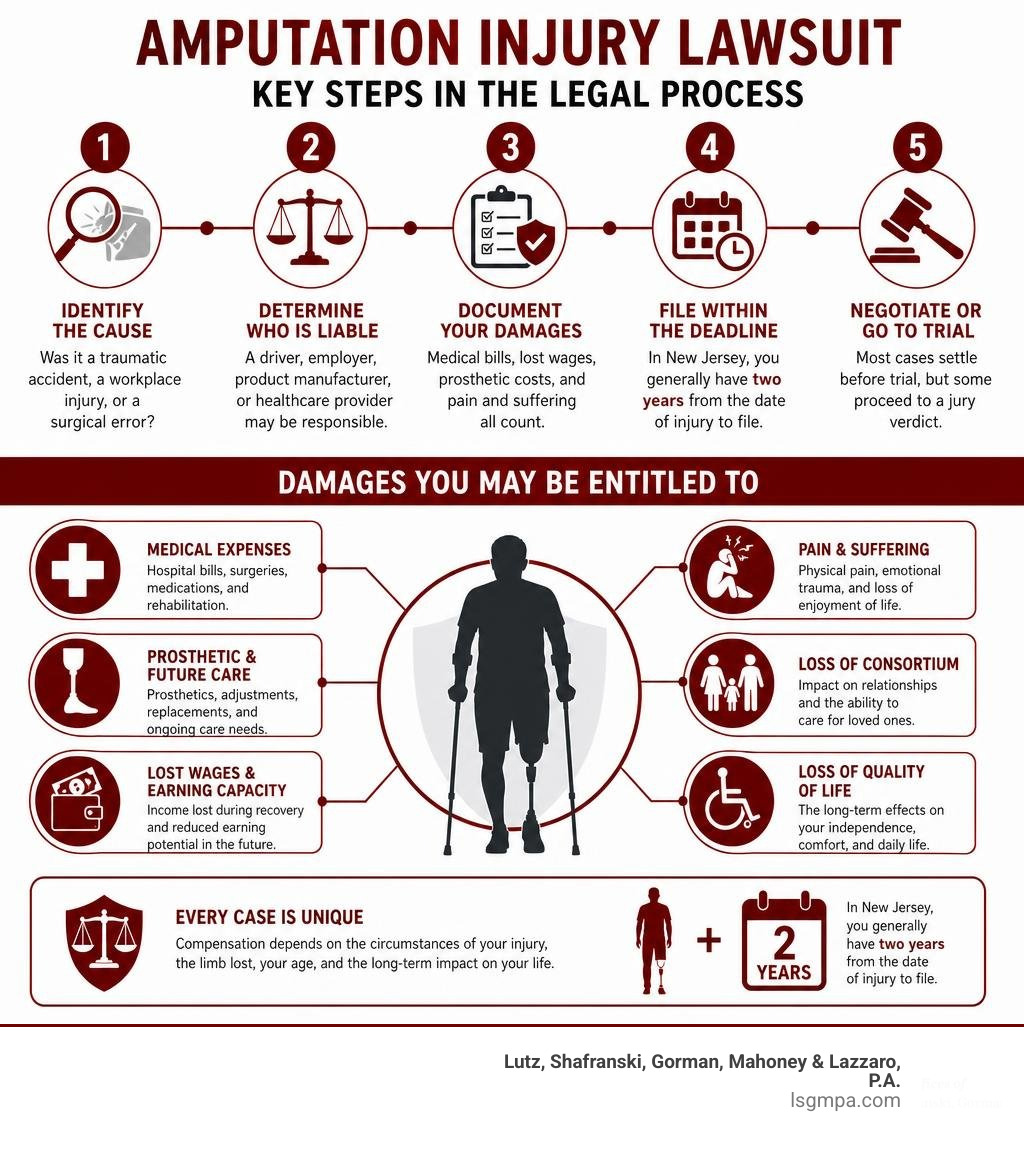
Here is what the process typically looks like:
Losing a limb changes everything — your ability to work, care for your family, and enjoy daily life. According to the National Institutes of Health, approximately 400 Americans lose a limb in an injury accident every day. The physical trauma is only the beginning. The financial impact — surgeries, prosthetics, rehabilitation, and long-term care — can last a lifetime.
No two cases are identical. The compensation you may recover depends on which limb was lost, how it happened, your age, and the long-term impact on your life. Verdicts in amputation cases have ranged from hundreds of thousands of dollars to over $6 million, depending on these factors.
I’m Frank Lazzaro, a New Jersey Certified Civil Trial Attorney with a track record of seven-figure verdicts in serious personal injury cases, including amputation injury lawsuits involving surgical negligence and catastrophic accidents. If you or someone you love is facing life after limb loss caused by someone else’s negligence, this guide will walk you through exactly what to expect.
When we evaluate an amputation injury lawsuit, we must first look at the medical classification of the limb loss. Amputations are broadly divided into two categories: traumatic and surgical. While both lead to the same life-altering outcome, they require entirely different approaches when establishing legal causation and proving negligence in court.
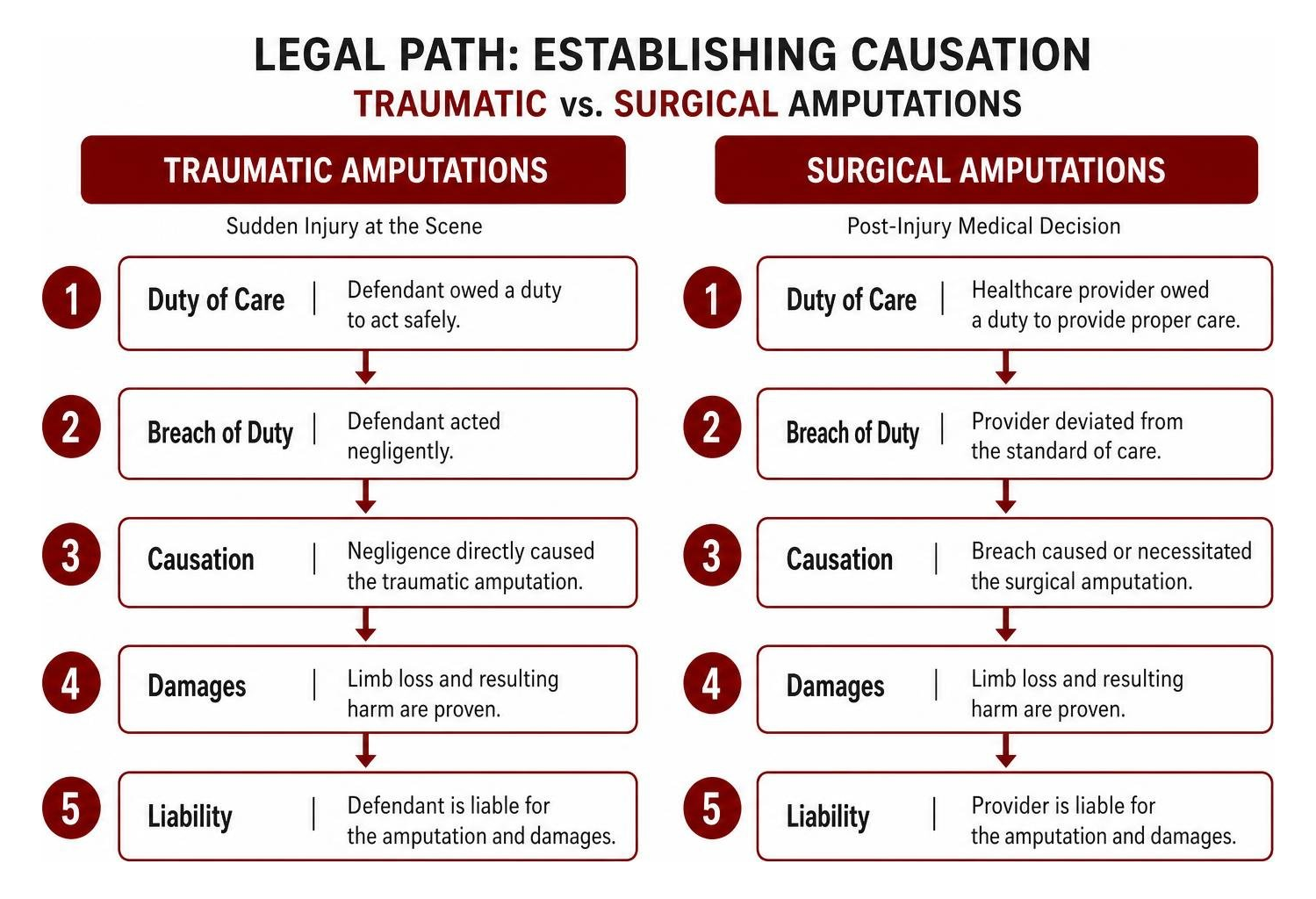
A traumatic amputation occurs instantly at the scene of an accident. It is violent, sudden, and entirely unexpected. In these cases, the physical force of the impact is so severe that the limb is severed directly, or crushed beyond any medical hope of repair.
These injuries are most common in high-velocity collisions, heavy machinery failures, or catastrophic workplace incidents. For example, a motorcyclist struck by an SUV may suffer immediate, irreversible limb loss on the asphalt. Seeking immediate representation from an attorney who understands these specific accidents is crucial; you can learn more about this in our guide on Why a Motorcycle Accident Lawyer Is Right for You.

From a legal standpoint, proving causation in a traumatic amputation is usually straightforward. We do not have to debate when or why the limb was lost; the connection between the defendant’s reckless driving or unsafe workplace and the missing limb is immediate and undeniable.
A surgical amputation, on the other hand, is a planned medical procedure performed in an operating room. It occurs when doctors determine that keeping the limb poses a threat to the patient’s life.
Surgical amputations often follow a delayed timeline. A patient might suffer a severe crush injury in a car crash, undergo multiple surgeries over several weeks to salvage the limb, and ultimately have to undergo an amputation due to dead tissue (necrosis), uncontrollable infection, or failed vascular reconstruction.
In the legal arena, surgical amputations can complicate an amputation injury lawsuit. The defense may argue that the amputation was not directly caused by the original accident, but rather by a pre-existing medical condition, a subsequent infection, or even the patient’s own lifestyle choices. Proving the chain of causation requires a meticulous review of medical records to show that “but for” the defendant’s initial negligence, the medical complications necessitating the surgical amputation would never have occurred.
To win an amputation injury lawsuit, we must establish liability. This means proving that another party owed you a duty of care, breached that duty through negligent actions, and directly caused your injury. Depending on how your injury occurred, liability may rest on a negligent driver, an irresponsible employer, a product manufacturer, or a negligent medical professional.

In some complex road accidents, such as underride collisions involving commercial trucks, identifying the at-fault parties requires an in-depth investigation. For more information on navigating these highly specialized claims, see The Ultimate Guide to Carriage Underride Claims and Finding the Right Lawyer.
Workplace accidents are a leading cause of traumatic amputations, particularly in construction, manufacturing, and warehousing. If you lose a limb while on the job in New Jersey, your immediate source of recovery is typically workers’ compensation. Under the New Jersey Department of Labor and Workforce Development guidelines, workers’ comp is a “no-fault” system, meaning you can receive benefits for medical treatment and partial lost wages regardless of who caused the accident.
However, workers’ compensation is generally the “exclusive remedy” against your employer, meaning you cannot sue your boss or coworkers for negligence. To recover full compensation—including pain and suffering—we must look for third-party liability.
A third-party claim is a separate personal injury lawsuit filed against an entity other than your employer. Examples include:
Under product liability law, manufacturers have a legal obligation to design and produce products that are safe for consumer and industrial use. If a machine lacks necessary safety guards, or if a power tool is designed without feasible safety technology, the manufacturer can be held strictly liable for resulting injuries.
A classic example of product liability in amputation cases involves table saws. Many modern saws are designed without “flesh-detection” technology—a safety feature that automatically stops the blade the instant it touches human skin. If a worker loses a finger or hand using a saw that lacked this feasible safety technology, we can pursue a design defect claim against the manufacturer.
Not all amputation lawsuits stem from physical impacts. Many are the result of medical malpractice, where a healthcare provider’s failure to meet the accepted standard of care leads to a preventable amputation. Common medical errors that lead to limb loss include:
For example, a high-profile case discussed in NSW woman seeks damages from health district over amputated lower leg – ABC News highlights the intense legal battles that arise when a patient alleges doctors rushed to amputate a limb based on visual inspection rather than performing standard diagnostic tests to confirm whether the tissue was actually dead.
The financial and emotional toll of losing a limb is staggering. In an amputation injury lawsuit, we seek to recover both economic and non-economic damages to cover your past, present, and future losses.
| Economic Damages (Objectively Quantifiable) | Non-Economic Damages (Subjective Losses) |
|---|---|
| Emergency medical bills & surgical fees | Physical pain and suffering |
| Lifetime prosthetic fitting, maintenance & replacement | Phantom limb pain and neuropathic distress |
| Physical, occupational & vocational rehabilitation | Emotional distress, anxiety, and depression |
| Lost wages & permanent loss of earning capacity | Loss of enjoyment of life (hedonic damages) |
| Home and vehicle accessibility modifications | Loss of consortium (impact on spousal relationship) |
Economic damages represent the concrete financial losses that can be documented with receipts, bills, and expert projections. Because an amputation is a permanent, catastrophic injury, these costs must be projected over your entire expected lifespan.
To do this, we work closely with life care planners and forensic economists. A life care planner compiles a comprehensive document detailing every medical need you will have for the rest of your life. This includes:
Non-economic damages compensate you for the physical and psychological toll of your injury. While these damages do not come with a price tag, they often make up the largest portion of a jury award or settlement.
When negotiating a settlement or preparing for trial, several key variables will influence the ultimate value of your case:
In New Jersey, you generally cannot file a personal injury lawsuit directly against your employer due to the workers’ compensation system. However, you can sue a third party whose negligence contributed to your injury.
If your amputation was caused by a defective machine, a negligent contractor on a construction site, or a motor vehicle accident while driving for work, we can pursue a third-party personal injury lawsuit alongside your workers’ compensation claim. This allows you to recover damages not covered by workers’ comp, such as full pain and suffering.
Under New Jersey law, the statute of limitations for personal injury claims is two years from the date the injury occurred. If you fail to file your lawsuit within this window, you lose your right to seek compensation forever.
There are critical exceptions to keep in mind:
Yes, provided your lawsuit is handled by an experienced attorney who properly calculates your future economic damages. We do not negotiate settlements based solely on your current medical bills. We utilize life care planners to project the exact cost of prosthetic replacements, socket adjustments, physical therapy, and maintenance over your entire life expectancy to ensure you do not run out of funds in the future.
Losing a limb is a devastating, life-altering event. While no amount of money can replace what you have lost, a successful amputation injury lawsuit can provide the financial security you need to access cutting-edge medical care, secure top-tier prosthetic technology, and support your family.
At Lutz, Shafranski, Gorman, Mahoney & Lazzaro, P.A. (LSGMPA), we have spent decades fighting for catastrophic injury victims in New Brunswick, Milltown, Perth Amboy, and throughout New Jersey. We handle all personal injury and medical malpractice cases on a contingency fee basis—meaning you pay absolutely nothing upfront, and we only get paid if we successfully resolve your claim.
If you are ready to explore your legal options, we are here to listen, advise, and advocate for you every step of the way. Schedule a free consultation with a New Brunswick catastrophic injury lawyer today, or visit our office to discuss your case.