

 Call Us Today (732) 249-0444
 August 29, 2026

After a fall on snow or black ice, choose a snow removal injury attorney who can quickly investigate the property, preserve evidence, and explain New Jersey’s snow-and-ice rules in plain language. Look for a lawyer who will:
A property owner may still be responsible even when it hired a snow contractor. The key questions are often whether the walkway was properly cleared and salted, whether melting snow refroze into black ice, and whether the owner or manager followed its own safety procedures. Acting fast matters: take photos, report the fall, get medical care, and ask in writing that any camera footage be preserved.
I am Frank Lazzaro, a New Jersey Supreme Court Certified Civil Trial Attorney who has handled serious personal injury cases and obtained multiple six- and seven-figure results. As a snow removal injury attorney, I focus on the facts that can establish responsibility and support a fair recovery for medical bills, lost income, and other harm.
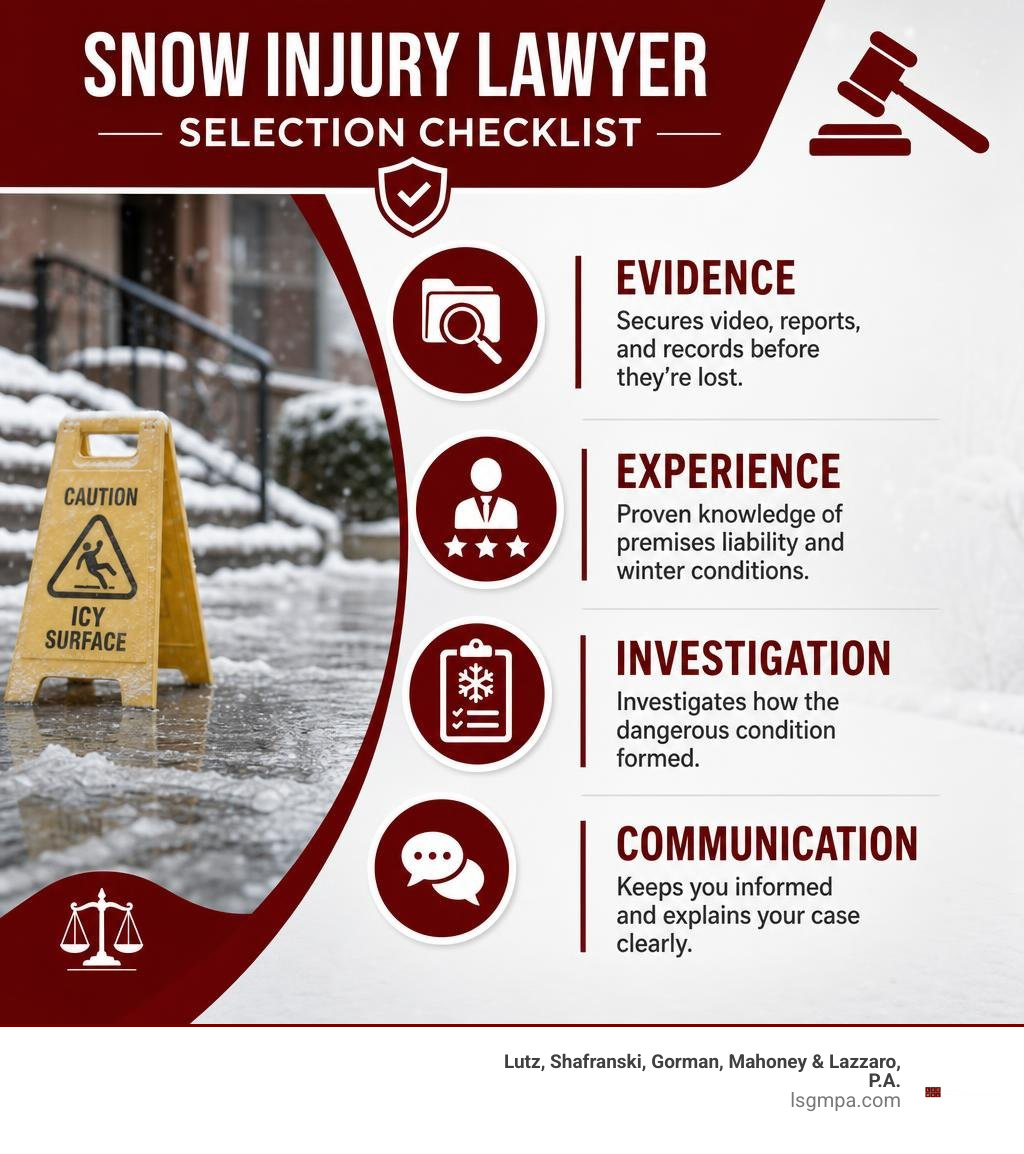
Winter weather in New Jersey brings severe freezing conditions, slick parking lots, and treacherous building entrances. When a property owner or property management firm fails to maintain safe walking surfaces, serious slip and fall accidents happen within seconds. Victims frequently suffer catastrophic orthopedic fractures, torn ligaments, spinal trauma, or head injuries.
Under premises liability law, commercial property owners and residential landlords have an affirmative legal duty of care to maintain reasonably safe grounds. This means they must monitor incoming storms, clear walkways, apply salt or de-icing agents, and fix dangerous conditions created by freeze-thaw cycles.
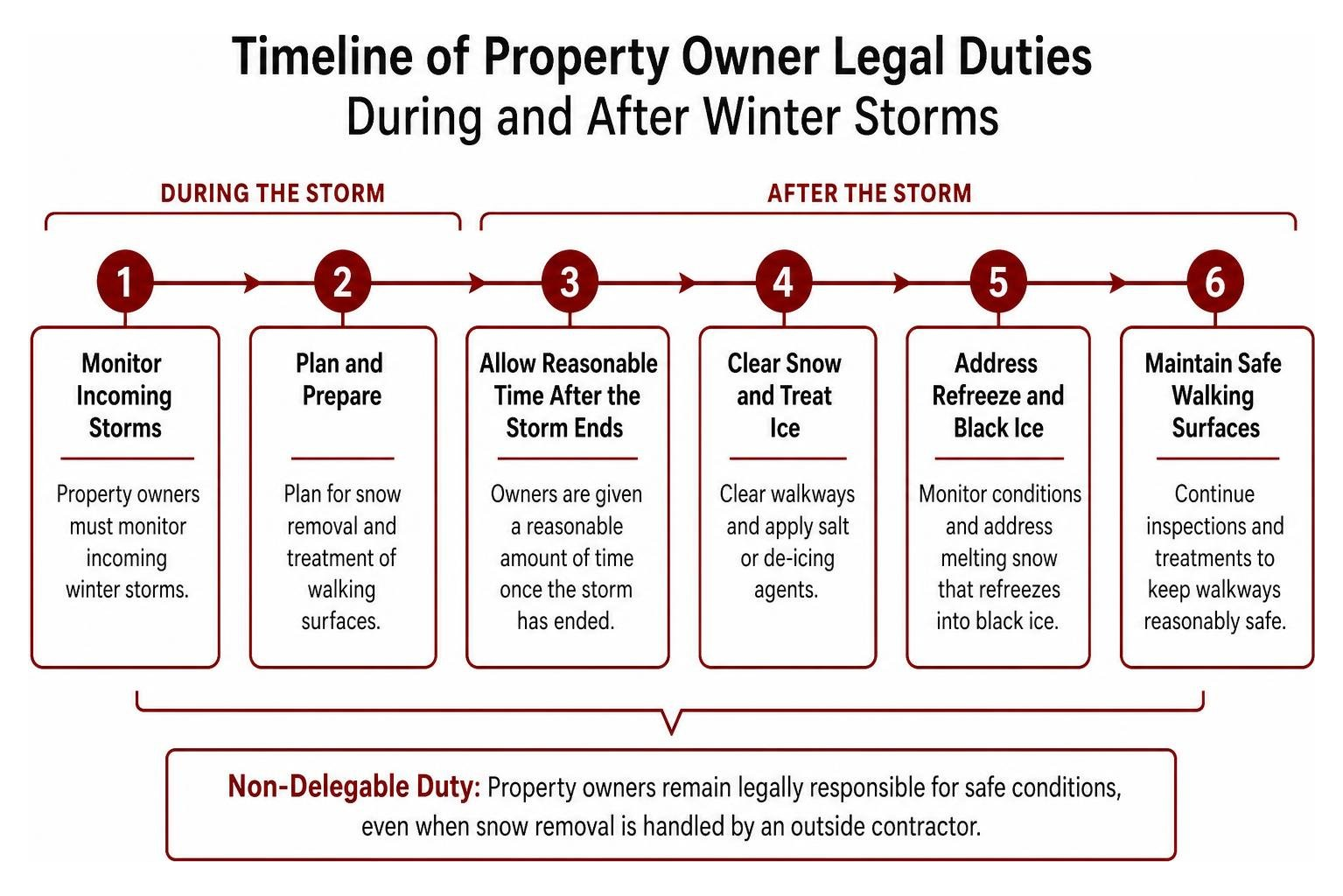
Many landlords believe that handing off snow clearance duties to an outside commercial vendor absolves them of all fault. That is simply not the case under state law. Property owners maintain non-delegable premises liability duties to their lawful guests, tenants, and visitors. While an outside plowing contractor might share responsibility for sloppy clearing, the property manager remains legally accountable for ensuring the grounds are actually safe. Understanding these complex corporate layers is why you need a slip and fall lawyer to hold every negligent party responsible.
In New Jersey, property owners are generally granted a reasonable amount of time following the conclusion of a winter storm to remove accumulated snow and treat ice hazards. However, “reasonable” is not an open-ended excuse to ignore walkways for days on end.
Local municipal codes across Middlesex County communities—such as New Brunswick, Edison, Woodbridge, Piscataway, East Brunswick, Sayreville, and Perth Amboy—often establish strict post-storm clearance windows. Many municipal ordinances mandate that residential and commercial sidewalks must be thoroughly cleared within 12 hours after precipitation concludes.
When a landlord misses these deadlines or fails to salt untreated communal access paths, stairwells, or parking stalls, their delay establishes clear evidence of negligence. Evaluating how local town ordinances interact with broader premises liability principles is a cornerstone in learning how to choose the best slip and fall personal injury attorney for your case.
Black ice represents one of the most deceptive and severe winter hazards. Because it forms as a transparent glaze over dark asphalt or concrete, pedestrians cannot easily detect it. Black ice frequently develops when daytime temperatures cause high snowbanks to melt, allowing water to cascade across walkways before refreezing during sub-freezing overnight hours.
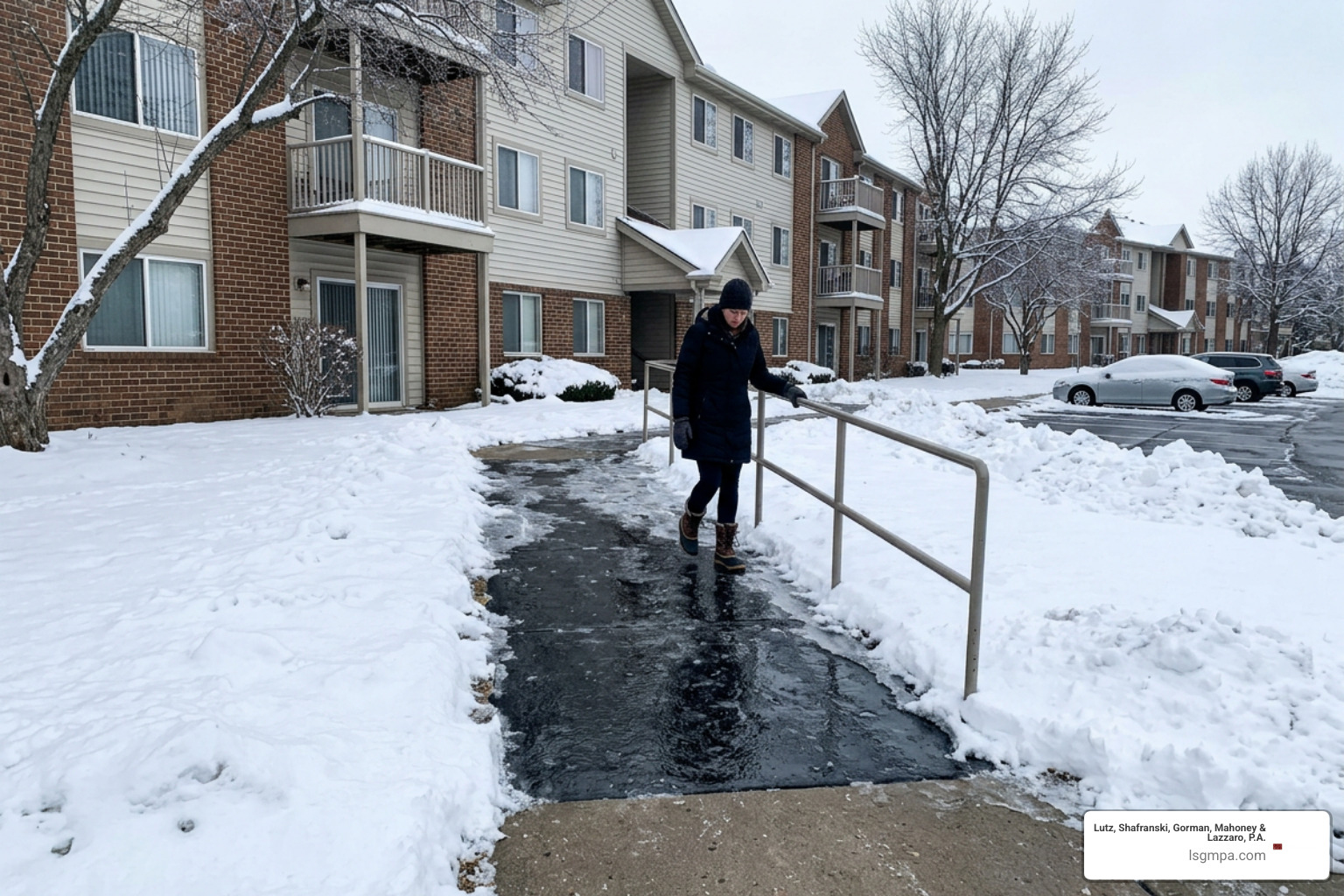
When injury claims arise from black ice, defense insurers routinely blame the victim, arguing they assumed the risk by walking outside in winter. However, under the reasonable belief doctrine, if an individual reasonably believes a surface is merely wet pavement rather than sheet ice—particularly after observing prior maintenance or seeing cleared neighboring areas—they did not legally assume the risk of injury.
Landlords cannot escape liability when negligent snow placement causes persistent runoff drainage that continuously refreezes across pedestrian pathways.
Winter property maintenance involves numerous parties, including professional commercial plowing outfits, amateur local shovelers, and visiting third parties such as delivery couriers, postal carriers, and tenants. Determining legal liability after a shoveling accident depends directly on who was injured, how the hazard formed, and the contractual relationships involved.
| Feature | Professional Snow Contractor | Amateur / Neighborhood Shoveler |
|---|---|---|
| Worker Injury Lawsuits | Barred by inherent risk doctrine (Workers’ Comp applies) | Barred unless homeowner actively intervenes or provides faulty tools |
| Third-Party Slip Liability | Contractor must indemnify / defend property owner | Property owner remains directly liable for poor work |
| Equipment Provision | Contractor brings independent commercial equipment | Homeowner often supplies household tools or snowblowers |
| Insurance Coverage | Commercial General Liability & Workers’ Compensation | Covered under Homeowner’s Liability Policy |
When a third-party visitor or delivery driver slips and falls on an icy driveway that was cleared improperly, the property owner remains primarily responsible. While professional contractors carry independent commercial general liability policies that include obligations to defend and indemnify the property owner, hiring informal, uninsured help leaves the property owner personally exposed under their standard homeowners’ policy.
Under standard property liability rules, there is an inherent danger carve-out for hired contractors. When a homeowner hires an outside professional or tradesperson specifically to correct or remove a known hazard—such as hiring a contractor to clear a snowy driveway—the worker generally cannot sue the property owner if they slip on that very snow.
However, this protection is not absolute. A property owner can be held liable for a hired worker’s injuries if:
Understanding the specific conditions governing liability for hiring snow shovelers is essential when assessing whether an injured worker or an injured third party has a viable premises liability claim.
The legal protection homeowners enjoy under the independent contractor carve-out disappears the moment they supply their own tools. If a property owner lends a hired neighborhood worker a damaged snowblower with a missing safety guard, a cracked shovel that snaps under heavy loads, or unsafe ladders for roof clearing, the property owner creates direct liability for any resulting trauma.
In such circumstances, the claim falls under the homeowner’s personal liability insurance coverage. Navigating these overlapping homeowner policies, commercial exclusions, and equipment liability claims requires seasoned local counsel. Review our comprehensive checklist for choosing an injury lawyer in Perth Amboy to understand how local litigation experience makes a decisive difference in complex premises actions across Middlesex County.
Insurance carriers routinely attempt to devalue winter slip and fall claims by making low initial settlement offers before a lawsuit is filed. For instance, an insurer might initially offer an injured victim $30,000 for a severe fracture, hoping the victim accepts before discovering the full extent of their long-term orthopedic impairment.
Through aggressive formal litigation—including depositions of corporate property managers, retention of meteorological engineers, and comprehensive medical reviews—our firm regularly elevates case values to six- and seven-figure recoveries, including securing $200,000 or more in disputed black ice settlements that insurers originally attempted to dismiss.
When a fall causes debilitating trauma requiring multi-level spinal surgeries, joint replacements, or permanent physical limitations, consult our guide to finding a catastrophic injury lawyer to ensure your long-term medical costs and lost future earnings are fully calculated.
Winning a winter slip and fall lawsuit requires concrete, contemporaneous evidence that proves exactly how and why the hazard existed.
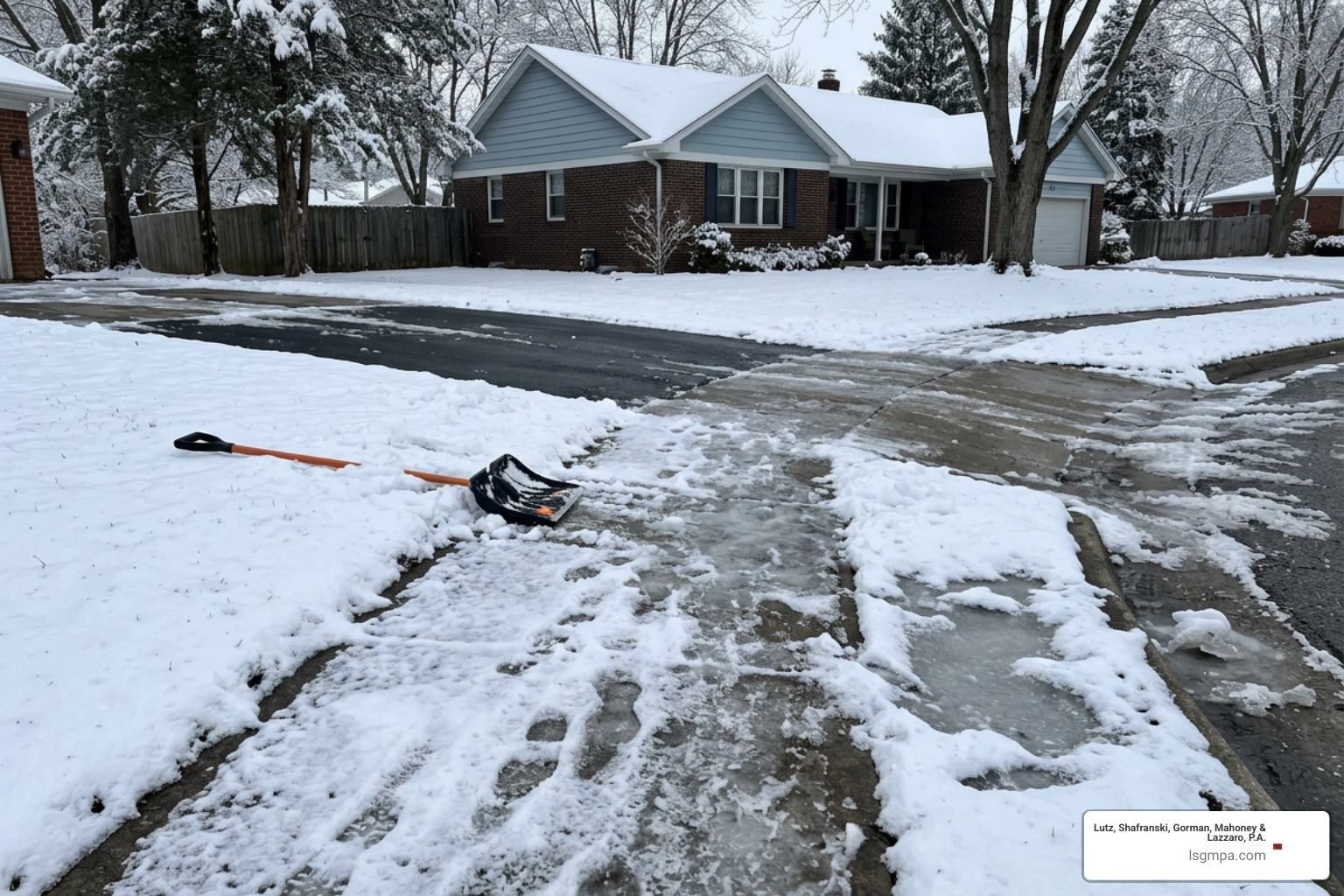
Critical evidence that builds an undeniable liability record includes:
Defense attorneys in winter injury claims lean heavily on comparative negligence and “assumption of risk” arguments, claiming that anyone who walks outside in sub-freezing temperatures should anticipate ice and watch their step.
We dismantle this defense by proving tenant expectation and reasonable reliance. If an apartment complex or commercial shopping center has historically cleared walkways by early morning, a visitor walking across what appears to be damp pavement is acting with reasonable prudence. When property managers fail to spread salt or fail to correct known drainage flaws, the fault lies entirely with their failure to maintain safety. Review our guide on accident claim lawyers explained to see how proven litigation strategies overcome comparative fault arguments.
Property owners must clear ice and snow within a reasonable timeframe following the end of a winter storm. In many Middlesex County municipalities, local town ordinances establish explicit deadlines, frequently requiring complete clearance of public-facing sidewalks within 12 hours after snowfall concludes. Commercial property owners and retail shopping centers are held to continuous standards of reasonable care during normal business operating hours.
If an adult or neighborhood youth is hired solely to clear snow, they generally cannot sue the property owner for injuries caused by ordinary slipping hazards associated with that snow. However, if the homeowner provides defective equipment (such as a broken snowblower), directs the worker into hazardous concealed areas, or actively controls the work, the homeowner can be held legally liable under their homeowners’ insurance coverage.
Immediately seek professional medical care to document your physical trauma. Take detailed photographs and videos of the fall location, showing the exact ice condition, lack of salt, and nearby snow piles. Report the accident in writing to the building owner or property manager, request that all surveillance footage covering the area be preserved immediately, and contact an experienced premises liability attorney before speaking to any insurance adjusters.
A serious winter slip and fall can disrupt your life, leaving you with mounting medical bills, extensive rehabilitation needs, and missed paychecks. Property owners and corporate insurance carriers will do everything possible to shift the blame onto you, claiming you should have seen the ice or stayed inside.
You do not have to fight insurance adjusters alone. At Lutz, Shafranski, Gorman, Mahoney & Lazzaro, P.A., we provide dedicated, results-driven representation to accident victims across New Brunswick, Edison, Woodbridge, Piscataway, Perth Amboy, East Brunswick, Sayreville, and the surrounding Middlesex County communities. We hold negligent property owners and commercial maintenance companies accountable, fighting for the maximum compensation you deserve. Contact our team today for a free, comprehensive review of your injury claim.