

 Call Us Today (732) 249-0444
 July 8, 2026

A slip and fall personal injury attorney helps injured people hold negligent property owners legally accountable and recover compensation for medical bills, lost wages, and pain and suffering.
Quick answers to common questions:
Every year, at least one million people are hospitalized in the United States as a direct result of slip and fall accidents — roughly 2,740 serious injuries every single day. Falls account for more than 8 million emergency room visits annually, and the total medical costs tied to fall injuries have surpassed $50 billion in a single year.
Yet many injured people in New Jersey hesitate to take legal action. They feel embarrassed. They assume the fall was their own fault. Or they simply don’t know that the property owner may be legally responsible for their medical bills and lost income.
That hesitation can be costly.
Evidence disappears fast. Surveillance footage gets overwritten within days. Witnesses forget details. And insurance adjusters — working for the property owner, not for you — may contact you quickly, hoping to settle your claim for far less than it’s worth before you understand your rights.
This guide explains everything you need to know: how slip and fall claims work in New Jersey, what you need to prove, what your case may be worth, and — most importantly — how to choose the right attorney to fight for you.
My name is Frank Lazzaro, and I am one of the roughly 2% of attorneys certified by the Supreme Court of New Jersey as a Certified Civil Trial Attorney, with a track record of obtaining multiple six- and seven-figure verdicts and settlements in slip and fall personal injury and other serious injury cases. I have seen how the right legal representation — and the right evidence strategy — makes the difference between a dismissed claim and a life-changing recovery.
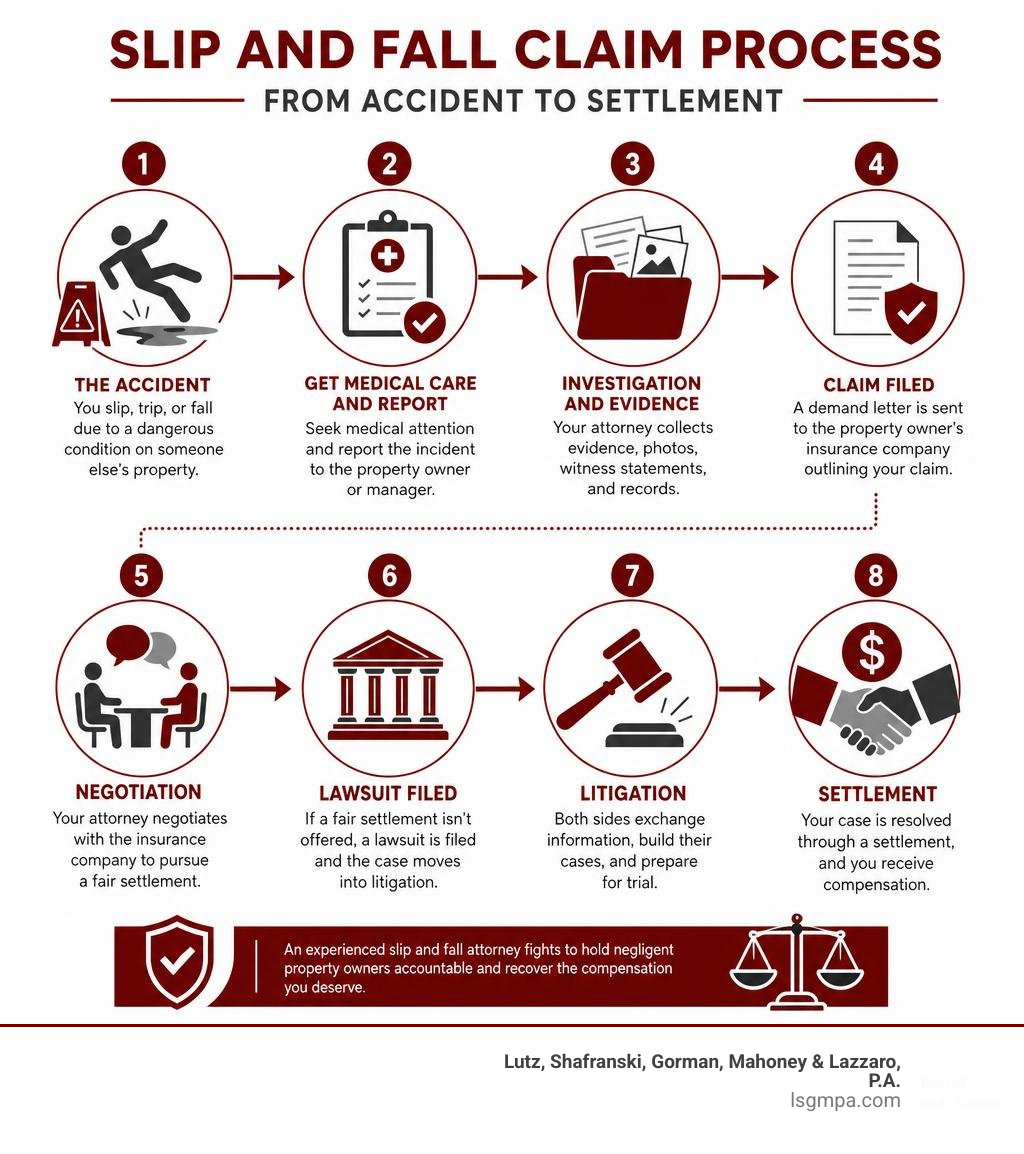

When you visit a supermarket in New Brunswick, dine at a restaurant in Perth Amboy, or park your car in a commercial lot in Milltown, you have a legal right to expect that the premises are reasonably safe. Under New Jersey premises liability law, property owners, managers, and commercial tenants owe a “duty of care” to lawful visitors.
This duty means they must actively inspect their properties, fix dangerous conditions promptly, and provide clear warnings about any hazards they cannot immediately resolve. When they fail to do so, a routine outing can turn into a life-altering accident.
Dangerous conditions can take many forms depending on the setting. In our decades of representing injured clients across New Jersey, we routinely see slip and fall accidents caused by:
The physical impact of a sudden fall can be devastating. Despite the common misconception that slip and falls only cause minor bruises, these accidents frequently result in severe, long-term physical damage:
The medical costs associated with these injuries accumulate rapidly. Emergency room visits, diagnostic imaging (like MRIs and CT scans), surgeries, prescription medications, and ongoing physical therapy can easily push medical bills into tens or hundreds of thousands of dollars. This is why securing a qualified slip and fall personal injury attorney is critical to protecting your financial future.
To win a premises liability claim in New Jersey, the burden of proof rests entirely on you, the injured party. Simply showing that you fell on someone else’s property and got hurt is not enough. You must prove that the property owner or manager was negligent.
Our team of New Jersey Slip and Fall Lawyers focuses on building a rock-solid foundation for your case by proving four key legal elements:
The most challenging hurdle in any slip and fall case is proving “notice.” You must establish that the property owner knew—or should have known—about the hazard before your accident occurred. This is divided into two categories:
To prove constructive notice, we dive deep into the business’s internal records. We request and analyze maintenance logs, sweep sheets, and employee shift schedules to determine when the area was last inspected. If a grocery store aisle wasn’t swept or inspected for hours, we can argue they failed in their duty of reasonable care.
A successful claim relies on objective, physical evidence. Because property owners often clean up spills or repair hazards immediately after an accident, we act quickly to preserve crucial evidence:
What you do in the minutes and hours following a slip and fall can make or break your potential legal claim. Taking the right steps immediately helps preserve vital evidence and protects your legal rights.
If you are physically able to do so, follow this step-by-step checklist at the accident scene:
Your health must be your absolute priority. Even if you believe your injuries are minor, you must seek a professional medical evaluation on the same day as your fall.
Many serious injuries, such as internal bleeding, concussions, and spinal disc herniations, are delayed-onset injuries. They may not show significant symptoms until hours or days after the adrenaline of the fall wears off.
Furthermore, insurance companies look closely at the gap in time between your accident and your first medical treatment. If you wait weeks to see a doctor, the insurer will argue that your injuries were not serious or were caused by an unrelated event.
Be sure to keep a detailed personal journal documenting your physical pain, limitations, and how the injuries impact your daily life, and store all medical bills, receipts, and diagnostic records in a safe place.

Choosing the right legal representation is the single most important decision you will make for your recovery. You should never settle for a general practice lawyer who handles divorces, wills, and occasional slip and falls. You need a dedicated personal injury team with deep experience in New Jersey premises liability law.
When evaluating potential law firms to handle your case, look for the following qualifications:
Insurance companies are profit-driven corporations. Their primary goal is to pay you as little as possible—or nothing at all. They employ highly trained insurance adjusters who use sophisticated tactics to minimize payouts:
An experienced slip and fall personal injury attorney acts as your shield against these tactics. We handle all communications, build an undeniable wall of evidence, and demonstrate to the insurer that we are fully prepared to take your case to trial if they refuse to offer a fair settlement.
In New Jersey, the statute of limitations for a personal injury claim is two years from the exact date of the slip and fall accident. If you do not file a formal lawsuit within this two-year window, you lose your legal right to pursue compensation forever.
However, if your fall occurred on public or government-owned property (such as a municipal sidewalk in New Brunswick, a public school in Milltown, or a government office in Perth Amboy), you must comply with the strict rules of the New Jersey Tort Claims Act. This law requires you to file a formal Notice of Claim with the responsible government entity within 90 days of the accident. Failing to meet this short deadline will bar your claim completely.
New Jersey follows a modified comparative negligence system, specifically the “51% bar rule.” This means that you can still recover compensation even if you were partially at fault for your fall, as long as your percentage of responsibility is not greater than 50%.
If you are found partially at fault, your final compensation award will be reduced by your percentage of liability. For example, if a jury awards you $100,000 in damages but determines that you were 20% at fault because you were looking at your phone when you tripped, your final recovery will be reduced by 20%, leaving you with $80,000. If your fault is found to be 51% or higher, you are barred from recovering any compensation.
| Legal System | Fault Threshold for Recovery | Impact on Final Compensation |
|---|---|---|
| New Jersey Modified Comparative Negligence | Must be 50% or less at fault | Compensation is reduced by your exact percentage of fault. |
| Contributory Negligence (Other States) | Must be 0% at fault | Any percentage of fault (even 1%) completely bars recovery. |
While every case is unique and depends on the severity of the injuries and the strength of the evidence, successful slip and fall claims in New Jersey routinely result in substantial financial recoveries.
For example, a New Jersey woman who slipped and fell on ice at an airport terminal, requiring three back surgeries, secured a $3.1 million settlement. In another New Jersey case, a victim who suffered severe injuries after falling on defective curbing at a local bank received a $2.25 million recovery.
These outcomes demonstrate how a meticulous investigation, combined with aggressive representation, can secure the maximum compensation needed for medical expense recovery and pain and suffering damages.
A serious slip and fall accident can derail your life in an instant, leaving you with physical pain, emotional stress, and overwhelming financial burdens. You do not have to carry this weight alone.
At Lutz, Shafranski, Gorman, Mahoney & Lazzaro, P.A., we have dedicated our careers to helping injury victims throughout Middlesex County and across New Jersey. Our offices in New Brunswick, Perth Amboy, and Milltown are staffed by trial attorneys who provide compassionate, comprehensive advocacy for those suffering from serious injuries. We work tirelessly to recover every dollar you deserve for your medical bills, lost earnings, rehabilitation, and pain and suffering.
If you or a loved one has been injured, don’t wait for crucial evidence to disappear. Contact a specialized New Brunswick slip and fall lawyer at Lutz, Shafranski, Gorman, Mahoney & Lazzaro, P.A. today for a completely free, no-obligation case evaluation. We operate on a contingency fee basis — you pay us absolutely nothing unless we win your case.