

 Call Us Today (732) 249-0444
 August 22, 2026

If you were injured and need a hit and run accident lawyer, here is what you need to know right now:
Every single minute, at least one hit and run accident occurs somewhere in the United States. These crashes account for roughly 24% of all pedestrian fatalities. And yet, when the dust settles, the driver who caused it all is already gone.
That moment — when you look up and see the other car speeding away — is one of the most disorienting experiences a person can face. You are injured. You are confused. And the person responsible is nowhere to be found.
You are not powerless, though. The law gives you real options, and this guide will walk you through all of them.
I’m Frank Lazzaro, a Certified Civil Trial Attorney certified by the Supreme Court of New Jersey, and I have spent years fighting for injured victims in complex personal injury cases — including cases involving hit and run accident claims where the odds seemed stacked against my clients from the start. If you’ve been left in the dust by a fleeing driver, keep reading — your path to compensation likely exists, and we’ll show you exactly how to find it.
A hit and run accident occurs whenever a driver is involved in a collision—whether with another moving car, a parked vehicle, a pedestrian, or a bicyclist—and intentionally flees the scene without stopping to provide their contact information, render aid, or wait for law enforcement.
From a psychological and legal standpoint, the decision to flee is almost always driven by panic or a desire to escape immediate consequences. While some drivers try to claim they “didn’t know” they struck anything, this defense rarely holds up when significant injuries or property damage are involved.
In our experience representing victims across New Jersey, including New Brunswick, Milltown, and Perth Amboy, we find that drivers typically flee because of:
Because hit and run drivers are often speeding, distracted, or impaired, the physical impact of these crashes can be devastating. Compounding the trauma is the fact that victims are often left without immediate medical aid because the responsible party did not stop to call 911.

At our firm, we frequently represent victims suffering from:
Immediately after a crash, your body releases a massive flood of adrenaline. This chemical response is designed to help you survive, but it also temporarily masks physical pain. You might walk away from a hit and run feeling “fine,” only to wake up the next morning unable to move your neck or back. This is why securing immediate medical attention is non-negotiable.
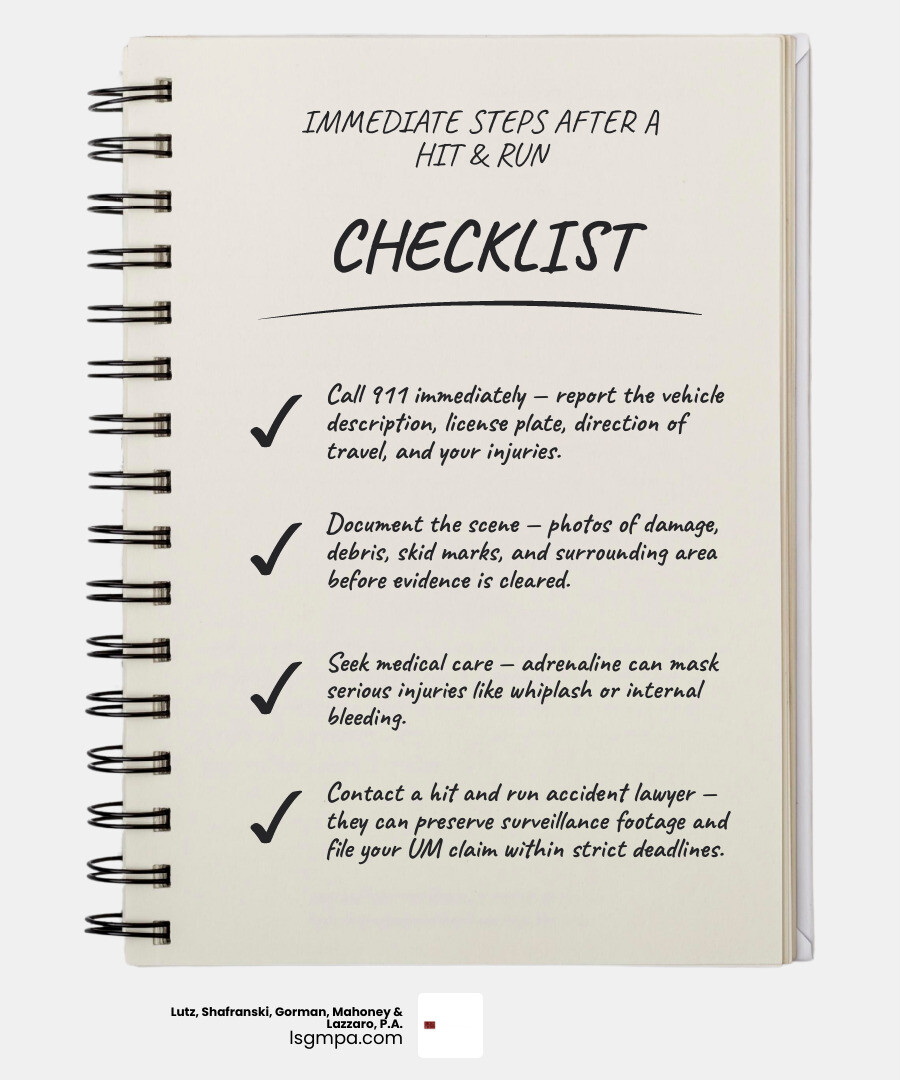
The moments following a hit and run are chaotic, but the steps you take can make or break your subsequent personal injury claim.
Just as there are things you should do, there are several critical mistakes that can severely damage your health and your claim:
When you hire a hit and run accident lawyer, you aren’t just getting someone to file paperwork; you are gaining a dedicated investigator.
To build a rock-solid case, we actively deploy a variety of investigative techniques:
Even if the driver is never found, we must still prove that the crash was caused by negligence. This requires establishing four core legal elements:
Special tracking methods are often used in commercial vehicle hit and runs. If you were struck by a delivery van or semi-truck, we can use GPS logs, fleet numbers, and company logos to track down the exact commercial vehicle involved.
If your hit and run involved a motorcycle, the stakes are even higher due to the lack of structural protection. To understand the unique elements of these claims, read our guide on Why a Motorcycle Accident Lawyer is Right for You as well as our resource on Motorcycle Crash Claims Your Guide to Getting Back on the Road.
If the police or our investigators track down the driver weeks or months after the crash, your legal strategy shifts. We can transition from a first-party insurance claim to a third-party liability lawsuit against the at-fault driver’s insurance policy.
Furthermore, because leaving the scene of an injury accident is a criminal act, we can pursue punitive damages in a civil lawsuit. Punitive damages are designed to punish the defendant for egregious, reckless behavior and deter others from acting similarly.
In a standard car accident, the at-fault driver’s insurance pays for your medical bills and car repairs. But what happens when that driver is gone?
Because New Jersey is a no-fault insurance state, your own auto insurance policy is your primary safety net.
| Coverage Type | What It Pays For | Who Pays | Key Limitation |
|---|---|---|---|
| Personal Injury Protection (PIP) | Medical bills, emergency room visits, medical equipment, and some lost wages. | Your own auto insurance company. | Subject to your chosen policy deductible and limits. |
| Uninsured Motorist (UM) | Pain and suffering, long-term lost earnings, and emotional distress. | Your own auto insurance company (acting as the substitute for the missing driver). | Cannot exceed the liability limits of your own policy. |
A common fear among hit and run victims is that filing an Uninsured Motorist or PIP claim will cause their auto insurance premiums to skyrocket.
Fortunately, in New Jersey, insurance companies are generally prohibited from raising your rates or penalizing you for filing a claim if you were not at fault for the accident. Since you were the victim of a crime, your premium should remain stable. However, insurance carriers are still businesses looking to protect their bottom lines, and they may try to dispute the severity of your injuries or argue that you shared fault.
In some accidents, liability isn’t entirely clear-cut. For example, if you were hit by a speeding car while making a turn, an insurance adjuster might argue that you share some responsibility.
New Jersey operates under a modified comparative negligence system (specifically the 51% bar rule). This means:
Hit and run laws, criminal penalties, and filing deadlines vary dramatically across the United States.
Here in New Jersey, navigating the local court systems and municipal codes requires deep local knowledge. Whether your accident occurred on the busy streets of New Brunswick, the residential roads of Milltown, or near the waterfront in Perth Amboy, local traffic patterns and municipal cameras play a major role in your case.
Furthermore, if your accident involved a public transit vehicle, such as a NJ Transit bus, the rules change entirely. Claims against government entities require filing a formal Notice of Claim within 90 days under the New Jersey Tort Claims Act. To see how these complex cases are handled, read our guide on Navigating the Legal Gridlock A Guide to Manhattan Bus Accident Lawyers.
Yes. If you have auto insurance, you can recover compensation through your Uninsured Motorist (UM) coverage. If you are an uninsured pedestrian, you may be eligible to file a claim through the New Jersey PLIGA fund.
At Lutz, Shafranski, Gorman, Mahoney & Lazzaro, P.A., we work on a contingency fee basis. This means there are absolutely no upfront fees or out-of-pocket costs. We only get paid if we successfully recover compensation for you. Your initial consultation is always 100% free.
In New Jersey, the standard statute of limitations for a personal injury claim is two years from the date of the accident. However, certain insurance policies have much shorter windows (sometimes as little as 30 to 90 days) for notifying your carrier of an Uninsured Motorist claim. It is vital to act quickly to protect your rights.
Being left on the side of the road by a negligent driver is an incredibly isolating experience, but you do not have to navigate the aftermath alone.
At Lutz, Shafranski, Gorman, Mahoney & Lazzaro, P.A., we provide comprehensive, compassionate advocacy for victims of serious injury claims. From our offices in New Brunswick, Milltown, and Perth Amboy, we handle every aspect of your case—from tracking down video evidence and dealing with difficult insurance adjusters to calculating your medical costs, lost earnings, and pain and suffering.
If you or a loved one has been injured, let us fight for the justice you deserve. Schedule a free consultation with a New Brunswick car accident lawyer today, and let us help you get back on the road to recovery.