Local Legal Help: Choosing the Right Crash Lawyer Near Me
 September 29, 2026
Find a Crash Lawyer Near Me Who Can Protect Your Claim
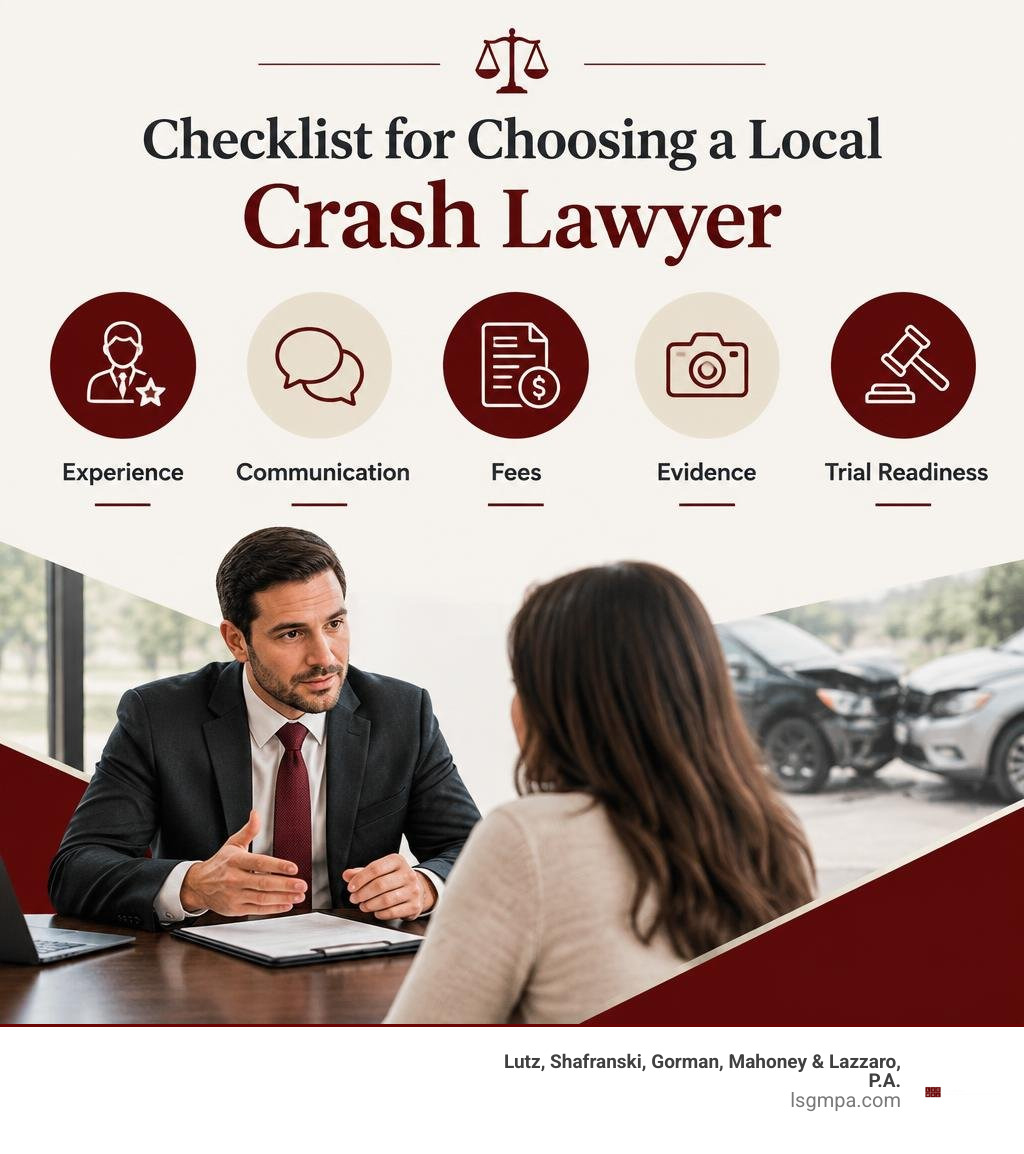
To find the right crash lawyer near me, look for a local New Jersey attorney who handles auto injury cases, can explain who may be at fault, works on a contingency fee when appropriate, and is prepared to take the case to court if an insurer will not make a fair offer.
Start with these three checks:
- Confirm relevant experience. Ask how often the lawyer handles car, truck, and uninsured-driver claims.
- Ask who will handle your case. You should know whether you will speak directly with the attorney and how often you will receive updates.
- Review their plan for evidence and deadlines. Photos, witness details, medical records, vehicle data, and video footage can disappear quickly after a crash.
The right local lawyer does more than file paperwork. They can deal with insurance adjusters, value medical costs and lost income, investigate fault, and explain how New Jersey rules may affect your recovery. A free consultation is a useful chance to compare answers before you hire anyone.
I am Frank Lazzaro, a New Jersey Certified Civil Trial Attorney who has obtained multiple six- and seven-figure personal injury verdicts and multiple millions of dollars in client recoveries. When you search for a crash lawyer near me, the next step is knowing which qualifications and questions truly matter.
Similar topics to crash lawyer near me:
For a broader understanding of how personal injury claims work, see the personal injury overview.
7 Key Qualities to Look for in a Crash Lawyer Near Me
When an unexpected collision turns your day upside down, choosing legal representation should not add to your stress. Securing fair compensation requires partnering with a legal team that understands both the courtroom and the local community. If you are finding the right car accident attorney in New Brunswick NJ or nearby communities, consider these core qualities:
- Local Courtroom Experience: Laws apply statewide, but local court customs, judges, and procedures vary across counties. A lawyer who frequently practices in Middlesex County knows how local venues operate and how insurance defense attorneys in the area build their strategies.
- Genuine Trial Readiness: Many attorneys settle every claim that crosses their desk. Insurance companies keep track of who goes to trial and who folds. When insurers know an attorney is ready to present a compelling case to a jury, their settlement offers change dramatically.
- Transparent Communication Standards: Nothing is more frustrating than hiring a firm only to be left in the dark. Your legal team should offer clear updates, answer your calls, and explain legal concepts without overwhelming jargon.
- Demonstrated Track Record: Look for verifiable results in complex personal injury matters. Consistent multi-million-dollar outcomes demonstrate that a firm has the resources to handle extensive investigations, expert witness testimonies, and aggressive litigation.
- Peer Recognition and Board Certification: Designations such as New Jersey Certified Civil Trial Attorney signify that an attorney has met rigorous standards of courtroom experience, peer review, and demonstrated skill.
- Focus on Personal Injury Law: The law is broad. An attorney handling divorces, estate planning, and occasional traffic tickets may not possess the detailed technical knowledge required to maximize an auto collision claim.
- Client-Centered Advocacy: We believe you are a person recovering from a traumatic event, not a case file. Look for an attorney who listens to your story and tailors their approach to your recovery needs.
For further insight into selecting counsel across regional communities, explore connecting with trusted car wreck injury lawyers in your area.
Essential Questions to Ask a Crash Lawyer Near Me During a Free Consultation
Most personal injury attorneys offer a free initial consultation. This meeting serves as an interview where you determine if the attorney is the right advocate for your case.
Here are essential questions to ask during that conversation:
- Who will be the lead attorney handling my day-to-day legal strategy?
- Will my case be passed off to a junior associate, paralegal, or outside referral firm?
- What is your current caseload volume, and do you have time to dedicate to my claim?
- What is your specific track record with car accident cases similar to mine?
- How often will you or your team reach out to provide status updates?
- What out-of-pocket costs might arise, and how are case expenses handled?
If you want practical advice on evaluating attorneys without feeling overwhelmed, review how to choose a car accident lawyer in Middletown without losing your mind.
Contingency Fee Structures and Legal Costs Explained
One of the biggest misconceptions about hiring an injury lawyer is the cost. Most people assume they need thousands of dollars in retainer fees. Reputable auto accident attorneys work on a contingency fee basis.

Under a contingency fee agreement:
- No Upfront Legal Fees: You do not pay hourly rates or upfront retainers out of pocket.
- We Only Get Paid If You Win: Our legal fee is a set percentage deducted directly from the final settlement or court verdict. If we do not recover compensation on your behalf, you do not owe legal fees.
- Case Expenses: Investigating a collision requires funds for accident reconstruction specialists, medical record retrieval, court filing fees, and expert witness depositions. A dedicated law firm advances these costs during litigation and recovers them from the final resolution.
To learn more about finding legal support during tough financial situations, see our resource on finding the top auto wreck attorneys when disaster strikes.
Immediate Post-Accident Checklist: Protecting Your Health and Evidence
The minutes and days following an auto wreck can impact your physical health and your ability to pursue compensation. Taking methodical steps helps safeguard your legal rights from the outset.
- Prioritize Scene Safety: Check yourself and your passengers for injuries. If the vehicles are drivable and you are in active traffic lanes, safely move to the shoulder. Turn on your hazard lights.
- Call 911 Dispatch: Request both police and emergency medical services. A formal police report creates an official record of the incident, documenting weather conditions, driver statements, and physical damage.
- Seek a Medical Evaluation Immediately: Adrenaline often masks symptoms of concussions, internal trauma, and soft-tissue tears. See a doctor right away, whether at an emergency room, an urgent care clinic, or through your primary physician.
- Gather Witness Details: If bystanders stopped to assist, ask for their names, phone numbers, and brief statements regarding what they saw.
- Notify Your Own Insurer: Report that an accident occurred, but stick strictly to the basic facts. Avoid offering speculative opinions about who was at fault.
For a detailed review of these critical early decisions, read our guide on steps to take after a Middletown car accident.
Documenting the Scene and Preserving Critical Evidence
Physical evidence at a crash site disappears quickly. Rain washes away fluid trails, skid marks fade under daily traffic, and vehicles are towed to salvage yards or repaired. Gathering evidence early strengthens your position when establishing liability.
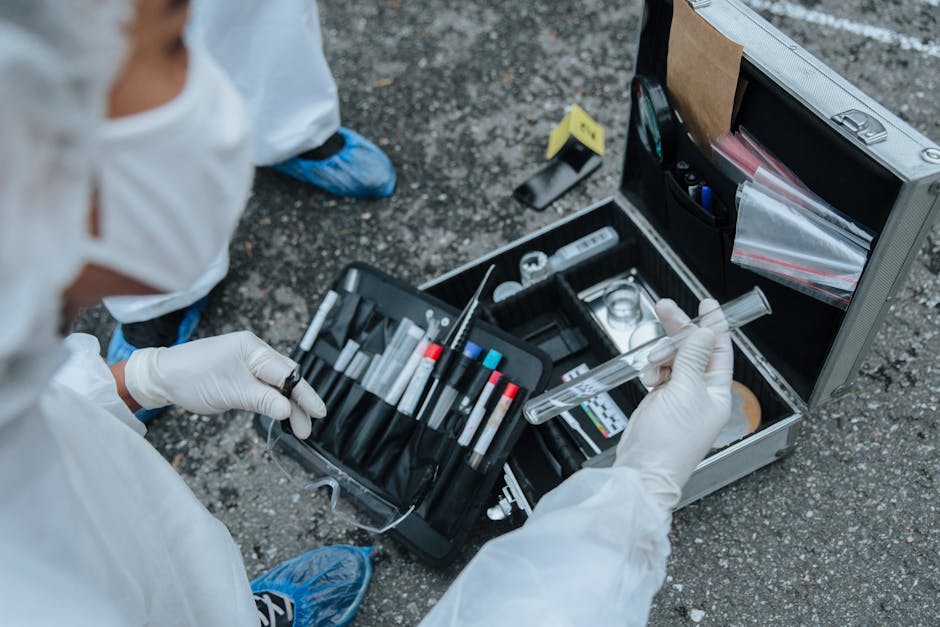
- Photographs and Video: Take wide-angle photos of the entire scene, traffic signals, road signs, and sightline obstructions. Take close-up photos of vehicle damage, paint transfers, shattered glass, deployed airbags, and visible physical injuries.
- Surveillance and Dashcam Footage: Nearby storefronts, traffic cameras, and dashboard cameras may have captured the crash. An attorney can send formal spoliation letters to preserve this digital evidence before it is overwritten.
- Physical Debris and Skid Marks: The length and angle of skid marks help accident reconstruction experts determine vehicle speeds and braking patterns.
For an in-depth breakdown of how evidence builds a claim, see accident claim lawyers explained: everything you need to know before filing.
Managing Insurance Adjusters and Recorded Statements
Shortly after a crash, you will likely receive a call from the other driver’s insurance adjuster. They may sound polite and helpful, but their primary goal is to minimize the insurance company’s payout.
Keep these protective measures in mind:
- Decline Recorded Statements: You are not legally required to give a recorded statement to the at-fault driver’s insurer. Adjusters are trained to ask questions designed to get you to inadvertently minimize your injuries or accept partial blame.
- Do Not Sign Broad Medical Authorizations: Insurers often request blanket medical releases to search your complete medical history for pre-existing conditions they can blame for your current pain.
- Beware of Quick Settlement Offers: Early settlement offers are almost always lowball figures made before you understand the full extent of your long-term medical needs and lost earnings.
To protect yourself against aggressive insurance tactics, read don’t get wrecked twice: finding the best car crash lawyers.
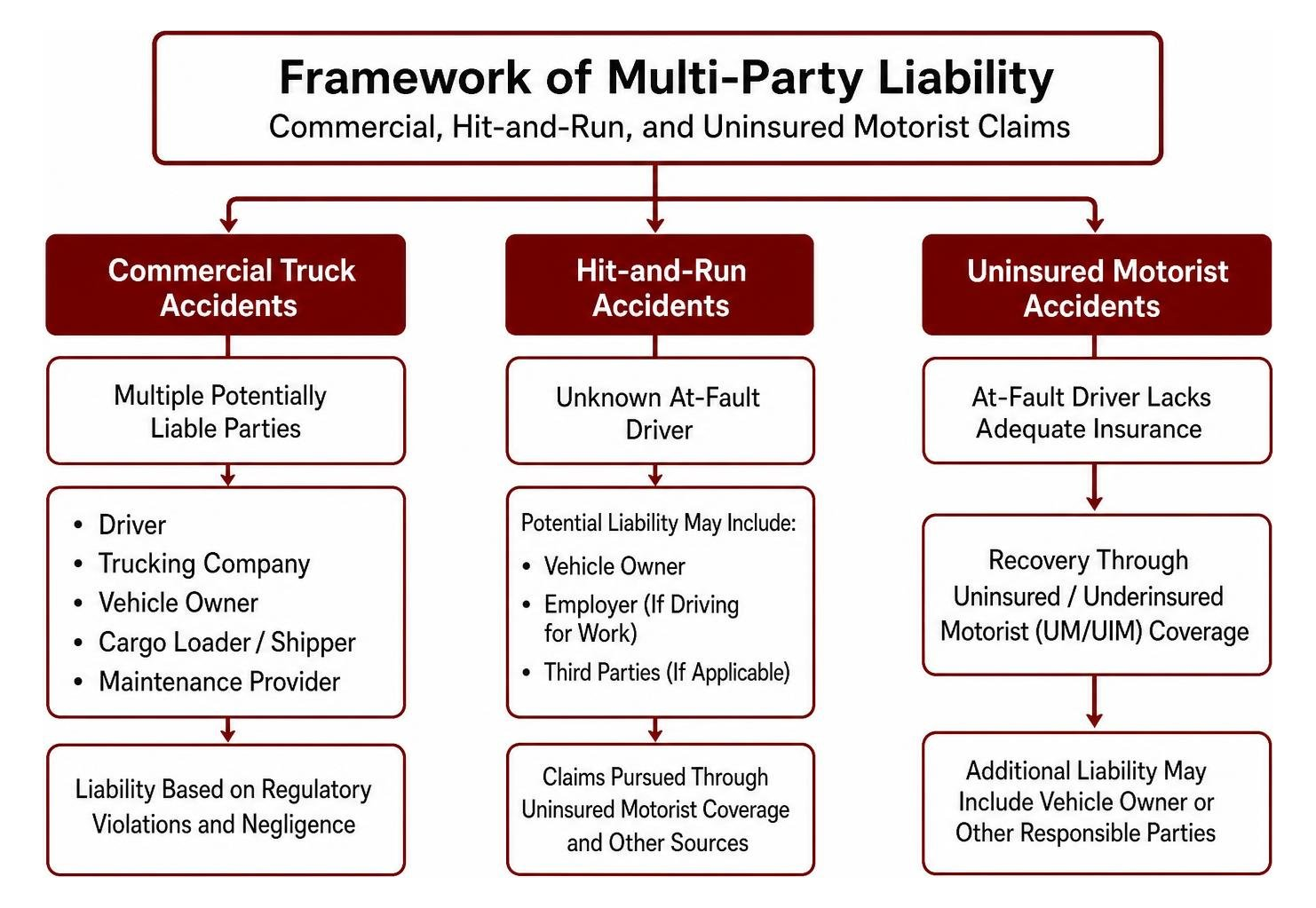
Navigating Complex Claims: Commercial Trucks, Hit-and-Runs, and Uninsured Drivers
Not every collision is a straightforward matter between two private passenger vehicles. Complex claims involve unique legal frameworks, multiple liable entities, and distinct insurance policy structures.
Commercial Truck Accidents and Regulatory Violations
Collisions involving commercial trucks, tractor-trailers, and delivery vehicles differ significantly from standard passenger car accidents. Because of the size and weight of commercial rigs, the resulting damage is often catastrophic.
These cases are governed by state laws and federal regulations enforced by the Federal Motor Carrier Safety Administration (FMCSA). When we investigate a commercial collision, we examine:
- Electronic Logging Devices (ELD): Tracking data reveals whether the truck driver exceeded legal hours-of-service limits and was driving fatigued.
- Maintenance and Inspection Records: Failure to replace worn brake pads, damaged tires, or malfunctioning steering components points to corporate negligence.
- Cargo Loading Logs: Improperly secured or overloaded cargo can cause rollovers, jackknifing, and extended braking distances.
- Multi-Party Liability: Liability may extend beyond the driver to include the trucking company, freight broker, cargo loading facility, or maintenance contractor.
Commercial carriers carry higher liability insurance limits than individual drivers, and their corporate defense teams act quickly to limit financial exposure. Preserving black-box data and maintenance logs requires prompt legal intervention.
Uninsured Motorists, Hit-and-Runs, and Property Damage
Encountering a driver who flees the scene or lacks auto insurance presents unique challenges, but it does not eliminate your options for financial recovery.
- Uninsured/Underinsured Motorist (UM/UIM) Coverage: If you are the victim of a hit-and-run or the at-fault driver has no insurance (or policy limits too low to cover your medical care), you can file a claim under your own policy’s UM/UIM endorsement. This allows your own insurer to step in and cover damages up to your policy limit.
- Hit-and-Run Investigations: Local police, surveillance footage, and witness accounts can sometimes identify the fleeing driver, enabling direct civil recovery.
- Property Damage and Diminished Value: Beyond personal injuries, you may seek compensation for the repair or total loss of your vehicle, rental car expenses, and diminished market value resulting from structural damage.
If you were involved in a collision where the driver fled, consult our guide on left in the dust: why you need a hit and run accident lawyer. For complex vehicle loss claims, review the ultimate guide to hiring an accident property damage lawyer.
Understanding Compensation, Injury Types, and Settlement Timelines
Auto collisions cause a broad range of physical trauma, ranging from immediate fractures to chronic soft-tissue and neurological conditions that emerge over time.
Common injuries include:
- Whiplash and Cervical Strain: Sudden acceleration-deceleration forces damage muscles, tendons, and ligaments in the neck and upper back.
- Traumatic Brain Injuries (TBI): Concussions and closed-head trauma can lead to cognitive issues, memory loss, headaches, and personality shifts.
- Spinal Trauma and Herniated Discs: Damage to vertebrae or intervertebral discs often requires epidural injections, physical therapy, or surgical fusion.
- Bone Fractures and Orthopedic Trauma: High-impact collisions frequently break ribs, arms, legs, pelvises, and facial bones.
- Internal Organ Damage: Blunt force trauma can cause internal bleeding, organ lacerations, and life-threatening complications.
To understand why thorough legal representation matters for bodily injury claims, read don’t settle for less with an attorney for car crash injuries alongside a practical guide to hiring a New Brunswick injury lawyer.
Economic vs Non-Economic Damages Breakdown
Compensation in personal injury law is split into two primary categories: economic damages and non-economic damages. Both are essential to securing a full financial recovery.
| Damage Category |
Description |
Specific Examples |
| Economic Damages (Tangible financial losses) |
Direct monetary costs resulting from the accident, supported by bills, receipts, and financial statements. |
• Past and future medical expenses
• Physical therapy and rehabilitation
• Prescription medications and medical devices
• Past lost wages and income
• Diminished future earning capacity
• Vehicle repair or replacement costs |
| Non-Economic Damages (Intangible personal losses) |
Subjective, non-monetary consequences that affect your quality of life, comfort, and emotional well-being. |
• Physical pain and suffering
• Emotional distress, anxiety, and PTSD
• Loss of enjoyment of life’s activities
• Permanent impairment or physical disfigurement
• Loss of consortium and companionship |
Case Timelines and Factors Influencing Settlement Duration
Clients frequently ask how long it takes to resolve a car accident claim. While some cases resolve in a few months, complex litigation involving severe injuries can take a year or longer.
Key factors influencing your case timeline include:
- Reaching Maximum Medical Improvement (MMI): Settling a claim before your doctors fully understand your long-term prognosis is risky. You generally want to reach MMI so all future medical expenses are accounted for.
- Investigation and Evidence Gathering: Procuring police reports, medical records, digital logs, and reconstruction evaluations takes time.
- The Discovery and Negotiation Phase: Once a demand package is submitted, settlement negotiations take place. If an agreement cannot be reached, filing a lawsuit begins formal discovery, including depositions and expert exchanges.
- Trial Scheduling: If the insurance company refuses to offer a fair settlement, your case may proceed to trial. Court schedules and trial dockets influence the final resolution date.
For more information on navigating early legal claims without undue financial strain, explore don’t let a fender bender break the bank: find a car accident lawyer in New Jersey.
Frequently Asked Questions About Auto Accident Claims
You should consult an attorney if you suffered physical injuries, required emergency or follow-up medical care, missed work, or if fault for the accident is disputed. Handling a claim alone often leaves you vulnerable to low settlement offers from insurance companies. A lawyer handles communication with insurers, calculates the full scope of your damages, and negotiates on your behalf so you can focus on healing.
How long do I have to file an auto accident claim?
In New Jersey, the general statute of limitations for personal injury lawsuits is two years from the date of the accident. If you fail to file a lawsuit within this window, you lose your legal right to seek compensation in court.
However, if your crash involved a government vehicle, a public transit bus, or a municipal entity, you must file a formal Notice of Tort Claim within 90 days of the incident. Missing this strict 90-day deadline can permanently bar your claim, which is why reaching out to an attorney promptly is critical.
Can I recover compensation if I was partially at fault for the crash?
Yes. New Jersey operates under a modified comparative negligence system (specifically the 51% bar rule).
Under this standard:
- You can recover damages as long as your share of fault is 50% or less.
- Your final compensation payout will be reduced by your percentage of fault. For instance, if your total damages are $100,000 but you are determined to be 20% at fault, you would receive $80,000.
- If you are found to be 51% or more at fault, you are barred from recovering compensation from the other party.
Conclusion
Car accidents can disrupt your physical health, financial security, and emotional well-being. Trying to navigate complex insurance rules, preserve critical crash evidence, and calculate future medical costs while recovering from injuries is a heavy burden to carry alone.
At Lutz, Shafranski, Gorman, Mahoney & Lazzaro, P.A., our legal team provides comprehensive advocacy for injury victims throughout New Jersey. We focus on recovering full compensation for your past and future medical bills, lost wages, and pain and suffering. If you or a loved one has been hurt in a collision, contact our dedicated Perth Amboy car accident lawyer team today for a free consultation to review your rights and take the next step forward.


 Call Us Today (732) 249-0444
