

 Call Us Today (732) 249-0444
 July 6, 2026

A motorcycle crash claim is a formal demand for compensation after a rider is injured due to someone else’s negligence. Here is what you need to know right away:
Quick answers to the most common questions:
Motorcyclists face risks that most drivers never think about. According to 2023 NHTSA data, riders are 28 times more likely to be killed in a traffic accident than passenger vehicle occupants. In New Jersey alone, there were 99 fatal motorcycle crashes in a single recent year. When a crash happens, the injuries are often severe — and the financial impact can be devastating.
That is why understanding how a motorcycle crash claim works is so important. The process is not simple. Insurance companies frequently use anti-rider bias, shared fault arguments, and quick lowball offers to minimize what they pay you. Knowing your rights from the start puts you in a much stronger position.
I am Frank Lazzaro, a Certified Civil Trial Attorney certified by the Supreme Court of New Jersey — a distinction held by roughly 2% of attorneys in the state. I have handled motorcycle crash claims resulting in multiple six- and seven-figure recoveries for injured riders, and I know exactly how insurers fight these cases. In the sections below, I will walk you through everything you need to know to protect your claim and maximize your recovery.

When you begin a motorcycle crash claim, you will naturally wonder: “How much is my claim worth?”
There is no magic formula. Every crash is unique, and the value depends on injury severity, fault, insurance coverage, and financial losses.
In legal terms, compensation is divided into economic damages and non-economic damages.
Economic damages are tangible, measurable financial losses with a direct price tag. They include:
Non-economic damages compensate you for the subjective, non-financial impact of the accident. They include:
To help visualize how these damages differ, consider the table below:
| Economic Damages (Objectively Measurable) | Non-Economic Damages (Subjective/Human Impact) |
|---|---|
| Emergency room and hospital bills | Physical pain and physical discomfort |
| Future rehabilitative therapy costs | Anxiety, PTSD, and emotional distress |
| Lost income and missed bonuses | Loss of the ability to ride or enjoy hobbies |
| Lost future earning capacity | Permanent scarring, road rash marks, or limb loss |
| Cost of replacing helmet, gear, and bike | Loss of companionship or impact on family relationships |
New Jersey has highly specific car and motorcycle insurance laws that dramatically affect how a motorcycle crash claim is valued and paid. If you ride in New Brunswick, Milltown, or Perth Amboy, you must understand how these local rules apply to you.
New Jersey is a “no-fault” insurance state for traditional automobiles, meaning your own Personal Injury Protection (PIP) covers medical bills regardless of fault.
However, under New Jersey law, a motorcycle is not considered an “automobile.”
This is a massive trap. Because motorcycles are excluded from standard auto PIP, your household car insurance PIP will not cover you if you are hurt on a motorcycle. Standard motorcycle policies do not automatically include PIP. If you did not purchase medical payments (MedPay) coverage, you must rely on private health insurance or pay out of pocket until you recover damages from the at-fault driver.
In New Jersey, car insurance policies often include a “verbal threshold” (limitation on lawsuit option) restricting your right to sue for pain and suffering unless you sustained a permanent injury.
Fortunately, the verbal threshold does not apply to motorcycle crash claims.
You retain the unrestricted right to sue the at-fault driver for pain and suffering, regardless of your personal auto policy’s limitations. This makes it much easier for injured riders to pursue full compensation.
To recover compensation, you will generally file a claim against the at-fault driver’s liability insurance. New Jersey’s minimum limits are:
If you suffer a severe injury, a $25,000 policy will not cover your first day in the hospital. This is why injury severity and additional insurance layers (like UIM coverage) are so critical.
Because motorcycles offer no physical barrier, the physical toll of a collision is often extreme. Common high-impact injuries include:
Even with a helmet, violent forces can cause brain injuries ranging from mild concussions to permanent damage, often requiring lifetime care.
Spinal damage can lead to partial or total paralysis, requiring extensive home modifications and millions in lifetime medical care.
Road rash can strip away skin layers, exposing muscle and bone. It often requires skin grafts and leaves permanent scars.
Impacts frequently shatter bones. Leg fractures are incredibly common, often requiring surgery with plates and screws followed by months of rehab.
Crushed or severed limbs may require surgical amputation, significantly driving up the value of a claim due to prosthetic costs and profound emotional impact.
Even if your injuries are severe, two major forces can drastically reduce your recovery: shared fault rules and insurance policy limits. Understanding these concepts is crucial for your motorcycle crash claim.
Insurance adjusters often rely on unfair stereotypes to blame the rider and reduce their financial exposure.
New Jersey operates under a modified comparative negligence system with a 51% bar rule:
If your total damages equal $100,000 and you are found 20% at fault (e.g., for traveling slightly over the speed limit) while the other driver is 80% at fault, your payout is reduced by 20%:
$$\$100,000 \text{ (Total Damages)} – 20\% \text{ (Your Fault)} = \$80,000 \text{ (Your Recovery)}$$
New Jersey law requires all riders to wear a protective helmet. Riding without one does not prevent you from filing a claim, but it can hurt your case if you suffered head or brain injuries. The insurer will argue those injuries would have been prevented by a helmet. To counter this, we work with medical experts to prove which injuries (like fractures or internal trauma) would have occurred regardless of helmet use.
If an at-fault driver only carries New Jersey’s minimum $25,000 liability policy, that is likely the maximum you will recover from their insurer, regardless of your injury severity. To protect yourself, you must look to other insurance layers.
UM/UIM coverage is vital for motorcycle riders:
In New Jersey, if you have UM/UIM coverage on your household auto insurance policy, that coverage may follow you even when riding your motorcycle. We can often look to your household policy to find additional coverage, effectively “stacking” limits to maximize your recovery.
Most motorcycle crash claims are resolved through out-of-court settlements. However, there are times when an insurance company refuses to play fair, and filing a formal lawsuit is the only way to demand the compensation you deserve.
It is important to understand that a “claim” and a “lawsuit” are two entirely different legal paths.
A claim is an informal negotiation process between you (or your attorney) and the at-fault driver’s insurance company. You present evidence of fault and a detailed demand of your damages. The insurance adjuster reviews the packet and makes counteroffers. This process is relatively quick, less expensive, and takes place entirely outside of the court system.
If the insurance company denies liability, blames you for the crash, or refuses to make a reasonable settlement offer, we will transition your claim into a formal lawsuit. This process begins when we draft and file a complaint and a summons in a New Jersey court (such as the Superior Court in New Brunswick).
Once the lawsuit is filed, the case enters the discovery stage. This is typically the longest and most contentious part of the legal process, lasting anywhere from nine months to over a year. During discovery, both sides exchange documents, answer written questions (interrogatories), and conduct depositions under oath.
Filing a lawsuit does not mean your case will end up in front of a jury. In fact, the vast majority of lawsuits still settle before trial. However, initiating litigation shows the insurance company that you are serious.
A case’s “settlement value” is often a reflection of its “trial value” multiplied by your probability of winning. If we build an airtight case during the discovery phase, the insurer will often dramatically increase their settlement offer to avoid the high cost and unpredictability of a jury trial.
You cannot wait forever to take legal action. In New Jersey, the statute of limitations for personal injury claims is two years from the date of the accident. If you do not file a formal lawsuit in court before this two-year window closes, you permanently lose your right to seek compensation for your injuries.
Note: If your claim involves a government entity (such as a New Jersey Transit bus or a poorly maintained municipal road in Perth Amboy), you must file a formal Tort Claim Notice within 90 days of the crash, or your claim will be barred entirely.

To win a motorcycle crash claim, you must prove that the other driver was negligent. Legally, this requires proving four essential elements:
The strength of your claim rests entirely on the quality of your evidence. Because crash scenes are cleared quickly, you must act fast to preserve vital information.
While physical injuries are the most critical part of a personal injury claim, you also need to get your bike repaired or replaced. Property damage claims are typically handled separately from your bodily injury claim, but they require just as much attention to detail. For a deeper look at managing vehicle damage, see our article on what to do with a wrecked car.
If your motorcycle is damaged but can be repaired, you face another hidden financial loss: diminished value.
Even if a highly skilled mechanic repairs your bike to perfect physical condition, its market value has permanently dropped. If you try to sell your motorcycle in the future, any buyer who runs a vehicle history report will see that it was involved in a major crash. Most buyers will demand a significant discount, or walk away entirely.
A diminished value claim allows you to recover this loss in resale value.
In New Jersey, you can file a third-party diminished value claim against the at-fault driver’s liability insurance. To succeed, you generally need to:
Insurance companies often try to use a basic mathematical formula (known as the 17C formula) to calculate diminished value, which routinely undervalues your loss. An independent appraisal that uses actual comparable sales data can often result in a valuation that is 30% to 50% higher than the insurer’s initial offer.
Navigating the aftermath of a motorcycle accident can be overwhelming. Here are clear, direct answers to some of the most common questions we hear from riders in New Jersey.
If you are involved in a crash, taking these steps immediately will protect both your health and your future legal claim:
Yes, you can still recover compensation. While New Jersey law requires all riders to wear helmets, failing to do so does not automatically bar you from filing a motorcycle crash claim.
Under New Jersey’s comparative negligence system, the defense must prove that your lack of a helmet directly caused or worsened your injuries. If you suffered a broken leg, internal bleeding, or road rash on your arms, a helmet would have done nothing to prevent those injuries. However, if you suffered a traumatic brain injury, the insurer will likely argue you are partially at fault for the severity of that specific injury.
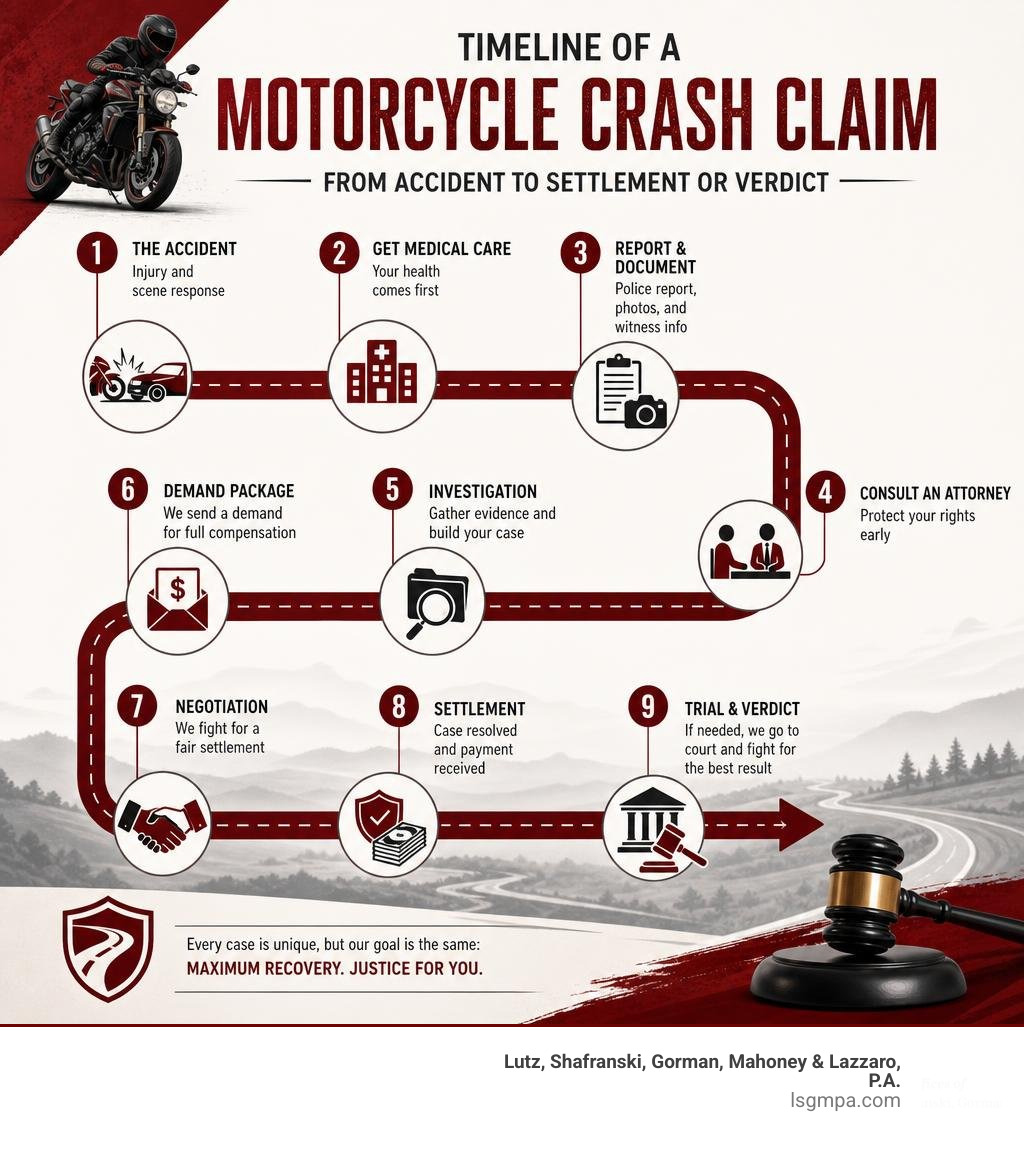
The timeline of a motorcycle crash claim varies depending on the complexity of your case:
A serious motorcycle accident can change your life in a fraction of a second. As your medical bills pile up and you miss time from work, the stress can feel unmanageable. You do not have to fight this battle alone.
At Lutz, Shafranski, Gorman, Mahoney & Lazzaro, P.A., we have spent decades fighting for injured riders in New Brunswick, Milltown, Perth Amboy, and throughout New Jersey. We understand the unique physics of motorcycle crashes, the complex insurance laws that govern them, and the unfair biases that riders face from insurance adjusters.
We handle all personal injury claims on a contingency fee basis. This means you pay absolutely nothing upfront, and we do not get paid unless we successfully recover compensation for you.
If you or a loved one has been injured, contact us today for a free, confidential consultation. Let our experienced New Brunswick Motorcycle Accident Lawyers handle the legal burden so you can focus on what matters most: your recovery and getting back on the road.