

 Call Us Today (732) 249-0444
 July 4, 2026

If you were hurt in a bus crash in New York City, finding a manhattan bus accident lawyer quickly is one of the most important steps you can take to protect your rights.
Here’s what you need to know right away:
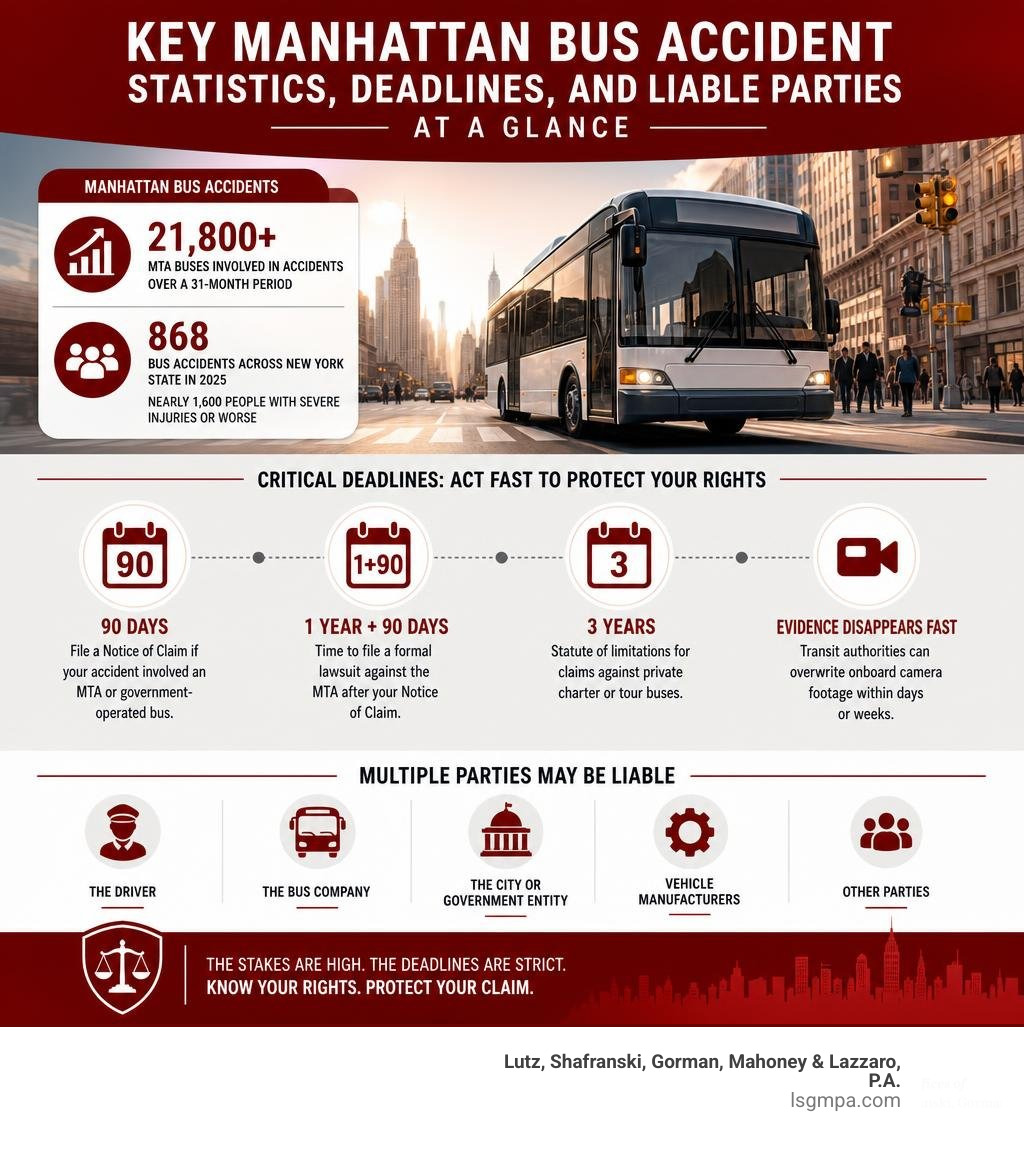
Bus accidents in Manhattan are not routine injury cases. NYC Transit operates more than 5,700 buses daily, carrying millions of riders through some of the most congested streets in the world. MTA buses alone were involved in more than 21,800 accidents over a 31-month period — that’s roughly 23 crashes every single day. In 2025, there were approximately 868 bus accidents across New York State, leaving nearly 1,600 people with severe injuries or worse.
The stakes are high, the deadlines are strict, and the legal rules are complex — especially when a government agency is involved.
I’m Frank Lazzaro, a New Jersey Supreme Court Certified Civil Trial Attorney with a record of multi-million dollar verdicts and settlements in serious personal injury cases, including those involving large commercial vehicles and public entities — the same skills that matter most in a manhattan bus accident lawyer engagement. If you or a loved one was injured in a Manhattan bus crash, this guide will walk you through everything you need to know to protect your claim.
Manhattan’s streets are a masterclass in organized chaos. Gridlocked traffic, darting delivery cyclists, thousands of pedestrians, and massive double-decker tour buses all share the same narrow asphalt. When you throw a 50,000-pound MTA bus into this mix, the potential for a catastrophic collision sky-rockets.
Because of their sheer size and weight, buses cannot stop on a dime. They require significantly longer braking distances than passenger cars, have massive blind spots (often called “no-zones”), and are prone to tipping or rolling over if a driver makes an abrupt maneuver. For commuters traveling from New Jersey transit hubs like Perth Amboy or New Brunswick into the Port Authority Bus Terminal, a collision on the Manhattan side can instantly derail their lives.
When these crashes occur, understanding how an experienced bus accident lawyer investigates the scene is critical. Proving fault requires looking past the immediate crash scene and digging into transit schedules, driver logs, and fleet maintenance records.
In our decades of handling personal injury claims, we have found that most bus accidents fall into a few distinct scenarios. Each of these situations presents unique challenges when it comes to proving liability:
One of the first questions we ask when evaluating a bus accident claim is: Who operated the bus?
Under New York law, buses are classified as common carriers. This means they are legally held to a higher duty of care than standard passenger vehicle drivers. They are responsible for transporting passengers safely and must exercise the utmost diligence to avoid injuries. However, how we pursue compensation depends entirely on whether the bus is publicly operated (like the MTA) or privately owned (such as a charter, tour, or commuter coach).
If you are a New Jersey resident commuting from New Brunswick or Milltown and get hit by a private charter bus, the rules of private commercial insurance apply. Private companies typically carry high-limit commercial liability policies, but their insurance adjusters are notoriously aggressive in trying to minimize payouts.
Alternatively, if you are injured by a public entity, you must navigate a minefield of government immunity rules and strict administrative procedures. Furthermore, New York follows a rule of pure comparative negligence (CPLR Section 1411). This means that even if you were partially at fault for the accident, you can still recover damages, though your final compensation will be reduced by your percentage of fault.
| Feature | Public MTA / Municipal Buses | Private Charter / Tour / Commuter Buses |
|---|---|---|
| Primary Defendant | New York City Transit Authority (NYCTA) / MTA | Private Bus Company (e.g., Greyhound, Coach USA, Tour Operators) |
| Notice of Claim Required? | Yes, must be filed within 90 days | No, standard civil lawsuit procedures apply |
| Time Limit to File Lawsuit | 1 year and 90 days from the accident date | 3 years from the accident date |
| Insurance Coverage | Self-insured / Government-funded | Commercial liability insurance policies |
| Standard of Care | Common Carrier (Heightened duty of care) | Common Carrier (Heightened duty of care) |
Identifying the correct operator is not always simple. For example, if you are injured in a collision involving a regional transit bus near Perth Amboy, you might need a Perth Amboy bus accident lawyer to sort out whether New Jersey Transit, the MTA, or a private contractor is the legally responsible party.
Proving negligence in a bus accident case requires a deep dive into commercial vehicle regulations and physical evidence. Because transit authorities and private bus companies immediately send their own investigators to the scene of a crash, victims are at an immediate disadvantage unless they have an experienced legal team fighting for them.
To build a winning case, we gather and analyze several key pieces of evidence:
If your accident involved an MTA bus, a school bus run by a public school district, or any other government-operated vehicle, you cannot simply file a lawsuit when you feel like it. You must first comply with strict statutory notice requirements.
Under New York General Municipal Law § 50-e and Public Authorities Law § 1212, you must file a formal Notice of Claim within 90 days of the accident.

This document alerts the government agency that you intend to sue and gives them an opportunity to investigate your claim. If you miss this 90-day window, your case is almost certainly over before it even begins.
Once the Notice of Claim is filed, you must wait at least 30 days to allow the agency to conduct a hearing (known as a 50-h hearing) where they can question you under oath about your injuries. Only after satisfying these requirements can you file a formal personal injury lawsuit, which must be initiated within 1 year and 90 days of the date of the accident.
These compressed timelines make it critical to consult a professional as soon as possible. Whether you are dealing with an accident in New York City or a regional transit issue, acting quickly is the only way to preserve your right to compensation. For accidents occurring just outside the city, consulting a specialized bus accident lawyer can help clarify which state and municipal rules apply to your specific claim.
The physical and financial toll of a bus accident can be overwhelming. Victims often face months of medical treatment, a complete loss of income, and severe emotional trauma. In New York, injured victims have the right to pursue both economic and non-economic damages to make themselves whole again.
These damages are designed to cover the direct out-of-pocket expenses caused by your injuries:
These damages compensate you for the intangible impact of the accident on your quality of life:
In the most tragic cases where a bus accident results in a loss of life, the victim’s family can file a wrongful death claim. Securing experienced representation from a New Brunswick Wrongful Death Lawyer is vital to help families recover compensation for funeral costs, lost financial support, and the loss of companionship.
You should not try to handle a bus accident claim on your own, nor should you hand it over to a general practice attorney who occasionally handles simple car insurance claims. Bus accidents involve an intricate web of state and federal regulations, municipal codes, and aggressive corporate defense teams.
At Lutz, Shafranski, Gorman, Mahoney & Lazzaro, P.A., we provide the comprehensive, trial-ready advocacy required to take on public transit authorities and large commercial carriers. We handle every aspect of your case so you can focus on healing:
If you are a New Jersey commuter or resident who was injured in a transit crash, our team at Lutz, Shafranski, Gorman, Mahoney & Lazzaro, P.A. is ready to stand by your side. You can explore our dedicated resources for transit victims, including our New Brunswick Bus Accident Lawyer page, to learn more about how we fight for the injured.
Your first priority must always be safety. Call 911 immediately to report the crash and request medical assistance. Even if you feel fine, get a comprehensive medical evaluation; the adrenaline of a crash can easily mask serious injuries like internal bleeding or concussions.
If you are physically able, take photos of the bus, the surrounding traffic conditions, any other vehicles involved, and your visible injuries. Collect contact information from other passengers and eyewitnesses on the street. Finally, do not sign any papers or give recorded statements to insurance adjusters or transit authority representatives until you have spoken with a lawyer.
Yes, absolutely. Under the common carrier standard, bus operators have a legal duty to provide a safe ride. If a driver accelerates too quickly or slams on the brakes with excessive, violent force—throwing you from your seat or causing you to fall—you have a valid claim for negligence. To win these cases, we gather onboard video footage, bus telemetry data, and witness statements to prove the driver’s actions were unreasonable under the circumstances.
New York operates under a pure comparative negligence rule (CPLR Section 1411). This means you can still recover compensation even if you are determined to be partially responsible for the accident.
For example, if a jury determines that your total damages are $100,000, but finds that you were 20% at fault for the crash (perhaps because you were distracted while crossing the street), your final compensation award will be reduced by 20%, leaving you with $80,000. Our job is to build a robust case that minimizes your percentage of fault to maximize your financial recovery.
A bus accident can turn your life upside down in an instant, leaving you with physical pain, mounting medical bills, and immense stress. Navigating the legal gridlock of municipal claims and commercial insurance policies is not something you should do alone.

At Lutz, Shafranski, Gorman, Mahoney & Lazzaro, P.A., we have spent decades helping injury victims throughout New Jersey, including New Brunswick, Milltown, and Perth Amboy, secure the justice and compensation they deserve. If you were injured in a transit crash, contact our New Brunswick Bus Accident Lawyer team today for a free, no-obligation consultation, and let us help you get your life back on track.