

 Call Us Today (732) 249-0444
 October 14, 2026

Workers’ comp settlement lawyers help injured workers get fair compensation after a workplace injury — without having to fight the insurance company alone.
Here’s a quick answer to what they do and when you need one:
Workers’ compensation was originally designed to be a straightforward, no-fault system. But decades of legal changes have made it anything but simple. Today, insurance companies show up to every hearing with experienced attorneys. Unrepresented workers often find themselves negotiating alone against professionals whose job is to pay out as little as possible.
The decisions you make during a workers’ comp case can affect you for the rest of your life — which is exactly why having the right lawyer in your corner matters.
I’m Frank Lazzaro, a Certified Civil Trial Attorney recognized by the Supreme Court of New Jersey, with a track record of multi-million dollar recoveries for injured clients — including workers navigating the complex world of workers’ comp settlement lawyers and insurance disputes. In this guide, I’ll walk you through everything you need to know to protect your rights and your financial future.
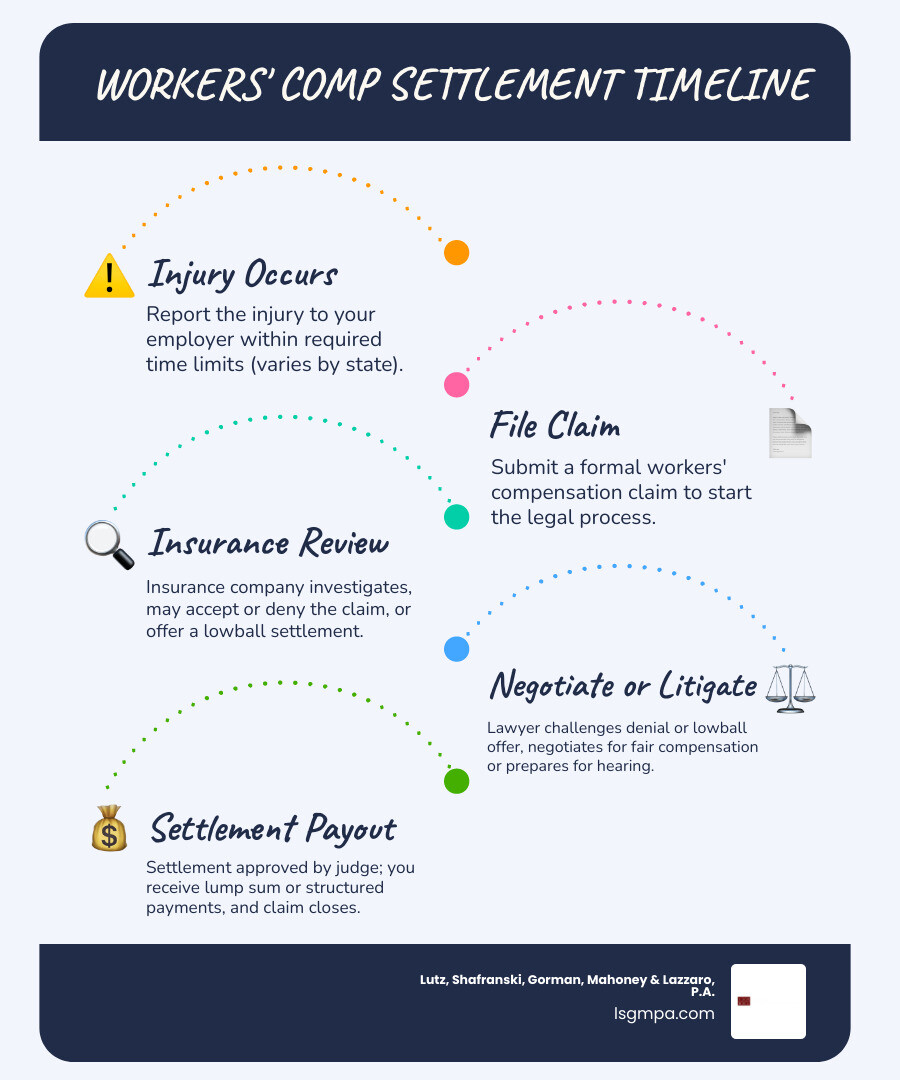
A workers’ compensation settlement is a voluntary agreement between you (the injured worker) and your employer’s insurance company. In exchange for a sum of money—paid either as a single check or structured over time—you agree to resolve some or all of your workers’ comp claims.
Once a settlement is finalized and approved by a judge, it represents a major turning point in your recovery process. Depending on how the agreement is structured, it may close your claim entirely, meaning the insurance company is no longer responsible for your medical bills, lost wages, or any future complications arising from the injury.
In New Jersey, settlements do not happen automatically. You cannot be forced to settle, and you cannot force the insurance company to settle either. Instead, both parties must negotiate terms that make sense for your physical recovery and financial stability.
To help you understand the two primary paths for settling a case in New Jersey, we have outlined the core differences between the two main statutory methods below:
| Feature | Section 20 Settlement (Compromise & Release equivalent) | Section 22 Settlement (Stipulated Award equivalent) |
|---|---|---|
| Primary Use | Used when liability, causation, or dependency are disputed by the insurer. | Used when the insurer accepts the claim but disagrees on the extent of permanent disability. |
| Future Medical Rights | Completely closed. You are responsible for all future medical care. | Can remain open. You can request additional treatment if your condition worsens. |
| Right to Reopen Case | No. This is a final, absolute closure of the claim. | Yes. You have up to two years from the last payment to reopen the case if your condition degrades. |
| Payment Structure | One lump-sum payment. | Paid weekly or as a lump sum representing accrued back-payments. |
While other states use terms like “Compromise and Release” or “Stipulated Award,” New Jersey law handles these concepts through specific statutory mechanisms known as Section 20 and Section 22 settlements.
A Section 20 settlement is New Jersey’s version of a Compromise and Release. It is a full and final buyout of your claim. It is only allowed when there is a genuine dispute over whether your injury was work-related, the extent of your employer’s liability, or if the claim was filed on time. Because it represents a total release of liability, you receive a lump sum, but you surrender all rights to future medical treatment and weekly disability benefits for this injury.
A Section 22 settlement (officially called an Order Approving Settlement) functions like a Stipulated Award. Here, the insurance company admits the injury is work-related and agrees that you have a specific percentage of permanent partial disability. You receive a financial award based on New Jersey’s disability schedules, but your medical benefits for the injury remain active, and you retain the right to reopen your case if your physical condition gets worse.
If you choose a full buyout of your claim, you must decide how you want to receive your funds. Workers’ comp settlement lawyers often help clients weigh the pros and cons of immediate cash versus long-term security.
You do not always need a lawyer for a minor workplace injury that heals quickly with basic medical care. However, when insurance companies begin protecting their profit margins at the expense of your health, hiring specialized workers’ comp settlement lawyers becomes essential.
You should strongly consider consulting an attorney if you experience any of the following red flags:
Insurance adjusters are trained professionals whose primary goal is to settle your claim for as little as possible. Common tactics they use to devalue your claim include:
If you have been injured on the job, you might also have questions about other types of accidents. For instance, if your workplace injury involved a vehicle, you may want to read our guide on Wrecked Car Why You Need an Automobile Property Damage Lawyer Now or learn more about The Ultimate Guide to Hiring an Accident Property Damage Lawyer. Similarly, if your injury occurred due to a dangerous condition on a property, understanding Why You Need a Slip and Fall Lawyer can help you protect your rights.
Workers’ compensation is a highly specialized field of law. General practice attorneys who occasionally handle traffic tickets or estate planning are rarely equipped to navigate the complex procedural rules of the New Jersey Division of Workers’ Compensation.
When searching for representation in New Brunswick, Milltown, or Perth Amboy, look for a firm with deep roots in local New Jersey court systems. An attorney who regularly appears before local workers’ compensation judges understands how those specific judges view permanent disability ratings and settlement structures.
Always check client reviews, ask about the attorney’s trial experience, and verify that they offer a free, no-obligation consultation to review your case.
Calculating the true value of a workers’ compensation claim is not a matter of guesswork. It is a highly structured mathematical process based on New Jersey statutory guidelines.
The baseline formula for permanent partial disability (PPD) in New Jersey relies on several key metrics:
While other states have their own calculation matrices, New Jersey relies strictly on its own unique statutory schedule. For example, New Jersey law values different body parts (such as a hand, an arm, or a leg) at a specific maximum number of weeks. If a doctor rates your arm injury at a 15% permanent impairment, you are entitled to 15% of the total weeks allocated to an arm, paid out at your statutory disability rate.
Several variables can dramatically alter the final value of your settlement:
If you are dealing with a complex recovery, you may also find our resource on How to Choose the Best Slip and Fall Personal Injury Attorney for Your Case helpful for understanding how to evaluate legal advocates.
It is generally highly risky to settle your case before you have reached Maximum Medical Improvement (MMI). Until your medical condition is stable, it is impossible to know if you will need future surgeries, regular injections, or permanent light-duty restrictions.
If you choose to settle your claim through a Section 20 lump sum while still needing treatment, you are taking on a massive medical risk. You must calculate the lifetime cost of your future medical care and ensure the settlement check is large enough to cover those bills out of pocket. If you underestimate these costs, you cannot go back to the insurance company for more money later.
If you are currently receiving Medicare or Social Security Disability Insurance (SSDI) benefits—or if you expect to apply for them in the near future—settling your workers’ comp claim requires extreme caution.
Federal law prohibits workers’ compensation settlements from shifting the burden of future medical care onto taxpayers. If you settle your workers’ comp claim and close out your medical benefits, Medicare will refuse to pay for any medical treatments related to your work injury until your settlement funds designated for medical care are entirely exhausted.
Furthermore, if your workers’ comp settlement is not structured correctly, it can trigger a “Social Security offset,” which slashes your monthly SSDI checks. Experienced workers’ comp settlement lawyers use specific legal language in settlement agreements to spread the lump sum over your lifetime, minimizing or completely eliminating this offset.
To protect Medicare’s interests, larger settlements often require a Medicare Set-Aside (MSA). An MSA is a financial allocation where a portion of your settlement is placed into a dedicated, interest-bearing trust account.
This money can only be used to pay for medical treatments and prescriptions related to your work injury that would normally be covered by Medicare. Once the MSA account is properly exhausted according to federal guidelines, Medicare steps in to cover your ongoing injury-related care. Failing to set up an MSA when required can result in Medicare denying your medical claims or revoking your eligibility entirely.
One of the most common reasons injured workers hesitate to hire workers’ comp settlement lawyers is the fear of legal bills. Fortunately, the workers’ compensation system is designed to be highly accessible to injured employees, regardless of their financial situation.
Workers’ compensation attorneys operate on a contingency fee basis. This means:
In New Jersey, no workers’ compensation settlement is valid or legally binding until it has been reviewed and approved by a Workers’ Compensation Judge. The judge’s role is to act as an independent safeguard, ensuring that the settlement is fair, mathematically accurate, and that you fully understand the rights you are giving up.
If you settle your case under a Section 22 Order Approving Settlement, you retain the right to reopen your claim within two years of receiving your final settlement payment. If your work-related injury worsens during this time, your attorney can file a formal application for modification, requesting additional medical treatment and increased disability compensation. However, if you settled via a Section 20 lump sum, your case is closed permanently and can never be reopened under any circumstances.
Do not panic, and do not sign anything. Reject the offer politely and contact a qualified workers’ comp attorney immediately. We will help you secure an independent medical examination from an objective physician to establish your true level of impairment, gather evidence of your lost wages, and negotiate directly with the insurer from a position of strength.
It depends entirely on how your case was settled. If you signed a Section 20 settlement, you cannot reopen your case under any circumstances. If your case was settled via a Section 22 Order Approving Settlement, you have exactly two years from the date of your last settlement check to file a petition to reopen your case due to a worsening of your condition.
Once both parties agree on a settlement figure, it typically takes 4 to 8 weeks to draft the formal paperwork, schedule a hearing before a New Jersey workers’ compensation judge, and secure judicial approval. After the judge signs the order, the insurance company is legally required to disburse your settlement check within a statutory timeframe, usually within several weeks.
Navigating the aftermath of a workplace injury is physically exhausting and legally overwhelming. You do not have to battle insurance adjusters and corporate defense lawyers on your own.
At Lutz, Shafranski, Gorman, Mahoney & Lazzaro, P.A., we have spent decades providing comprehensive, aggressive advocacy for injured workers across New Jersey—including New Brunswick, Milltown, and Perth Amboy. We understand how the local court systems operate, and we know exactly how to counter the tactics insurance companies use to devalue your pain and suffering.
If you or a loved one is recovering from an on-the-job injury, you may also have rights regarding other accidents. For example, if your workplace injury involved a road accident, you can read our guide on Motorcycle Crash Claims Your Guide to Getting Back on the Road.
Let us handle the legal maze so you can focus on your recovery. Contact us today for a free, confidential consultation with an experienced New Brunswick Workers’ Compensation Lawyer to secure the financial future you deserve.