

 Call Us Today (732) 249-0444
 September 10, 2026

After an Uber or Lyft crash, protect your claim by getting medical care, calling police, saving screenshots of the ride and app details, taking photos, and avoiding recorded insurance statements until you understand your options. A New Brunswick rideshare accident lawyer can identify every available insurance policy, including the higher coverage that may apply when the driver had accepted a trip or was carrying a passenger.
Rideshare claims are not always like ordinary car accident claims. Under New Jersey law, a driver who is logged in but waiting for a request may have lower coverage limits. Once a ride is accepted or a passenger is being transported, the transportation network company must provide at least $1.5 million in coverage for injuries, death, and property damage. The driver’s app status, other drivers’ fault, and your own auto policy can all affect the claim.
I am Frank Lazzaro, a New Jersey Certified Civil Trial Attorney with experience obtaining substantial personal injury recoveries and trying complex injury cases. As a New Brunswick rideshare accident lawyer, I help injured people assess liability, preserve key evidence, and pursue fair compensation for medical bills, lost income, and pain and suffering.
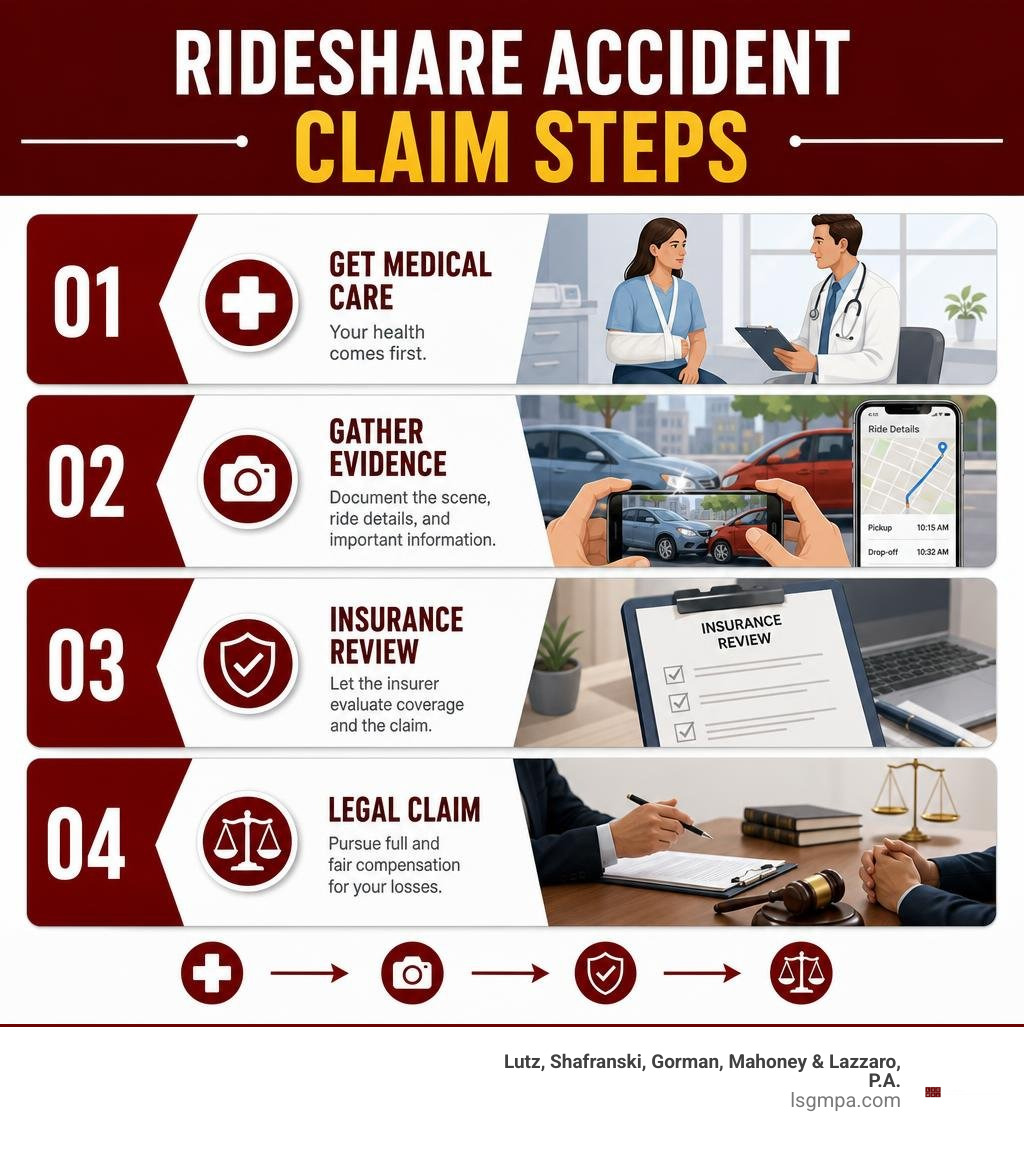
Simple new brunswick rideshare accident lawyer word guide:
Navigating the aftermath of a rideshare crash is distinctly different from dealing with a fender-bender between two everyday motorists. In New Jersey, rideshare services like Uber and Lyft are legally defined as Transportation Network Companies (TNCs). The statutory framework governing these services, specifically N.J.S.A. §39:5H-10, establishes mandatory insurance requirements that change dynamically based on what the driver was doing on the digital platform at the precise millisecond of the crash.
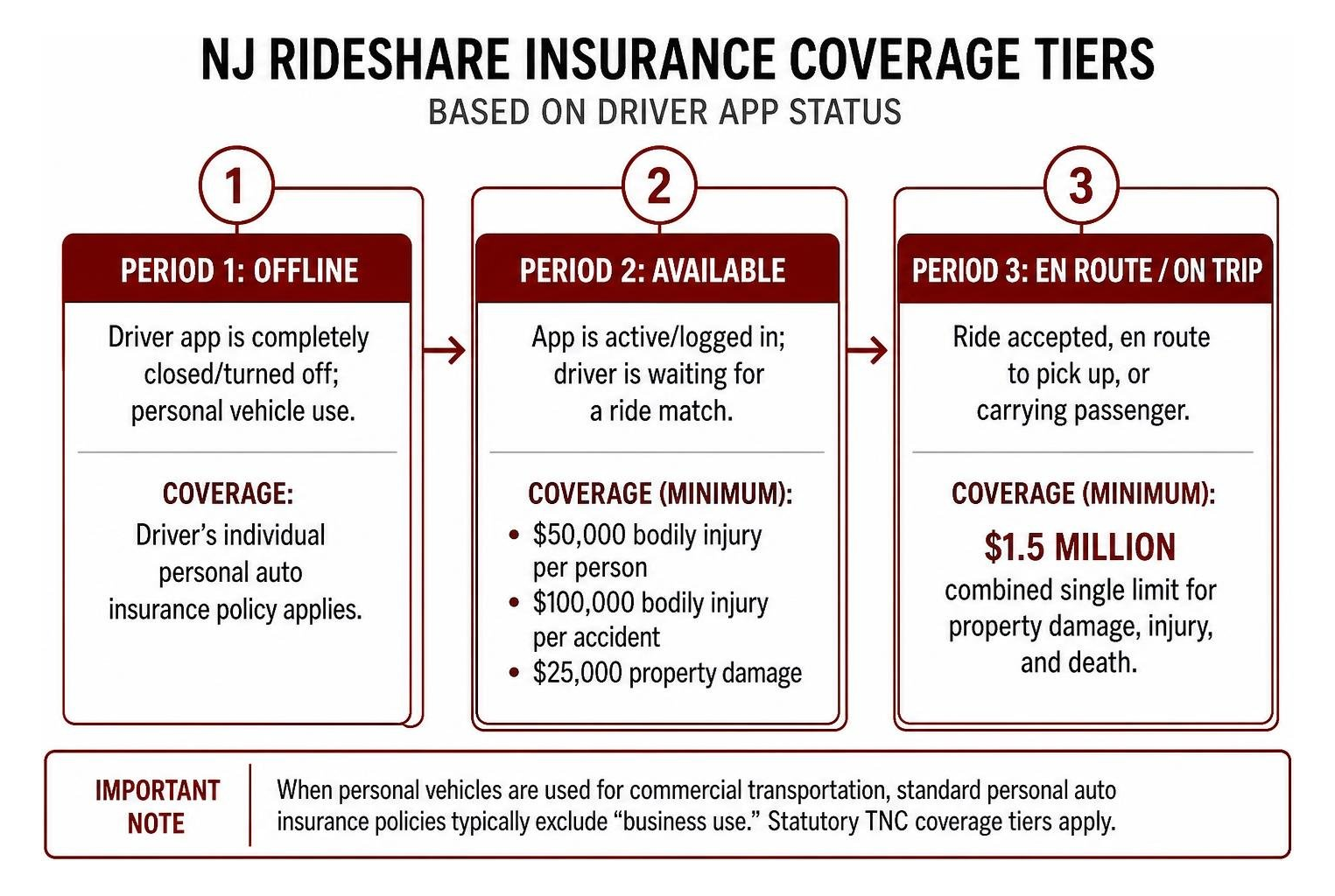
Understanding how these policy tiers activate is essential for recovering compensation. When personal vehicles are used for commercial transportation, standard personal auto insurance policies almost universally enforce a “business use” exclusion. If an app-based driver causes a wreck while working, their individual insurer will likely deny the claim outright. That is where statutory TNC coverage tiers step in.
| Driver App Status | Description | Minimum Statutory Insurance Coverage |
|---|---|---|
| Period 1: Offline | Driver app is completely closed/turned off; personal vehicle use. | Driver’s individual personal auto insurance policy applies. |
| Period 2: Available | App is active/logged in; driver is waiting for a ride match. | $50,000 bodily injury per person $100,000 bodily injury per accident $25,000 property damage |
| Period 3: En Route / On Trip | Ride accepted, en route to pick up, or carrying passenger. | $1.5 million combined single limit for property damage, injury, and death |
Let us take a closer look at these distinct coverage phases:
It is common to confuse rideshare vehicles with traditional municipal taxi cabs, but under New Jersey law, they operate under entirely separate legal doctrines. Under N.J.S.A. §39:5H-2, traditional taxis, limousines, and livery vehicles are explicitly excluded from the definition of a Transportation Network Company.
Traditional taxicabs are governed by local municipal ordinances (such as those established by the City of New Brunswick) and state commercial carrier statutes. Rather than using an app-based, three-tier dynamic coverage model, taxi owners must maintain continuous commercial automobile insurance policies.
Liability claims against a taxi service can involve:
Because taxi companies do not utilize the $1.5 million statutory TNC umbrella, resolving an injury claim after a taxi collision requires a different investigative strategy focused on fleet maintenance logs, municipal licensing compliance, and commercial auto carrier limits.
The moments directly following a collision can be disorienting, especially when you are sitting in the back of a vehicle operated by a stranger. Taking structured, deliberate actions will help protect your health and legal rights.
Rideshare vehicles travel countless miles across bustling Middlesex County corridors every day, making them vulnerable to erratic or hit-and-run drivers. When a rideshare vehicle is struck by a motorist who flees the scene, navigating the subsequent claim involves intricate uninsured motorist (UM) mechanics.
Under N.J.S.A. §39:5H-10, if an app-based vehicle is in Period 3 (carrying a passenger or en route) and becomes the victim of a phantom vehicle or hit-and-run, the TNC’s $1.5 million UM/UIM policy steps in to provide coverage for injured occupants. However, accessing these benefits requires adhering to strict evidentiary burdens and prompt notice requirements. For a thorough review of managing phantom vehicle incidents, explore Left In The Dust Why You Need A Hit And Run Accident Lawyer to understand how statutory UM benefits are triggered.
To secure fair compensation after a crash, you must establish liability under New Jersey’s comparative negligence laws. Rideshare collisions often feature multiple potentially liable parties:
When pursuing a personal injury claim in New Jersey, victims can recover economic and noneconomic damages:
Navigating the nuances of serious injury compensation is detailed further in A Practical Guide To Hiring A New Brunswick Injury Lawyer.
Proving liability in a TNC crash demands an aggressive, tech-forward investigation. Rideshare companies hold voluminous digital data logs that reveal exactly what occurred before, during, and after an impact.
Our legal team utilizes formal preservation letters and subpoenas to obtain:
TNC collision claims are inherently layered. Rather than dealing with a single adjuster, you are often thrown into a dispute involving a personal auto insurer, a multi-billion-dollar rideshare corporation, a third-party commercial claims administrator (such as Sedgwick or Progressive Commercial), and potentially other motorists’ carriers.
Each insurer has a primary financial incentive: minimize payout by deflecting fault onto someone else. The personal insurer will point to the TNC’s commercial policy; the TNC’s claims administrator will argue the driver was outside Period 3 or that another motorist shares comparative fault.
At Lutz, Shafranski, Gorman, Mahoney & Lazzaro, P.A., we manage every phase of the legal process. We handle all formal communications with adjusters, conduct deep investigations to preserve dynamic electronic data, coordinate with leading medical and economic experts, and construct a compelling case for trial or settlement negotiations.
You should reach out to an experienced attorney immediately if:
In most standard collisions, you do not sue Uber or Lyft directly as an employer under traditional respondeat superior doctrines because these companies classify their drivers as independent contractors rather than employees. However, New Jersey’s TNC law bypasses this hurdle by legally requiring the rideshare corporation to maintain a $1.5 million commercial liability policy that covers the driver’s negligence during Period 3.
Direct corporate lawsuits against Uber or Lyft are generally reserved for claims of direct corporate negligence, such as failing to perform mandatory background checks, knowingly hiring a driver with a suspended license, or failing to remove a driver with documented safety complaints.
If an at-fault rideshare driver was actively logged into the app, you do not have to rely solely on their personal auto policy. If they were waiting for a ride request (Period 2), the statutory TNC policy provides up to $50,000 per person and $100,000 per crash in bodily injury coverage. If they had accepted a fare or had you in the car (Period 3), the $1.5 million commercial policy serves as the primary coverage source, ensuring substantial financial protection regardless of the driver’s private policy limits.
Under New Jersey law (N.J.S.A. §2A:14-2), the statute of limitations for personal injury claims arising from a motor vehicle accident is two years from the date the injury occurred. If you fail to file a lawsuit in a court of competent jurisdiction within this two-year window, the court will dismiss your case, and you will lose all leverage to negotiate a settlement. If a public entity was involved (such as a collision with a New Jersey Transit bus or municipal vehicle), you must also file a formal Tort Claims Act notice within 90 days.
A rideshare accident can abruptly disrupt your life, leaving you with piling medical bills, lost income, and the stress of dealing with aggressive commercial insurance adjusters. You do not have to navigate this intricate legal terrain alone.
At Lutz, Shafranski, Gorman, Mahoney & Lazzaro, P.A., our attorneys bring decades of trial experience across New Brunswick, Edison, Perth Amboy, Woodbridge, Piscataway, East Brunswick, Sayreville, North Brunswick, and throughout Middlesex County. We are dedicated to holding negligent drivers and corporate insurers accountable so you can focus fully on your recovery.
If you or a loved one was injured in a rideshare crash, contact our office today to schedule a free, confidential case evaluation. Explore our extensive New Brunswick Legal Guidance and Injury Representation to learn how our dedicated team advocates for injury victims across our community.
