

 Call Us Today (732) 249-0444
 July 22, 2026

If you need a middletown drunk driving accident lawyer, here is what you should know right now:
Being hit by a drunk driver is not just a frightening moment — it can reshape your entire life. Medical bills pile up. You may miss weeks or months of work. The physical pain is real, and so is the emotional toll.
Drunk driving accidents are entirely preventable. Yet they keep happening. In Middletown, Connecticut alone, over 3,000 crashes involving more than 7,000 individuals occurred between 2020 and 2022 — with a significant stretch of those on Route 9. Across New York State, alcohol-related crashes account for more than 30% of all fatal car accidents. The numbers are sobering.
The good news? You have legal rights, and a skilled attorney can help you use them.
I’m Frank Lazzaro, a New Jersey Supreme Court Certified Civil Trial Attorney who has recovered millions of dollars for injury victims — including those hurt by drunk and impaired drivers — and I’ve been named to the Top 100 Lawyers list in New Jersey Super Lawyers Magazine. As a Middletown drunk driving accident lawyer serving injured New Jersey residents, I know exactly how to build a strong case against a negligent driver and the insurance companies protecting them.

When you are hurt in a motor vehicle collision in New Jersey, figuring out who pays for what can feel like trying to solve a Rubik’s Cube in the dark. New Jersey operates under a unique hybrid system of auto insurance laws. To successfully navigate this system, you need to understand how fault, Personal Injury Protection (PIP), and comparative negligence interact.
First, New Jersey is a “no-fault” insurance state when it comes to medical treatment. This means that regardless of who caused the collision, your own auto insurance policy’s Personal Injury Protection (PIP) coverage is responsible for paying your initial medical bills. However, PIP has limits, and it does not compensate you for physical pain, emotional trauma, or the full extent of your lost earning capacity.
To pursue the at-fault drunk driver for these “non-economic” damages, your injuries must typically meet a certain legal threshold (often called the “verbal threshold” or limitation on lawsuit option), which includes permanent injuries, significant scarring, or displaced fractures. Because drunk driving collisions frequently happen at high speeds, the resulting harm almost always clears this legal hurdle.
New Jersey also follows a modified comparative negligence rule. This means that if you are found partially to blame for the accident, your financial recovery will be reduced by your percentage of fault. For example, if a jury decides you were 10% at fault because you were slightly speeding, and the drunk driver was 90% at fault, your $100,000 award would be reduced to $90,000. If you are found to be 51% or more at fault, you cannot recover any damages at all under New Jersey law.
Drunk drivers and their insurance defense teams will often try to point the finger back at you to reduce their financial exposure. That is why having an experienced Middletown drunk driving accident lawyer on your side is critical. We protect you from unfair blame and establish clear liability.
Proving that a driver was under the influence of drugs or alcohol requires quick, thorough, and aggressive evidence collection. While a police officer’s arrest is a strong starting point, a civil injury claim requires its own independent portfolio of proof. We gather and utilize several types of evidence:
It is common to confuse the criminal prosecution of a drunk driver with a civil personal injury lawsuit. However, these are two entirely separate legal tracks that proceed independently of one another:
Because the civil burden of proof is much lower, we can often successfully recover compensation for you even if the driver is ultimately acquitted of their criminal DUI charges or if the charges are dismissed due to a technicality in the police procedures.
Additionally, under the legal doctrine of negligence per se, if a driver is convicted of a DUI in connection with your accident, that conviction can be used as automatic proof of negligence in your civil case. This leaves the insurance company with virtually no choice but to negotiate a fair settlement for your damages.

If you have been injured by an impaired driver, you have the right to pursue comprehensive compensation. In New Jersey, civil damages are divided into three main categories: economic damages, non-economic damages, and punitive damages.
| Damage Type | Description | Examples |
|---|---|---|
| Economic | Measurable financial losses | Emergency room bills, future surgeries, physical therapy, lost wages, loss of earning capacity, property damage |
| Non-Economic | Intangible, quality-of-life impacts | Physical pain and suffering, emotional distress, loss of enjoyment of life, loss of consortium, permanent scarring |
| Punitive | Punishment for gross negligence | Additional financial awards ordered by a court to penalize extreme intoxication or reckless behavior |
Drunk driving accidents are often violent, high-impact collisions. Because alcohol slows reaction times, impaired drivers rarely brake or swerve before impact, leading to catastrophic injuries. Some of the most common injuries we see in these cases include:
Insurance companies are in the business of saving money, not handing it out. If you try to negotiate with them alone, they will likely offer a lowball settlement that barely covers your immediate medical bills, let alone your future needs.
We maximize your settlement by exploring every possible avenue of financial recovery:
By investigating where the driver drank before getting behind the wheel, we can often secure additional compensation from these negligent third parties, which is especially vital if the drunk driver carries only minimal auto insurance coverage.
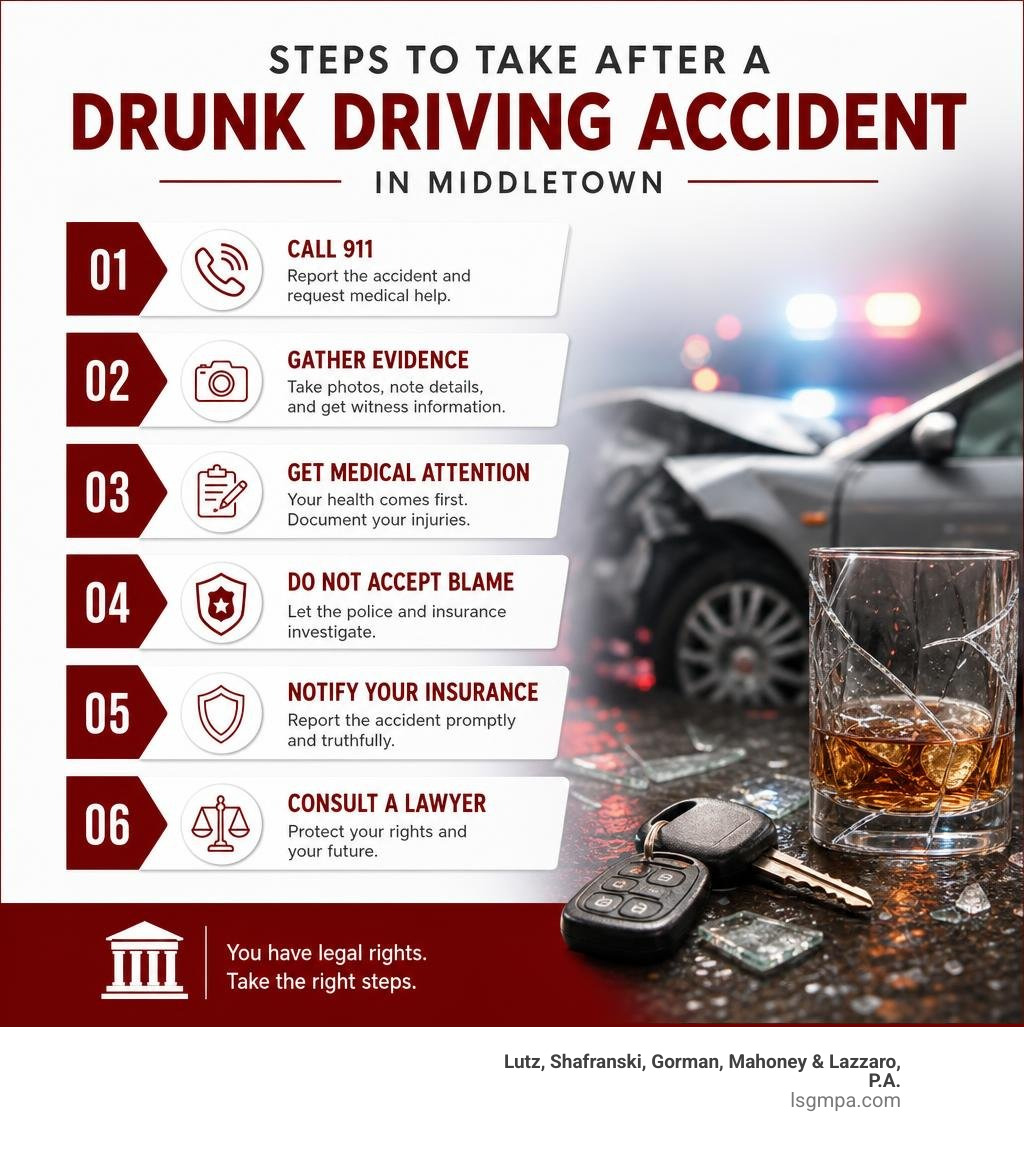
The hours and days following a crash are chaotic, but the steps you take during this window will directly impact your physical recovery and your legal claim.
If you are involved in a collision with a driver you suspect is under the influence, take the following actions to protect yourself:
You do not have unlimited time to seek justice. In New Jersey, the statute of limitations for personal injury claims is two years from the date of the accident. If you do not file a formal lawsuit within this two-year window, you will permanently lose your right to seek compensation.
If the drunk driving accident resulted in a tragic loss of life, the family has two years from the date of death to file a wrongful death claim. Securing experienced representation from a New Brunswick wrongful death lawyer as soon as possible ensures that critical evidence is preserved and your family’s legal rights are fully protected.
Yes. The civil court system operates independently of the criminal court system. A criminal conviction requires proof “beyond a reasonable doubt,” whereas a civil personal injury claim only requires a “preponderance of the evidence.” We can still build a powerful civil case using police records, witness testimony, and accident reconstruction experts even if the driver is acquitted or the criminal charges are dropped.
Insurance companies know that juries have zero sympathy for drunk drivers. Consequently, when liability is clear, they may try to settle your claim quickly before you realize the true, long-term costs of your injuries. Alternatively, they may try to drag out the process or argue that your injuries were pre-existing. Never accept an early settlement offer without having a Middletown drunk driving accident lawyer review it first.
Yes, under New Jersey’s dram shop and social host liability laws. If a commercial establishment (like a bar or restaurant) or a private host serves alcohol to an underage individual or someone who is visibly intoxicated, and that person subsequently causes a crash, the establishment or host can be held liable for your damages. This is a crucial source of recovery in cases involving catastrophic injuries and low-limit auto insurance policies.
A drunk driving accident is a traumatic event that can leave you facing physical pain, emotional distress, and overwhelming financial burdens. You do not have to walk this difficult road alone.
At Lutz, Shafranski, Gorman, Mahoney & Lazzaro, P.A., we provide compassionate, dedicated, and aggressive legal representation to injured victims throughout New Jersey. We handle every aspect of your legal claim—from investigating the crash and negotiating with insurance companies to filing a lawsuit and presenting your case to a jury—so you can focus entirely on your physical healing.
If you or a loved one has been injured by an impaired driver, contact us today for a free, no-obligation consultation. Let us fight to get you the justice and full financial compensation you deserve.
Schedule a consultation with a New Brunswick car accident lawyer today to protect your rights and start your journey toward recovery.