

 Call Us Today (732) 249-0444
 August 4, 2026

If you need a middletown car accident attorney, here are the most important steps to take right now:
A serious car accident on roads like Route 35 or Route 36 in Middletown, New Jersey can turn your life upside down in seconds. Medical bills pile up. You may miss work. And while you’re trying to recover, insurance adjusters are already working to minimize what they pay you.
New Jersey’s car accident laws are complex. The state runs a no-fault insurance system, which means the process for getting compensated is different here than in most other states. Knowing what to do — and what not to do — in the days after a crash can make a significant difference in your recovery, both physically and financially.
In 2023 alone, over five million people were treated in U.S. hospitals for motor vehicle injuries. In Monmouth County, crashes happen every day on busy commuter corridors and coastal access routes. The confusion and stress that follow a collision are real, and they are exactly what insurance companies count on.
I’m Frank Lazzaro, a Certified Civil Trial Attorney recognized by the Supreme Court of New Jersey, and I’ve spent my career helping injured New Jersey residents recover the compensation they deserve after car accidents — including those caused by negligent drivers in Middletown and throughout Monmouth County. As a Middletown car accident attorney, I’ve secured multiple six- and seven-figure verdicts and settlements for clients in situations just like yours, and I’ll walk you through exactly what you need to know.
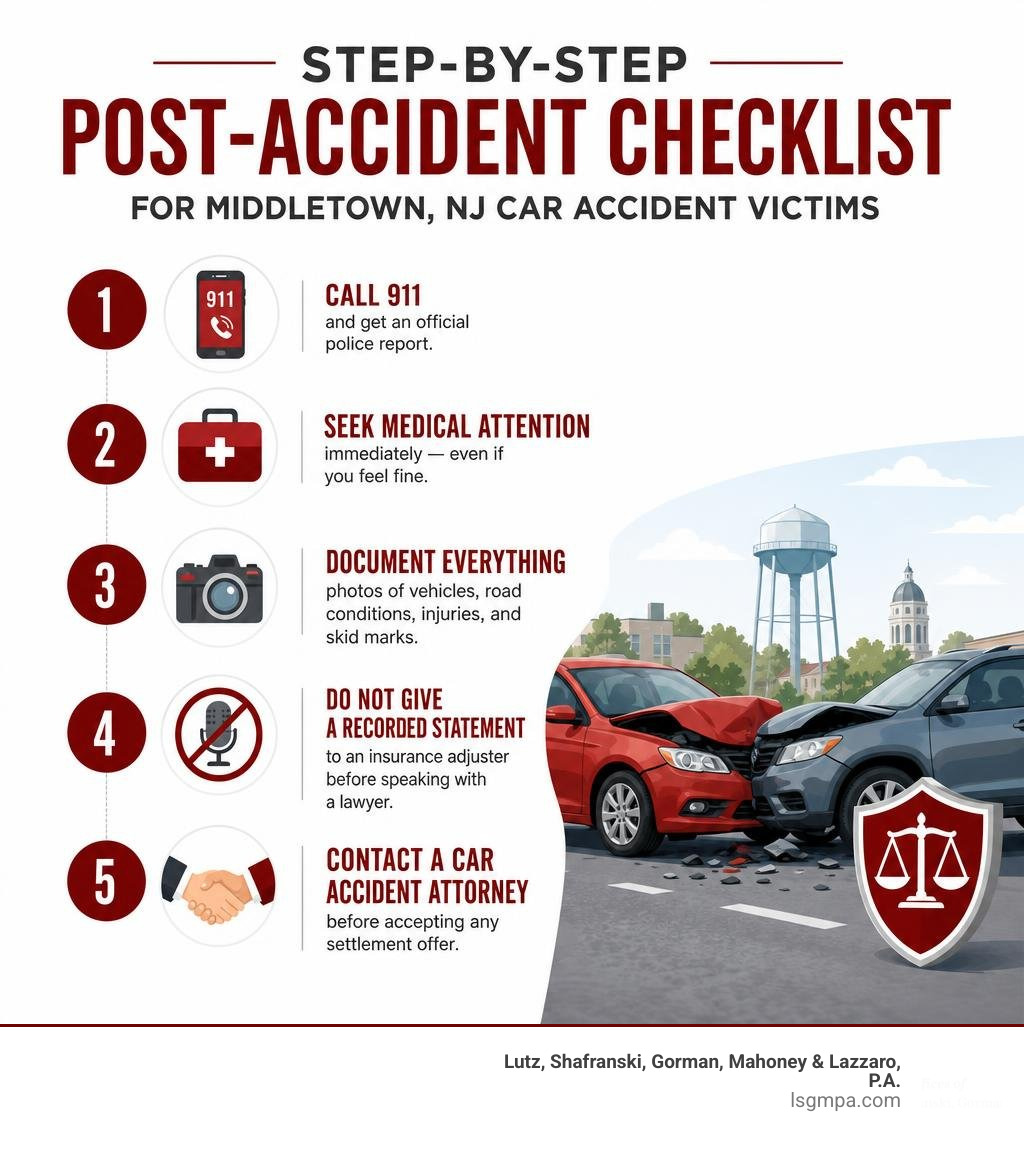
The moments immediately following a car accident are often a blur of shock, confusion, and flashing lights. However, the actions you take during this critical window lay the legal and medical foundation for any future personal injury claim.
First and foremost, you must call 911. Even if the other driver begs you to “handle it privately” or claims there is no real damage, do not skip this step. A law enforcement officer must come to the scene to document the incident and create an official police report. This report is a vital piece of evidence because it contains objective observations from an unbiased third party, details about traffic violations, and initial determinations of fault.
While you wait for the police to arrive, start collecting evidence if you are physically able to do so safely:
After the police clear the scene, your absolute priority must be a comprehensive medical evaluation. Many serious injuries, such as internal bleeding, soft tissue damage, whiplash, and concussions, do not show symptoms right away. Your body’s natural response to a crash is to flood your system with adrenaline and endorphins, which temporarily masks pain.
Delaying medical treatment not only puts your health at risk, but it also gives the insurance company a reason to claim your injuries were not caused by the accident. Seeking prompt care at a local emergency room or urgent care clinic establishes a direct, undeniable link between the collision and your medical condition.
If your vehicle was severely damaged, you will also need to deal with towing and storage issues. To protect your financial interests, check out this helpful guide on property damage claims to understand how to handle a wrecked vehicle.
New Jersey operates under a no-fault auto insurance system. This term is often misunderstood; it does not mean that no one is blamed for the accident. Instead, it means that regardless of who caused the crash, your own insurance policy covers your medical treatments through Personal Injury Protection (PIP) coverage.
PIP is designed to ensure that injured drivers and passengers get quick access to medical care without waiting for a lengthy legal battle to determine liability. However, PIP has limits, and it only covers economic losses like medical bills and some lost wages up to your policy’s cap. For a general consumer overview of New Jersey auto insurance coverage options, you can review information from the New Jersey Department of Banking and Insurance.
When you purchase car insurance in New Jersey, you must choose between two options regarding your right to sue: the Limitation on Lawsuit option, commonly called the verbal threshold, or the No Limitation on Lawsuit option.
If your policy includes the verbal threshold, you are legally barred from suing the at-fault driver for non-economic damages, such as pain and suffering, unless your injury falls into one of six specific categories defined by New Jersey law:
Proving that an injury is permanent requires objective medical evidence, such as MRIs, CT scans, or EMG testing, along with a formal certification from a licensed physician. Conditions like traumatic brain injuries (TBIs) and severe spinal damage often meet this threshold, but insurance companies will fight to argue that your injuries are temporary or pre-existing.
If you are taken to a local hospital like Riverview Medical Center in Red Bank or Jersey Shore University Medical Center, the medical records generated during your stay will serve as the cornerstone of your permanence proof. Navigating these complex medical-legal requirements is incredibly difficult on your own, which is why working with a skilled professional is so important.
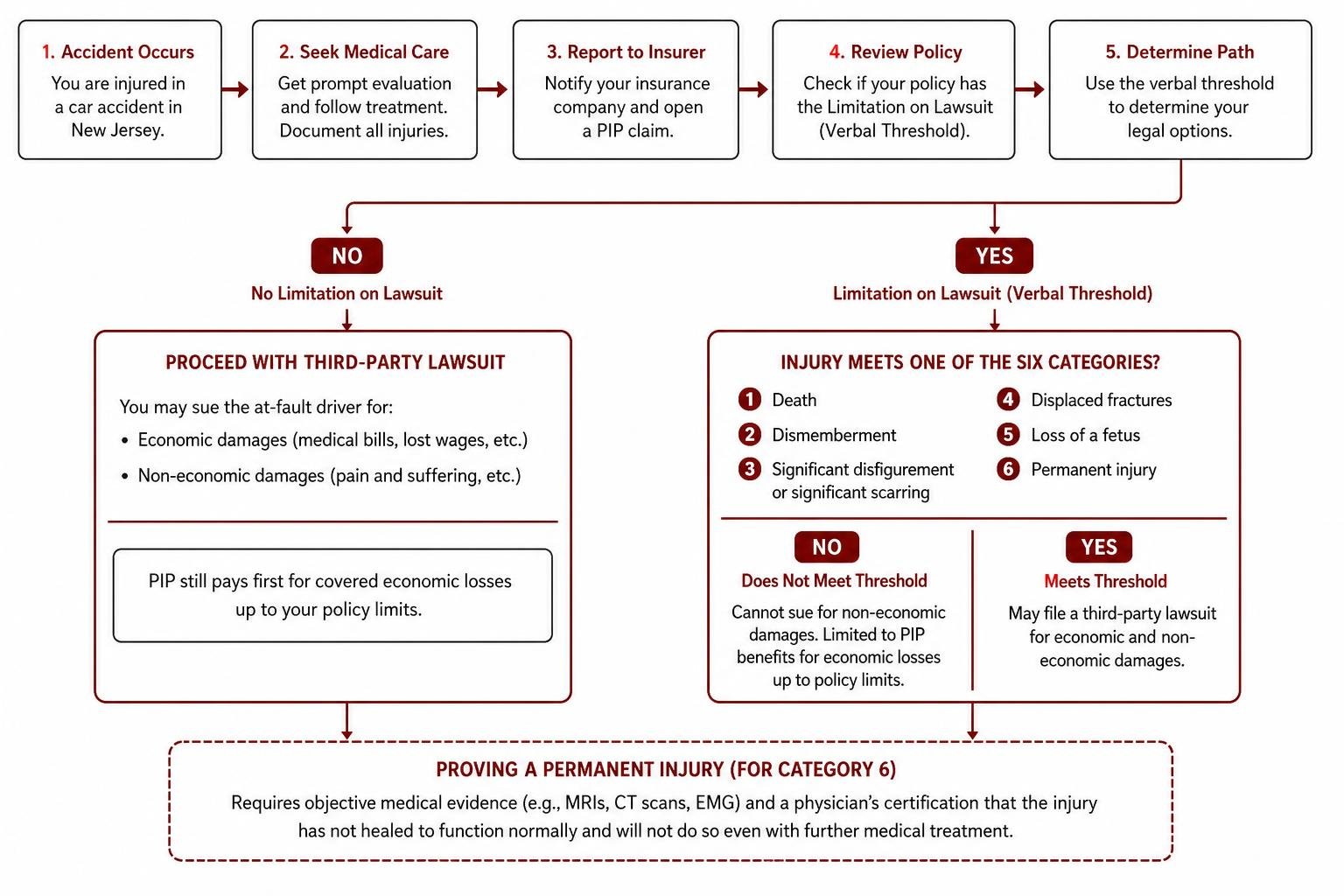
Understanding your legal options after a Middletown auto injury requires a careful analysis of your insurance policy, the severity of your injuries, and the specific facts of your crash.
Even though your own PIP insurance pays your initial medical bills, proving who was at fault is still critical if you want to recover compensation for outstanding medical expenses, lost wages, and pain and suffering from the negligent driver’s insurer.
Middletown is home to some of the busiest roads in Monmouth County. Commuters navigating Route 35, Route 36, and the access points to the Garden State Parkway deal with heavy congestion daily. This high-traffic environment is a breeding ground for negligent driving behaviors, including:
To secure a fair settlement, your legal team must prove that the other driver was negligent and that their negligence directly caused your injuries. We do this by conducting a thorough investigation. We collect and analyze police reports, obtain traffic camera footage, interview eyewitnesses, and review cell phone records to prove the driver was distracted at the moment of impact.
If you were hit by someone who was texting or using their phone, you have specific rights under state law. You can read more about distracted driving compensation rights to see how these claims are built and resolved.
Additionally, we work closely with accident reconstruction experts who can recreate the physics of the crash to demonstrate exactly how the other driver’s actions caused the collision. This level of preparation is essential for overcoming the standard defenses that insurance companies use to shift the blame onto you.
When you are injured in a car accident, the financial toll can be just as devastating as the physical pain. A successful personal injury claim can help you recover both economic and non-economic damages.
These are the tangible, easily calculable financial losses resulting from your accident:
These damages compensate you for the subjective, non-financial impacts of your injuries:
There is no such thing as an “average” settlement for a car accident in Middletown. The value of your claim depends entirely on the severity of your injuries, the clarity of liability, the amount of available insurance coverage, and how your injuries affect your daily life. An experienced middletown car accident attorney will carefully calculate the true value of your claim, ensuring that you do not accept a quick, lowball offer that fails to cover your long-term needs.
What happens if the driver who hit you has no insurance, or flees the scene of the accident? Fortunately, New Jersey law requires all standard auto insurance policies to include Uninsured/Underinsured Motorist (UM/UIM) coverage.
If you are involved in a hit-and-run or a collision with an uninsured driver, your UM coverage steps in to pay for your damages up to your policy limits. If the other driver has insurance but their policy limits are too low to cover your medical bills and lost wages, your UIM coverage can bridge the gap.
Another common hurdle in car accident claims is the concept of shared fault. The insurance company will almost certainly try to argue that you were partially responsible for the crash. New Jersey follows a modified comparative negligence system with a 50 percent threshold. This means you can still recover compensation as long as your share of the blame is not greater than 50 percent. However, your total financial recovery will be reduced by your percentage of fault.
To illustrate how this works, consider the following scenarios:
| Your Percentage of Fault | Total Damages Awarded | Your Final Compensation |
|---|---|---|
| 0% | $100,000 | $100,000 (Full recovery) |
| 10% (e.g., speeding slightly) | $100,000 | $90,000 (Reduced by 10%) |
| 40% (e.g., failing to signal) | $100,000 | $60,000 (Reduced by 40%) |
| 51% (e.g., majority fault) | $100,000 | $0 (No recovery allowed) |
Because even a small shift in the percentage of fault can cost you tens of thousands of dollars, having aggressive legal representation is vital. We know how to counter the insurance company’s attempts to unfairly shift the blame onto you.
If you are dealing with a complex claim involving both vehicle damage and bodily injury, you can learn more about hiring an accident property damage lawyer to protect your property rights while your injury claim is pending.
In New Jersey, the standard statute of limitations for personal injury claims is two years from the date of the accident. If you do not file a lawsuit within this two-year window, you will lose your legal right to pursue compensation forever.
However, there are critical exceptions. If your accident involved a vehicle owned or operated by a public entity (such as a NJ Transit bus, a county road crew, or a Middletown municipal vehicle), you must file a formal Notice of Claim within 90 days of the accident. Failing to meet this incredibly tight deadline can bar your claim entirely. This is why you should consult an attorney as soon as possible after a crash.
You should avoid saying anything that could be interpreted as admitting fault or minimizing your injuries. Insurance adjusters are trained professionals whose job is to save their company money. They may call you shortly after the crash, acting friendly and offering a quick settlement.
Do not apologize for the accident, do not agree to give a recorded statement, and do not sign any medical release forms without speaking to a lawyer first. Simply tell the adjuster that you are seeking medical treatment and that your middletown car accident attorney will handle all future communications.
If you sustained minor injuries that healed completely within a few days, you may be able to handle the insurance claim yourself. However, if you suffered severe injuries, missed work, have disputed liability, or are dealing with a permanent condition, you absolutely need an attorney.
Most personal injury lawyers, including our team, work on a contingency fee basis. This means there are no upfront costs, and we only get paid if we successfully recover compensation for you. Hiring a lawyer levels the playing field against powerful insurance companies and ensures you do not settle for a fraction of what your case is truly worth.
A car accident can disrupt your life, but you do not have to face the aftermath alone. At Lutz, Shafranski, Gorman, Mahoney & Lazzaro, P.A. (LSGMPA), we provide compassionate, comprehensive legal advocacy for serious injury claims. From managing medical bills and negotiating with insurance companies to fighting for your rights in court, we handle the heavy legal lifting so you can focus entirely on your recovery.
If you or a loved one was injured in a crash, we invite you to reach out to us today.
Contact LSGMPA today to Schedule a free consultation with a New Brunswick car accident lawyer and let us help you pursue the peace and justice you deserve.
