

 Call Us Today (732) 249-0444
 October 16, 2026

Compensation for burns depends heavily on how severe the injury is, how much of the body is affected, and whether it causes permanent scarring or disability. Here is a quick overview of typical settlement ranges:
| Burn Degree | Typical Settlement Range |
|---|---|
| First-degree | $5,000 – $25,000 |
| Second-degree (superficial) | $25,000 – $75,000 |
| Second-degree (deep) | $75,000 – $150,000 |
| Third-degree | $100,000 – $1,000,000+ |
| Fourth-degree | $500,000 – $10,000,000+ |
These are starting points, not guarantees. Your actual recovery depends on factors like medical costs, lost income, permanent scarring, and who was at fault.
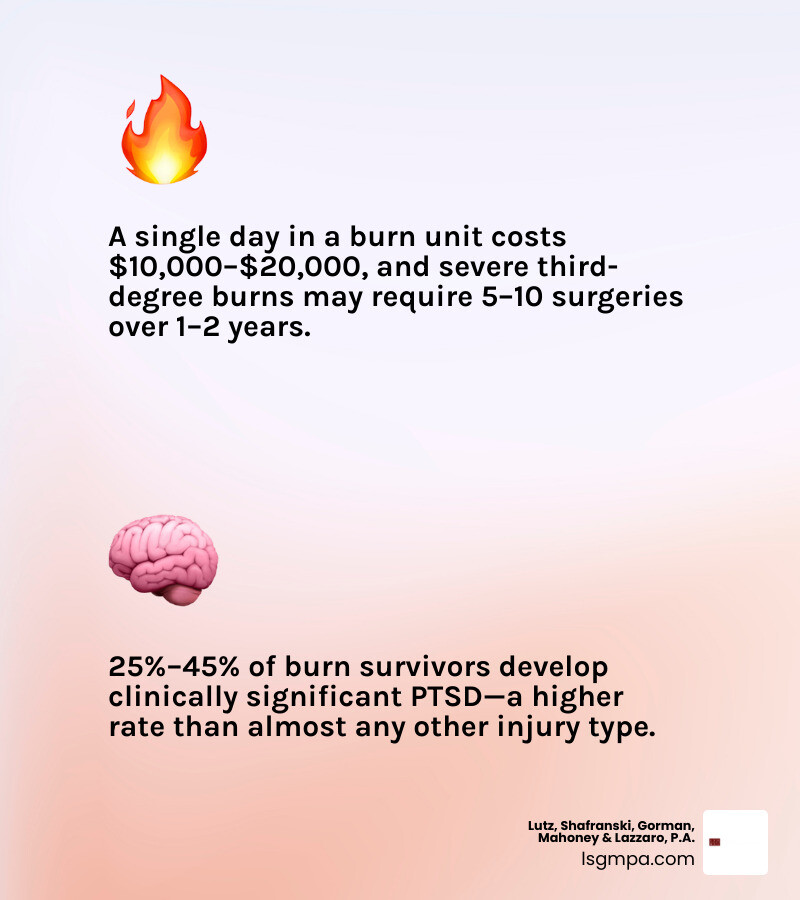
Burn injuries are among the most painful and costly injuries a person can suffer. A single day in a burn unit can cost $10,000 to $20,000. A serious third-degree burn may require five to ten surgeries over one to two years. And beyond the physical damage, 25% to 45% of burn survivors develop clinically significant PTSD — a higher rate than almost any other injury type.
If your burn was caused by some else’s negligence — a workplace accident, a defective product, a car fire, or a dangerous property — you have the right to pursue full compensation. But insurance companies have powerful resources designed to minimize what they pay you. Knowing what your claim is actually worth is the first step to protecting yourself.
I’m Frank Lazzaro, a Certified Civil Trial Attorney and one of roughly 2% of New Jersey attorneys to earn that designation from the Supreme Court of New Jersey, with a track record of multi-million-dollar recoveries for injured clients — including those seeking compensation for burns and other catastrophic injuries. In this guide, I’ll walk you through exactly how burn injury settlements are calculated so you can make informed decisions about your claim.
Evaluating a burn injury claim is far more complex than calculating the value of a typical personal injury case. Unlike a broken bone, which often heals cleanly within a predictable timeframe, a severe burn alters the patient’s physiology, carries a massive risk of life-threatening complications, and leaves permanent physical and psychological scars.
When we evaluate a burn injury case in New Jersey, we look closely at the underlying pathophysiology of the injury. According to the authoritative Clinical guide on thermal burn management, a thermal burn creates three distinct zones of tissue damage:
Because a burn is a dynamic, evolving wound, the initial medical assessment at an emergency room in New Brunswick or Perth Amboy may not reflect the ultimate severity of the injury. This is why we advise our clients never to accept an early insurance settlement. What looks like a minor partial-thickness burn on day one can easily degrade into a full-thickness wound requiring extensive skin grafts by week two.
The legal value of your claim is deeply tied to the medical classification of your burns. In New Jersey, insurance adjusters and juries use these classifications as a baseline to determine pain, suffering, and future medical needs. The Burn settlement value guide outlines how these degrees translate into financial compensation:
In personal injury law, visible scarring and disfigurement are among the most powerful drivers of high settlement values. This is especially true for burns that affect highly visible areas like the face, neck, hands, and forearms.
To quantify the physical severity of a scar, medical experts often use the Vancouver Scar Scale, which rates scars from 0 to 13 based on four characteristics:
However, a medical scale only tells half the story. The legal system recognizes that physical scars carry a heavy emotional and social burden. When a person’s appearance is permanently altered, they often experience severe psychological trauma, including social withdrawal, clinical depression, and loss of self-esteem.
The profound intersection of physical scarring and mental trauma was highlighted in a landmark Court of Appeal ruling on burn scarring and PTSD. The court noted that even when physical burn scars heal relatively well over time, the psychological scars — such as Post-Traumatic Stress Disorder (PTSD), severe depression, and secondary coping mechanisms (like substance abuse) — can persist for a lifetime. In many cases, the compensation awarded for the invisible, mental trauma of an explosion or fire can actually equal or exceed the damages awarded for the physical scars themselves.
Calculating the true value of a burn injury settlement requires a deep dive into both immediate medical expenses and the projected lifetime costs of recovery. Insurance companies will try to offer a quick payout that covers your initial hospital stay. However, they conveniently ignore the years of physical therapy, scar revision surgeries, and psychological support you will likely need.
To combat this, we work with medical experts, life care planners, and economic analysts to project every single dollar you will need to rebuild your life. You can also get an initial sense of your claim’s potential value by utilizing a specialized Burn injury settlement calculator, which helps visualize how different variables compound the overall value of a case.
One of the most critical factors in determining the value of a burn settlement is the Total Body Surface Area (TBSA) affected by the injury. Medical professionals calculate TBSA using the Rule of Nines, which divides the adult body into anatomical regions representing 9% (or multiples of 9%) of the total skin surface:
In the legal world, settlement values do not scale linearly with TBSA; they increase exponentially. A burn covering 5% TBSA is highly painful, but a burn covering 25% or more TBSA triggers a massive, systemic inflammatory response.
When a burn crosses the critical 20% TBSA threshold, capillaries throughout the entire body begin to leak fluid, leading to systemic hypotension, pulmonary edema, and potential multi-organ failure. The survivor will require massive fluid resuscitation (calculated using clinical formulas like the Parkland formula) and weeks in an intensive care burn unit. This level of systemic trauma dramatically drives up medical costs, pain and suffering, and ultimately, the final settlement value.
A comprehensive burn injury claim is split into two primary categories of damages: economic and non-economic.
These are the tangible, out-of-pocket expenses resulting from your injury. They are proven using bills, receipts, pay stubs, and expert financial projections:
These damages compensate you for the physical and emotional toll of the injury. While harder to quantify, they often make up the largest portion of a burn injury settlement:
If you have suffered a burn due to a dangerous property condition, such as a boiling water scald at a hotel or an apartment building fire caused by faulty wiring, understanding these damages is crucial. To learn more about how premises liability claims work, read our guide on why you need a slip and fall lawyer.
If you suffer a burn injury on the job in New Jersey, the legal path you take to secure compensation depends entirely on how the accident occurred. Workplace burns are incredibly common; in fact, work-related fires and explosions account for more than 5,000 burn injuries each year in the United States, and an estimated 42% of all work-related injuries are burns. Men suffer the vast majority (90%) of these reported work-related burn injuries, which are highly prevalent in industrial, manufacturing, construction, and food service sectors.
Under New Jersey law, if you are burned at work, your primary recourse is through the state’s workers’ compensation system. Workers’ comp is a “no-fault” system. This means you do not have to prove your employer did anything wrong to receive benefits. Even if the accident was partially your fault, you are still entitled to:
The major drawback of workers’ compensation is that it does not provide compensation for pain and suffering, emotional distress, or punitive damages. Additionally, you generally cannot sue your employer in civil court due to the “exclusive remedy” rule of workers’ compensation.
To ensure you are receiving the maximum benefits available under this system, it is highly recommended to seek professional representation. For more details on navigating these complex rules, see our article on how to choose the best slip and fall personal injury attorney for your case, which outlines the key qualities to look for in a local New Jersey injury lawyer.
While you cannot sue your employer, the exclusive remedy rule does not protect third parties whose negligence contributed to your injury. If an outside entity was responsible for your burn, you can file a third-party personal injury lawsuit alongside your workers’ compensation claim.
A third-party lawsuit allows you to pursue full, uncapped damages, including pain and suffering, mental anguish, and potentially punitive damages. Common examples of third-party liability in burn cases include:
To secure maximum compensation for burns in New Jersey, you must build an airtight case that proves the defendant’s negligence directly caused your injuries. Insurance companies will look for any excuse to shift the blame to you or downplay the severity of your physical and psychological trauma.
Proving a burn injury claim requires gathering and preserving critical physical, medical, and circumstantial evidence as quickly as possible after the accident. The most essential evidence includes:
New Jersey operates under a modified comparative negligence rule (specifically, the 51% bar). This means that as long as you are 50% or less at fault for the accident that caused your burns, you can still recover compensation. However, your final financial award will be reduced by your percentage of fault.
For example, if a jury determines your total damages are $500,000, but finds you were 20% at fault for the accident (perhaps because you ignored a warning sign), your final compensation will be reduced by 20%, leaving you with $400,000. If you are found to be 51% or more at fault, you are barred from recovering any compensation at all.
Additionally, New Jersey has a strict two-year statute of limitations for personal injury claims. With very few exceptions, if you do not file your lawsuit within two years of the date of the burn injury, you lose your right to pursue compensation forever.
Navigating these strict legal deadlines and comparative fault rules requires experienced legal counsel. To learn more about how to protect your rights after an accident, read the ultimate guide to hiring an accident property damage lawyer.
Because third-degree burns destroy the entire skin thickness and always require surgical intervention (such as debridement and split-thickness skin grafts), settlements are among the highest in personal injury law. Typical settlements range from $100,000 to over $1,000,000. The final value depends on the TBSA percentage, the location of the scarring (facial scarring settles for much higher amounts), and whether the victim experiences joint contractures or severe PTSD.
Yes, you can technically sue for a first-degree burn if it was caused by someone else’s negligence. However, because first-degree burns heal quickly and rarely generate substantial medical bills, pursuing them as a standalone lawsuit is usually not financially viable. Instead, first-degree burns are typically bundled with other physical or psychological injuries (such as orthopedic trauma or neck injuries from a car accident) to show the full scope of the accident.
In New Jersey, you have two years from the date of the burn injury to file a personal injury lawsuit. If you miss this deadline, the court will almost certainly dismiss your case, and you will lose your right to recover compensation. Because building a strong burn injury case requires extensive evidence collection and expert evaluations, it is critical to consult an attorney as soon as possible after your accident.
A severe burn injury can change your life in a fraction of a second, leaving you to face agonizing physical pain, overwhelming medical bills, and permanent emotional scars. You do not have to carry this heavy burden alone.
At Lutz, Shafranski, Gorman, Mahoney & Lazzaro, P.A., we have spent decades providing comprehensive advocacy for serious injury victims throughout New Jersey, including New Brunswick, Milltown, and Perth Amboy. We understand the complex medical and legal nuances of burn injury claims, and we are committed to fighting for the maximum compensation you deserve — covering everything from your immediate ICU bills to your long-term reconstructive surgeries and mental health support.
If you or a loved one has suffered a severe burn due to someone else’s negligence, contact us today for a free, compassionate, and confidential consultation. Let us handle the insurance companies so you can focus on your recovery.
Contact a New Jersey catastrophic injury lawyer at Lutz, Shafranski, Gorman, Mahoney & Lazzaro, P.A. today to discuss your rights and start your path to recovery.