

 Call Us Today (732) 249-0444
 October 8, 2026

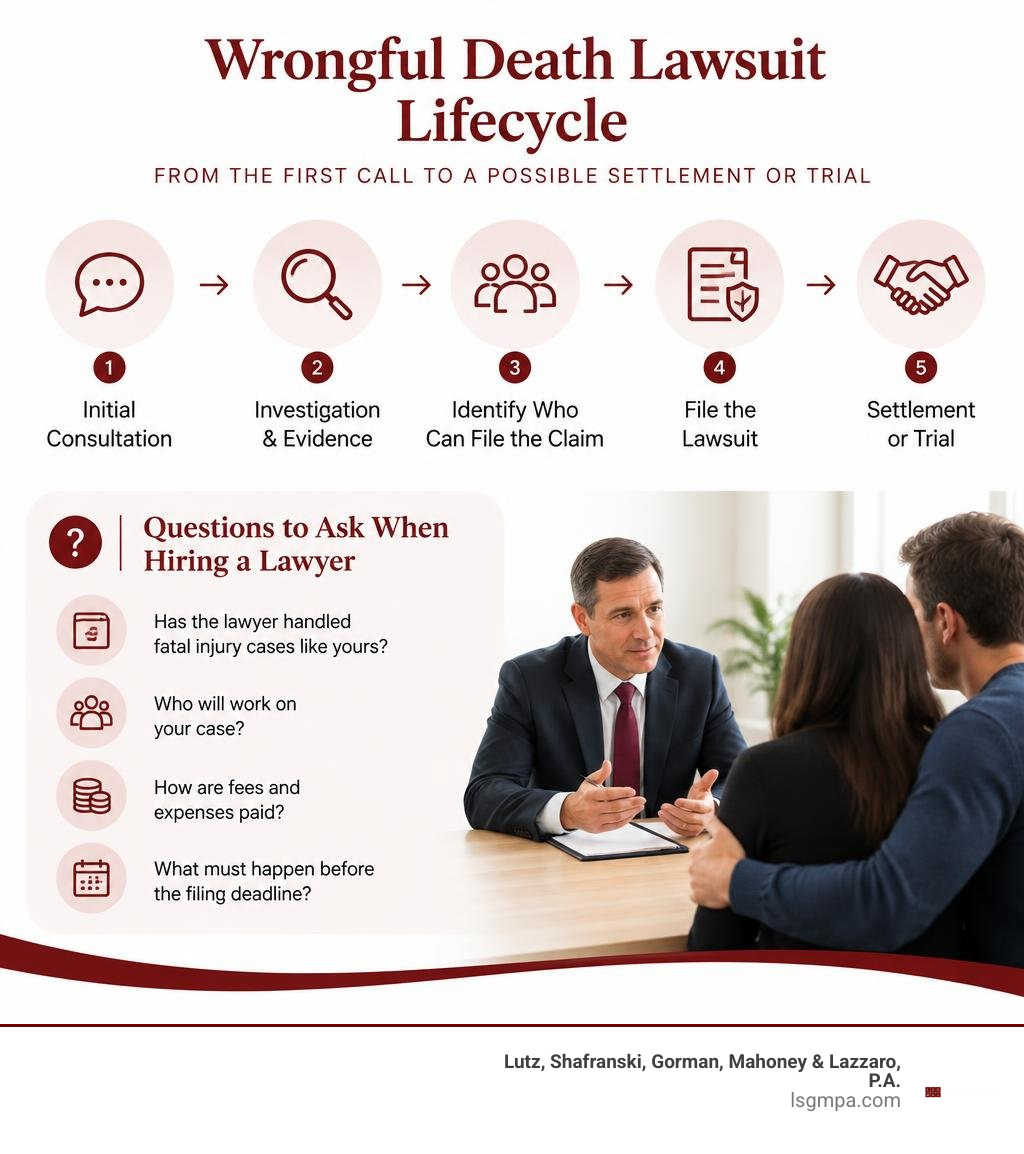
If you believe someone else’s actions caused your loved one’s death, speak with a wrongful death lawyer soon. Ask whether the lawyer has handled fatal injury cases like yours, who will work on your case, how fees and expenses are paid, and what must happen before the filing deadline. Bring any records you have, but don’t wait to call if you have none.
A lawyer can investigate what happened, identify who may file the claim, and seek compensation for the family’s losses. This guide explains what to expect, from the first consultation through a possible settlement or trial. For a broader overview of civil claims, the wrongful death claim entry provides useful background on how these actions work across jurisdictions.
I’m Frank Lazzaro, a wrongful death lawyer with Lutz, Shafranski, Gorman, Mahoney & Lazzaro, P.A., and a New Jersey Supreme Court Certified Civil Trial Attorney. My personal injury trial work has resulted in multiple six- and seven-figure verdicts; I’ll use that experience to help explain the questions worth asking as you choose counsel.
When a loved one is suddenly taken from you because another party acted recklessly or carelessly, the grief can feel paralyzing. Alongside the deep emotional trauma, families often face unexpected financial burdens, from sudden funeral bills to the loss of household income. Understanding your legal rights provides a path toward financial security and holds the responsible parties accountable.
In civil law, a wrongful death action arises when a person dies due to the legal fault of another person, corporation, or entity. Unlike criminal proceedings, which focus on penalizing an offender with jail time or fines paid to the state, a civil claim exists to compensate the surviving family members and the decedent’s estate for their measurable financial and personal losses. Learning what wrongful death lawsuit lawyers do helps clarify how an advocate takes on the legal and procedural burdens so your family can focus on healing.
To establish a wrongful death claim, we must demonstrate that the at-fault party’s conduct met the legal threshold of actionable civil negligence or intentional misconduct. Establishing liability requires proving four fundamental elements:
Legal standing dictates who has the formal right to bring a lawsuit before the court. In New Jersey, the law requires that a wrongful death lawsuit be brought by the decedent’s appointed personal representative (the executor named in a valid will, or an estate administrator appointed by the surrogate court if there is no will).
While the personal representative files the lawsuit, they do so on behalf of the statutory beneficiaries who suffered an actual financial loss from the death. Eligible beneficiaries typically include:
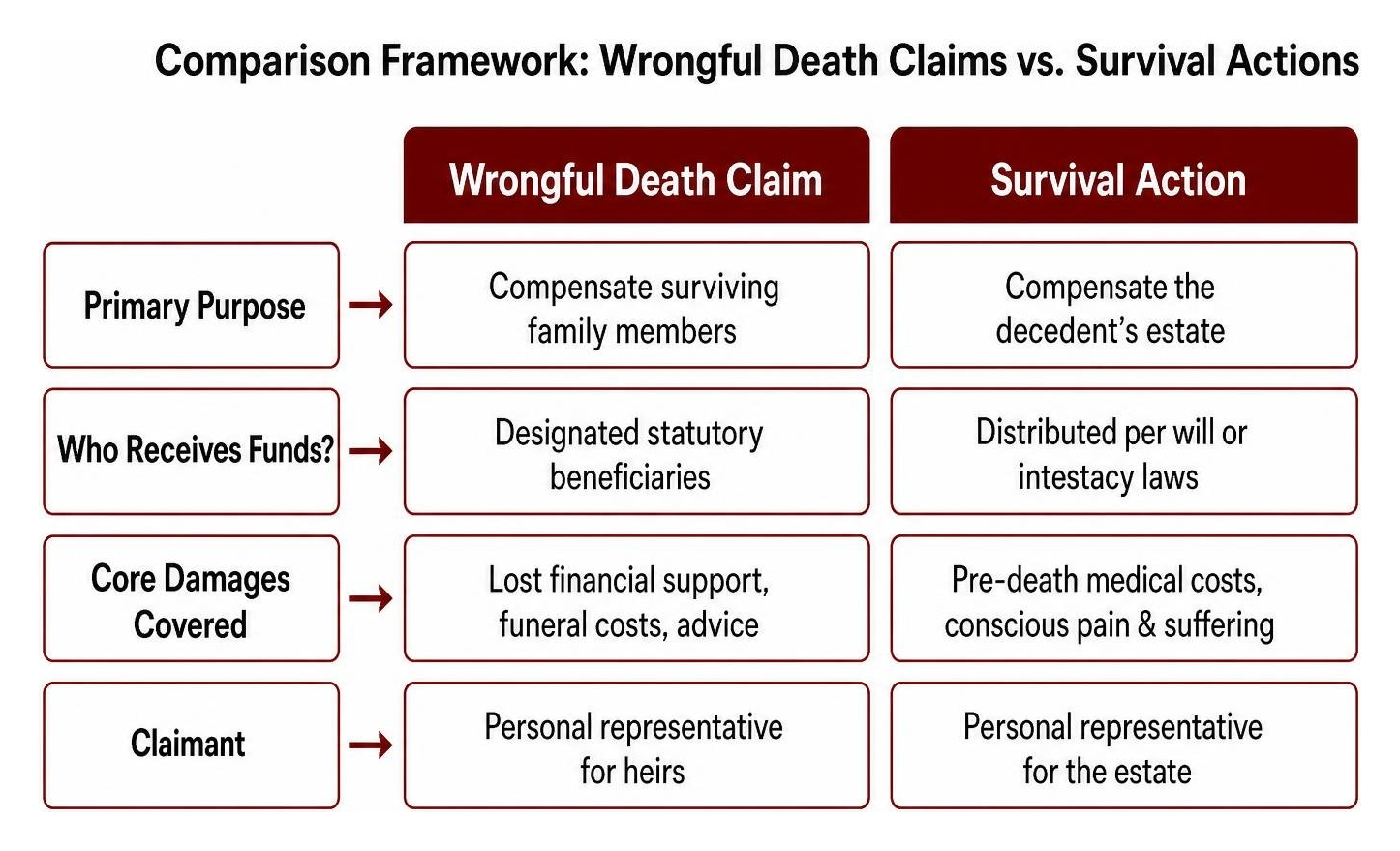
Many families assume that a single lawsuit covers every loss resulting from a tragedy. However, the law generally separates these matters into two distinct legal mechanisms: a wrongful death claim and a survival action.
| Feature | Wrongful Death Claim | Survival Action |
|---|---|---|
| Primary Purpose | Compensate surviving family members | Compensate the decedent’s estate |
| Who Receives Funds? | Designated statutory beneficiaries | Distributed per will or intestacy laws |
| Core Damages Covered | Lost financial support, funeral costs, advice | Pre-death medical costs, conscious pain & suffering |
| Claimant | Personal representative for heirs | Personal representative for the estate |
Fatal injuries happen across a broad spectrum of everyday settings. Determining liability requires a rigorous investigation of evidence, physical scenes, and corporate compliance records.
| Fatal Accident Category | Common At-Fault Parties | Key Evidence Analyzed |
|---|---|---|
| Motor Vehicle & Trucking | Negligent drivers, motor carriers, shippers | Telematics, dashcam, maintenance records |
| Medical Malpractice | Physicians, surgeons, hospital systems | Medical charts, audit logs, expert reviews |
| Workplace & Industrial | General contractors, equipment makers | OSHA reports, equipment logs, safety audits |
| Premises Liability | Property owners, property managers | Surveillance video, maintenance history |
High-speed roadways and congested corridors present significant hazards. Catastrophic highway collisions often involve tractor-trailers, commercial delivery vehicles, or impaired passenger car drivers. In these cases, liability often extends beyond the individual driver to commercial freight companies that violate Federal Motor Carrier Safety Administration (FMCSA) hours-of-service rules or neglect vehicle maintenance. Crash reconstruction engineers help us analyze braking distances, electronic logging device (ELD) telematics, and dashcam footage to demonstrate fault.
We place immense trust in our healthcare providers, but systemic understaffing, diagnostic failures, and surgical oversights can turn routine procedures fatal. When medical professionals fail to adhere to the accepted standard of care—whether through medication errors, delayed cancer diagnoses, or post-operative monitoring lapses—the hospital, clinic, or treating physician can be held liable. Navigating these claims requires deep trial experience, thorough reviews of audit trails, and testimony from respected medical experts.
Fatal injuries also occur in industrial and everyday public settings. Construction site collapses, industrial machinery malfunctions, and fatal falls on commercial properties present complex liability scenarios.
When a loved one suffers a fatal workplace incident, workers’ compensation may offer limited death benefits, but third-party lawsuits against negligent general contractors or equipment manufacturers often provide full legal accountability. In matters involving fatal brain trauma cases, our team examines product design flaws, OSHA safety violations, and property maintenance logs to establish liability.

Assigning a financial value to the loss of a family member can feel uncomfortable, but compensation serves a crucial practical function: restoring financial stability to a household facing an uncertain future.
Economic damages represent the tangible, quantifiable financial losses resulting from your loved one’s passing. These calculations often involve forensic economists and vocational experts who evaluate:
Non-economic damages address the intangible, deeply personal human losses endured by the family. While these damages do not have a receipt or paystub attached, their impact on a household is significant:

Proving negligence requires moving quickly to preserve evidence before it disappears. From the moment we take on a case, our trial attorneys work to assemble a comprehensive record: securing accident reports, subpoenaing electronic data, locating eyewitnesses, and collaborating with accident reconstructionists, medical specialists, and economic analysts.
When dealing with complex cases involving catastrophic injury claims, having seasoned trial attorneys at your side ensures that corporate defendants and insurance carriers cannot minimize your claim.
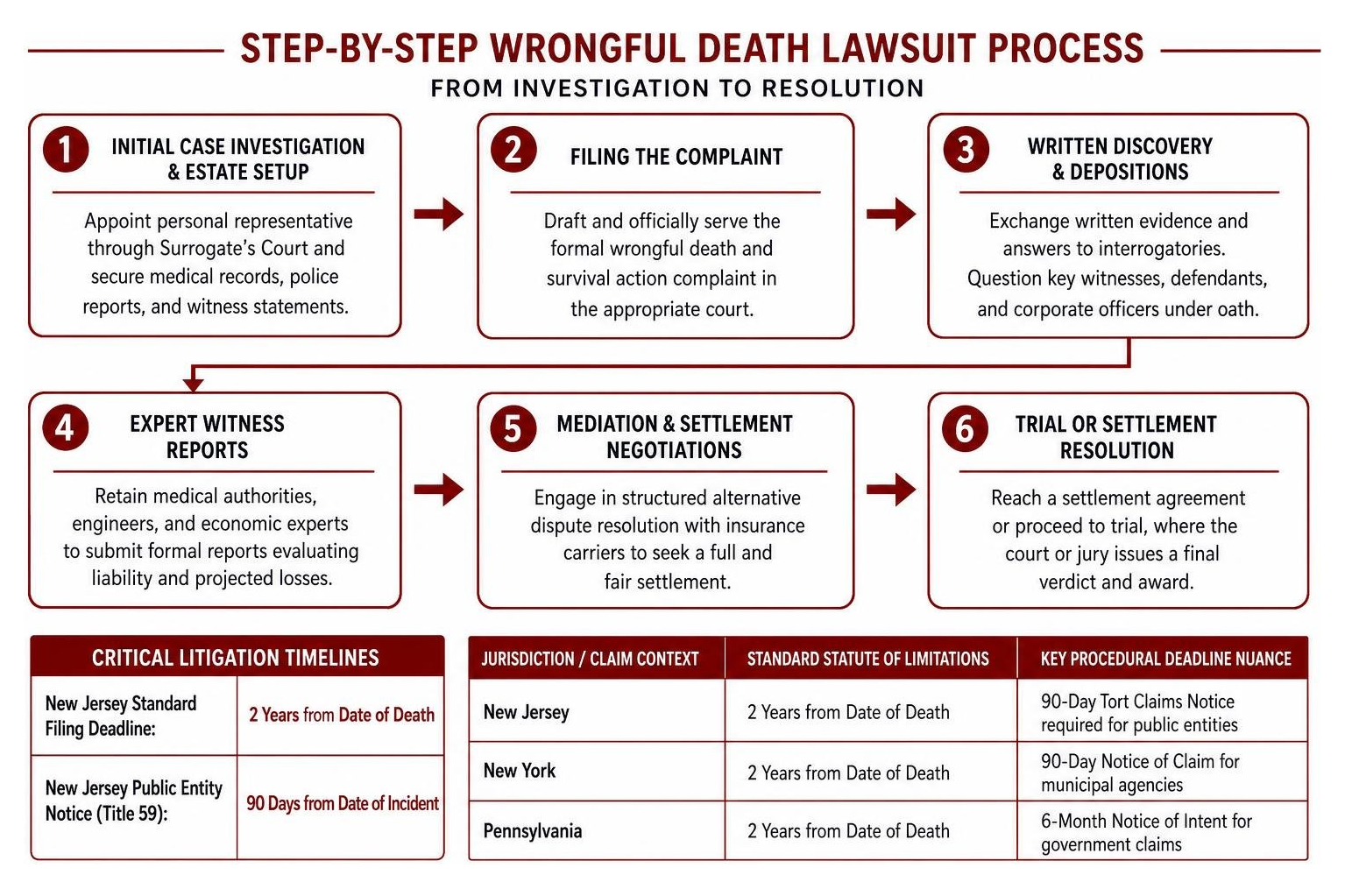
Timing is one of the most vital aspects of any wrongful death lawsuit. Every state sets a strict statute of limitations that limits how long you have to file a civil complaint in court. Missing this statutory deadline almost always results in a permanent dismissal of the lawsuit, regardless of how strong your evidence may be.
| Jurisdiction / Claim Context | Standard Statute of Limitations | Key Procedural Deadline Nuance |
|---|---|---|
| New Jersey | 2 Years from Date of Death | 90-Day Tort Claims Notice required for public entities |
| New York | 2 Years from Date of Death | 90-Day Notice of Claim for municipal agencies |
| Pennsylvania | 2 Years from Date of Death | 6-Month Notice of Intent for government claims |
Resolving a wrongful death lawsuit is a detailed process that can take anywhere from several months to a couple of years depending on liability disputes. Understanding standard accident claim procedures helps set realistic expectations for each stage:
Selecting the right legal team is a major decision for your family. You need an advocate with substantial courtroom experience, sufficient capital to fund complex litigation, and clear, compassionate communication. Reviewing a guide on hiring an injury lawyer will give you a practical foundation for evaluating local trial counsel.
Grieving families often worry about whether they can afford experienced legal counsel. Wrongful death attorneys represent clients on a contingency fee basis.
To help your legal team evaluate your claim efficiently, bring whatever documentation you have available. If you do not have every item, do not delay scheduling a meeting—your attorney can help obtain missing files.
New Jersey operates under a modified comparative negligence standard with a 51% bar rule. This means the family can still recover compensation as long as the decedent was not more than 50% responsible for the fatal incident.
If your loved one was found to bear 20% of the fault (for example, driving slightly over the speed limit while an oncoming truck made an illegal left turn), the total financial recovery is reduced by that 20%. If the decedent was 51% or more at fault, recovery is barred under state law.
Yes. Civil wrongful death lawsuits and criminal proceedings are entirely separate legal actions.
Even if the at-fault party was never ticketed, charged, or was acquitted in a criminal trial, you can still successfully pursue a civil wrongful death lawsuit.
Under New Jersey law, wrongful death settlement proceeds are distributed among statutory beneficiaries based on their actual financial dependency on the decedent, rather than a rigid flat percentage. If family members agree on an equitable allocation, the court will typically review and approve the distribution.
If there is a dispute among surviving heirs, the presiding judge conducts a formal allocation hearing to evaluate each dependent’s age, relationship, financial reliance, and projected future needs before approving the final disbursement.
Losing a loved one to another party’s negligence changes your family’s life forever. While no legal action or financial settlement can replace the person you lost, pursuing a civil claim provides vital financial stability, covers overwhelming costs, and holds responsible parties accountable.
At Lutz, Shafranski, Gorman, Mahoney & Lazzaro, P.A., we provide compassionate, dedicated advocacy to families throughout New Jersey, including Middlesex County communities such as New Brunswick, Milltown, Perth Amboy, Edison, Woodbridge, Piscataway, East Brunswick, Sayreville, Middlesex, North Brunswick, Highland Park, and Monroe. If you are facing the aftermath of a fatal accident, reach out to our team today for a free, confidential case evaluation.