The Ultimate Guide to Hiring an Accident Property Damage Lawyer
 June 26, 2026
What an Accident Property Damage Lawyer Does — and When You Need One
If your vehicle or belongings were damaged in a crash, an accident property damage lawyer can help you recover far more than what the insurance company’s first offer covers.
Here’s what you can typically recover with legal help:
- Vehicle repair costs — including OEM (original manufacturer) parts, not cheap aftermarket substitutes
- Total loss value — fair market value if your car is totaled, not a lowball software estimate
- Diminished value — the drop in your car’s resale value even after it’s fully repaired
- Rental car reimbursement — while your vehicle is being fixed or replaced
- Towing and storage fees — often overlooked but fully recoverable
- Personal property — laptops, phones, car seats, and other belongings damaged in the crash
- Sales tax and registration fees — on a replacement vehicle in many states
Insurance companies are not on your side. Their adjusters use automated tools designed to minimize payouts — and most people accept the first low offer simply because they don’t know they can push back.
That’s where legal representation makes a real difference.
I’m Frank Lazzaro, a New Jersey Supreme Court Certified Civil Trial Attorney with a track record of multi-million dollar recoveries for accident victims — including clients whose accident property damage lawyer needs were tangled up with serious injury claims that insurers tried to undervalue at every turn. If you’ve been in a crash and you’re not sure whether you’re getting a fair deal from the insurance company, this guide will walk you through everything you need to know.
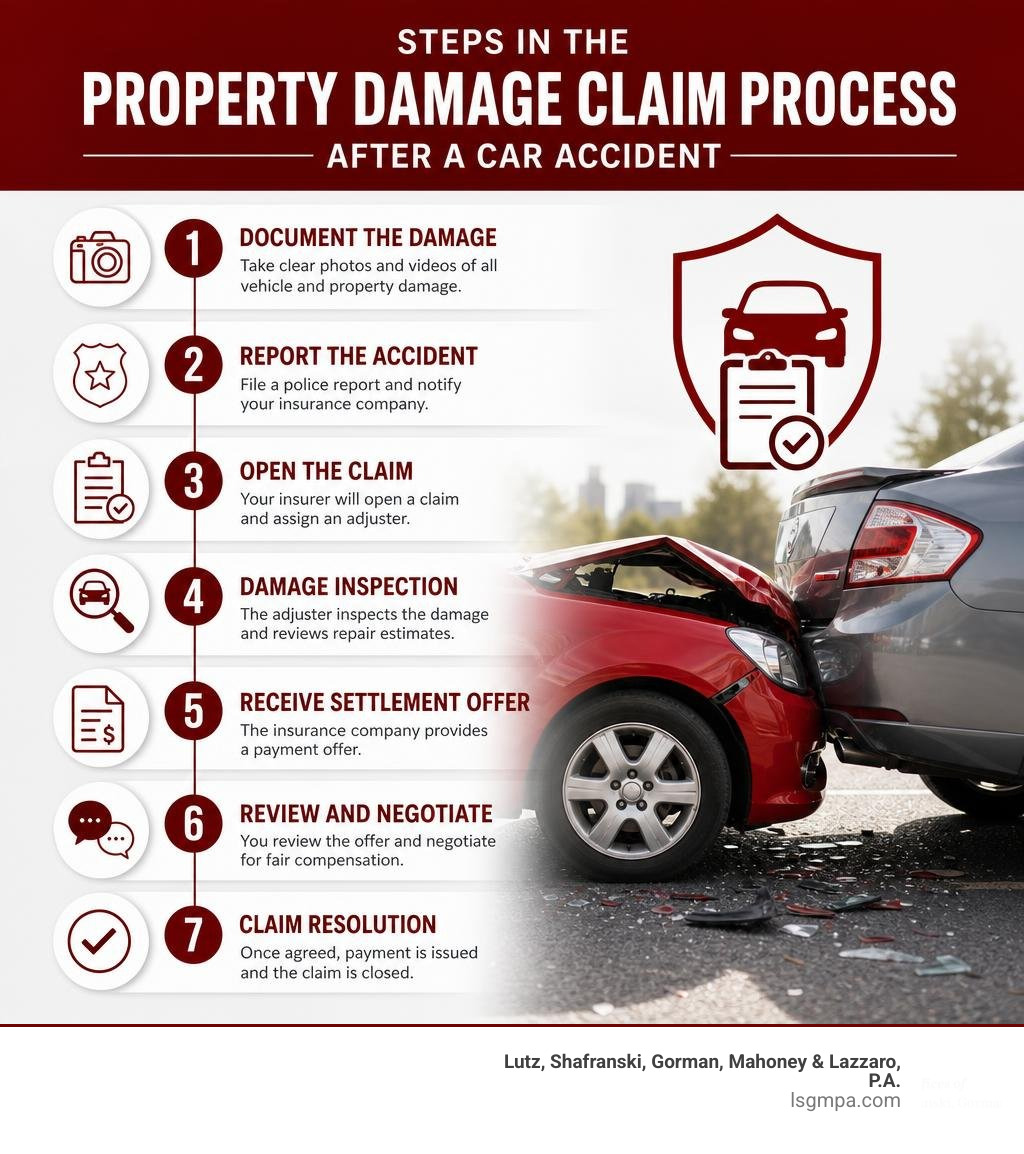
Understanding Property Damage Claims After a Car Accident
When you are involved in a motor vehicle collision, the physical and emotional toll is often compounded by the sudden loss of your primary means of transportation. Navigating the aftermath requires a clear understanding of how property damage claims are structured under the law, especially in New Jersey.
Property Damage Legal Concepts
To successfully recover compensation, you must establish three basic legal pillars:
- Negligence: The other driver failed to exercise reasonable care (e.g., texting while driving, speeding, or running a red light).
- Causation: This negligence directly caused the crash.
- Actual Damage: Your vehicle or personal belongings sustained tangible, measurable harm.
In New Jersey, a common point of confusion is our “no-fault” auto insurance system. Many drivers assume “no-fault” means their own insurance covers everything. However, New Jersey’s no-fault system only applies to medical expenses (Personal Injury Protection or PIP).
Property damage is entirely separate. It remains an “at-fault” system. This means you have two primary pathways to seek compensation:
- First-Party Claims: If you carry collision coverage on your own policy, you can file a claim with your insurer. They will pay for the repairs (minus your deductible) and may later pursue the at-fault driver’s insurance to recover the costs (a process called subrogation) and return your deductible.
- Third-Party Claims: You can file a claim directly against the at-fault driver’s liability insurance. Under New Jersey law, the driver who caused the accident is responsible for restoring your property to its pre-accident condition.
For example, under N.J.S.A. 39:4-89, New Jersey law maintains a strong presumption of fault for the rear driver in rear-end collisions. According to the New Jersey Department of Transportation (NJDOT), rear-end collisions made up a staggering 42.16% of all state traffic accidents in recent years. If you were rear-ended while stopped at a light in New Brunswick or Milltown, proving liability for your property damage is often straightforward, but getting the insurance company to pay the actual value of your repairs is another story entirely.
What an Accident Property Damage Lawyer Can Recover
When working with an experienced accident property damage lawyer, your recovery options expand far beyond a basic body shop estimate.
- OEM (Original Equipment Manufacturer) Parts: Insurance adjusters love to write estimates using “like kind and quality” (LKQ) or aftermarket parts. These are essentially generic, third-party knockoffs. We fight to ensure your vehicle is repaired using original factory parts to preserve its structural integrity and safety.
- Loss of Use & Rental Cars: You are entitled to a comparable rental vehicle while yours is in the shop. If the insurer delays repairs, they must continue paying for your rental. If you choose not to rent a car, you can still claim “loss of use” compensation for the days you were deprived of your vehicle.
- Diminished Value: This is the invisible financial hit. Even if a certified mechanic restores your car to pristine condition, its resale market value drops the moment an accident is registered on its Carfax report. In New Jersey, you can pursue a diminished value claim against the at-fault driver’s insurance to recover this lost equity.
- Towing, Storage, and Registration Fees: If your car was towed from the scene and stored at an impound lot, those daily fees accumulate rapidly. Furthermore, if your vehicle is declared a total loss, the insurance company must compensate you for the sales tax and registration fees associated with acquiring a replacement vehicle.
If you are dealing with property damage alongside an injury, it is vital to coordinate these claims carefully. Local representation is essential for navigating New Jersey’s unique court systems and ensuring your rights are fully protected.
How Insurance Companies Lowball and Undervalue Your Claim
Insurance companies are profit-driven corporations. Their primary goal is to resolve your claim as quickly and cheaply as possible. To achieve this, claims adjusters utilize a variety of sophisticated tactics designed to minimize your payout.

Common Insurance Underpayment Tactics
- Automated Software Estimates: Adjusters frequently use automated valuation software (like CCC ONE) to write initial repair estimates. These programs rely on standardized databases that often ignore local labor rates in high-cost areas like Middlesex County. They also assume the absolute minimum repair time.
- Ignoring Hidden Damage: A visual inspection only reveals surface-level damage. Crumpled crumple zones, bent frames, and hairline suspension fractures are often missed until the vehicle is completely torn down at a body shop. Insurers write their initial checks based on the visible damage, hoping you will sign a release before the true extent of the damage is discovered.
- The “Salt-Air” or Pre-existing Wear Discount: If you live or commute near coastal areas of New Jersey, adjusters might attempt to discount your vehicle’s valuation by claiming pre-existing rust or “salt-air” corrosion, even if the damage was entirely mechanical and caused by the impact.
- Unfair Total Loss Thresholds: In many states, a car is declared a total loss if repairs exceed 70% to 80% of its actual cash value (ACV). Insurers sometimes manipulate the ACV downward using lowball “comparable” vehicles from distant markets to force a total loss declaration, allowing them to pay you less than what it actually costs to buy a similar vehicle in New Jersey.
Challenging Insurer Valuations with an Accident Property Damage Lawyer
If you receive an inadequate settlement offer or a lowball total loss valuation, you do not have to accept it. We help our clients challenge these assessments through structured, evidence-based disputes:
- Independent Appraisals: We work with certified independent auto appraisers who conduct comprehensive physical inspections of the vehicle, documenting hidden structural damage and calculating accurate local repair costs.
- Local Comparable Sales Data: To dispute a low total loss valuation, we gather real-world sales data for identical vehicle makes, models, trims, and mileage options from local New Jersey dealerships.
- Bad Faith Claims: Under New Jersey law, insurance companies have an implied duty of good faith and fair dealing. If an insurer intentionally delays your claim, refuses to conduct a reasonable investigation, or offers an egregiously low settlement without justification, we can escalate the dispute by filing an insurance bad faith claim to hold them accountable under New Jersey law.
Key Deadlines and Regional Accident Hotspots
Time is of the essence when documenting property damage. Evidence degrades, vehicles are repaired or sold, and legal deadlines can permanently bar you from seeking recovery.
Comparative Legal Timelines and Limits
| Jurisdiction |
Property Damage Statute of Limitations |
Personal Injury Statute of Limitations |
Minimum Property Damage Liability Limit |
| New Jersey |
6 Years (N.J.S.A. 2A:14-1) |
2 Years (N.J.S.A. 2A:14-2) |
$5,000 (Basic Policy) |
| California |
3 Years (CCP § 338) |
2 Years |
$5,000 |
| Indiana |
2 Years (IC § 34-11-2-4) |
2 Years |
$25,000 |
While New Jersey provides a generous six-year window to file a lawsuit strictly for property damage, we strongly advise against waiting. If you suffered injuries in the same crash, your personal injury claim is bound by a strict two-year statute of limitations. Splitting your property damage and personal injury claims into separate legal actions years apart is highly inefficient and can severely compromise your negotiating leverage with the insurance company.
The New Jersey Department of Transportation publishes statewide crash information through its crash records and statistics resources, which can help put local collision patterns into context.
High-Risk Traffic Hotspots
High-traffic corridors naturally see higher collision rates, leading to severe vehicle damage. Nationally, areas like Marion County, Indiana, record over 36,000 collisions annually, while coastal areas like Seal Beach, California, experience catastrophic multi-vehicle accidents, such as the infamous 9-vehicle pileup at PCH and 2nd Street in 2023.
Locally, our clients frequently encounter hazardous driving conditions and severe collisions at known New Jersey hotspots:
- Route 18 in New Brunswick: The frequent lane merges, heavy commuter traffic heading toward Rutgers University, and sudden stop-and-go patterns lead to daily rear-end collisions and significant front-end damage.
- The New Jersey Turnpike (Exit 9 near Milltown): High-speed truck traffic mixing with passenger vehicles often results in high-impact sideswipes and catastrophic total-loss accidents.
- Route 35 and Route 9 in Perth Amboy: Congested commercial corridors with numerous intersection turns create a high frequency of T-bone collisions, which regularly cause severe frame damage to passenger cars.
If you have been involved in an accident in these areas, seeking immediate legal guidance from an experienced local attorney can help clarify your options and protect your claim from the start.
When to Hire an Accident Property Damage Lawyer
For minor “fender benders” where liability is clear, the insurance company agrees to pay the repair shop’s estimate, and there are no injuries, you can likely resolve the property damage claim on your own.
However, you should contact an accident property damage lawyer immediately if you encounter any of the following red flags:
- The At-Fault Driver is Uninsured or Underinsured: If the driver who hit you carries only New Jersey’s minimum $5,000 property damage liability limit, it will not cover the cost of repairing a modern vehicle (where the average new car costs over $48,000). We can help you navigate your own Uninsured/Underinsured Motorist (UM/UIM) coverage to bridge the gap.
- Liability is Disputed: If the other driver’s insurance company claims you were partially or entirely at fault, they will attempt to reduce your payout under New Jersey’s comparative negligence rules. We gather police reports, traffic camera footage, and witness statements to establish clear liability.
- You Sustained Physical Injuries: If you are dealing with medical treatments, hospital bills, and lost wages, you should never negotiate with an insurance adjuster alone. Insurers often try to slide “release of all claims” language into property damage checks, which could inadvertently waive your right to pursue compensation for your physical injuries.
- The Insurer is Delaying or Denying Your Claim: If your claim has stalled, or if the insurer refuses to pay for a rental car while your vehicle sits in an impound lot, legal intervention is often the only way to break the gridlock.
To understand how legal fees work in these scenarios, you can discuss contingency fee structures directly with your attorney during your initial consultation.
Frequently Asked Questions About Property Damage
How long do I have to file a property damage lawsuit?
In New Jersey, the statute of limitations for filing a property damage lawsuit is six years from the date of the accident (N.J.S.A. 2A:14-1). This is significantly longer than states like Indiana (2 years) or California (3 years). However, if you also sustained physical injuries, the personal injury deadline is strictly two years. It is always best to resolve both claims concurrently.
Can I claim diminished value if my car was fully repaired?
Yes. New Jersey law allows you to recover the “diminished value” of your vehicle. Even if the repairs are flawless, the vehicle’s accident history permanently reduces its resale value. To secure this compensation, you must file a third-party claim against the at-fault driver’s insurance company backed by a professional, independent diminished value appraisal.
- Prioritize Safety: Move to a safe location and check for injuries.
- Call the Police: Ensure an official police report is filed, especially if damage exceeds $500.
- Document the Scene: Take high-quality photos and videos of both vehicles, the surrounding road conditions, skid marks, and traffic signs.
- Exchange Information: Collect names, contact details, and insurance information from all drivers involved.
- Identify Witnesses: Gather contact information from anyone who saw the crash occur.
- Seek Medical Attention: Even if you feel fine, underlying soft-tissue injuries may take days to present symptoms.
- Contact a Lawyer: Speak to an attorney before giving any recorded statements to insurance adjusters.
Conclusion
Dealing with property damage after a car accident is stressful, but you do not have to fight the insurance companies alone. At Lutz, Shafranski, Gorman, Mahoney & Lazzaro, P.A., we provide comprehensive advocacy for accident victims across New Jersey, including New Brunswick, Milltown, and Perth Amboy.
Our firm specializes in serious injury claims, ensuring that your medical costs, lost earnings, pain and suffering, and associated property losses are fully addressed. We stand up to insurance companies to secure the maximum recovery you deserve.
If you or a loved one has been injured in an accident, contact us today for a free, no-obligation consultation. Let us handle the legal battle while you focus on your recovery.
New Brunswick Car Accident Lawyer


 Call Us Today (732) 249-0444
