

 Call Us Today (732) 249-0444
 October 30, 2026

A title 59 slip and fall claim is fundamentally different from a standard personal injury case — and the differences can make or break your ability to recover compensation.
Here is what you need to know right away:
If you slipped on a broken municipal sidewalk, fell in a public school, or were hurt in a government-owned building, you are not dealing with ordinary negligence law. You are navigating the New Jersey Tort Claims Act, also known as Title 59 — a body of law specifically designed to limit when and how much the government can be sued.
That single missed deadline has ended more cases than almost any other mistake in public entity litigation.
I’m Frank Lazzaro, a Certified Civil Trial Attorney certified by the Supreme Court of New Jersey, and I have spent years handling title 59 slip and fall cases — securing multi-million dollar recoveries for clients injured on public property throughout New Jersey. In the sections below, I’ll walk you through exactly how Title 59 works and what you must do to protect your rights.
To understand a title 59 slip and fall case, we must first look at the history of sovereign immunity. Historically, under English common law, there was a rule: “The King can do no wrong.” This meant you could not sue the government unless the government gave you permission to do so.
When the United States was founded, we kept this concept, calling it “sovereign immunity.” However, as governments grew and began operating public transit, maintaining public parks, and running school systems, it became clear that completely blocking injured citizens from seeking justice was unfair.
In response, the New Jersey Legislature enacted the New Jersey Tort Claims Act, codified as 2024 New Jersey Revised Statutes Title 59 – Claims Against Public Entities .
Title 59 establishes a default rule that is the exact opposite of private personal injury law. In a standard slip and fall case against a private business (like a grocery store or apartment complex), the rule is that the owner is liable if they were negligent. Under Title 59, the default rule is immunity. Public entities and public employees are immune from liability unless a specific statutory exception is carved out in the text of the law.
In other words, you do not start with a right to sue; you start with a barrier, and we must find the specific legal key to unlock your claim.
It is also worth noting a common point of confusion for those researching legal terms online. If you search for “Title 59” without specifying New Jersey, you might run into Washington State’s “Title 59 RCW,” which governs landlord-tenant relationships, or New York’s “Code Rule 59,” which deals with workplace safety and loss prevention. If you are injured in New Brunswick, Milltown, or Perth Amboy, those out-of-state laws are completely irrelevant. Your case is governed strictly by New Jersey’s Title 59.

When you slip and fall on private property, proving your case involves showing that the property owner knew or should have known about a hazard and failed to fix it. When you sue a public entity—whether it is a municipality like Perth Amboy, a county board, or a state agency—the bar is set much higher.
To successfully establish liability for a title 59 slip and fall under N.J.S.A. 59:4-2, you must prove the following elements:
This last requirement—proving that the government’s conduct was “palpably unreasonable”—is the highest hurdle in a public slip and fall case. It is not enough to show that the town was careless or slow. You must show that their behavior was patently unacceptable, obvious, and glaringly wrong to any reasonable person.
This is exactly Why You Need A Slip And Fall Lawyer who understands how to gather the necessary evidence, such as municipal maintenance logs, prior complaints, and expert engineering testimonies, to meet this strict legal standard.
What exactly is a “dangerous condition” under Title 59? The statute defines it as a physical condition of property that creates a substantial risk of injury when the property is used with due care in a manner in which it is reasonably foreseeable that it will be used.
Common examples of dangerous conditions that can lead to a valid title 59 slip and fall claim include:
If a pedestrian is walking while distracted by their phone and trips over a minor, half-inch crack, the court will likely find that the property did not present a “substantial risk” when used with due care. However, if a deep, water-filled pothole exists in a poorly lit public parking lot in New Brunswick, and multiple residents have complained about it for months, the legal foundation for a dangerous condition is much stronger.
Even if we can prove all the elements of a dangerous condition, the public entity has several powerful shields (immunities) it can raise to defeat your claim:
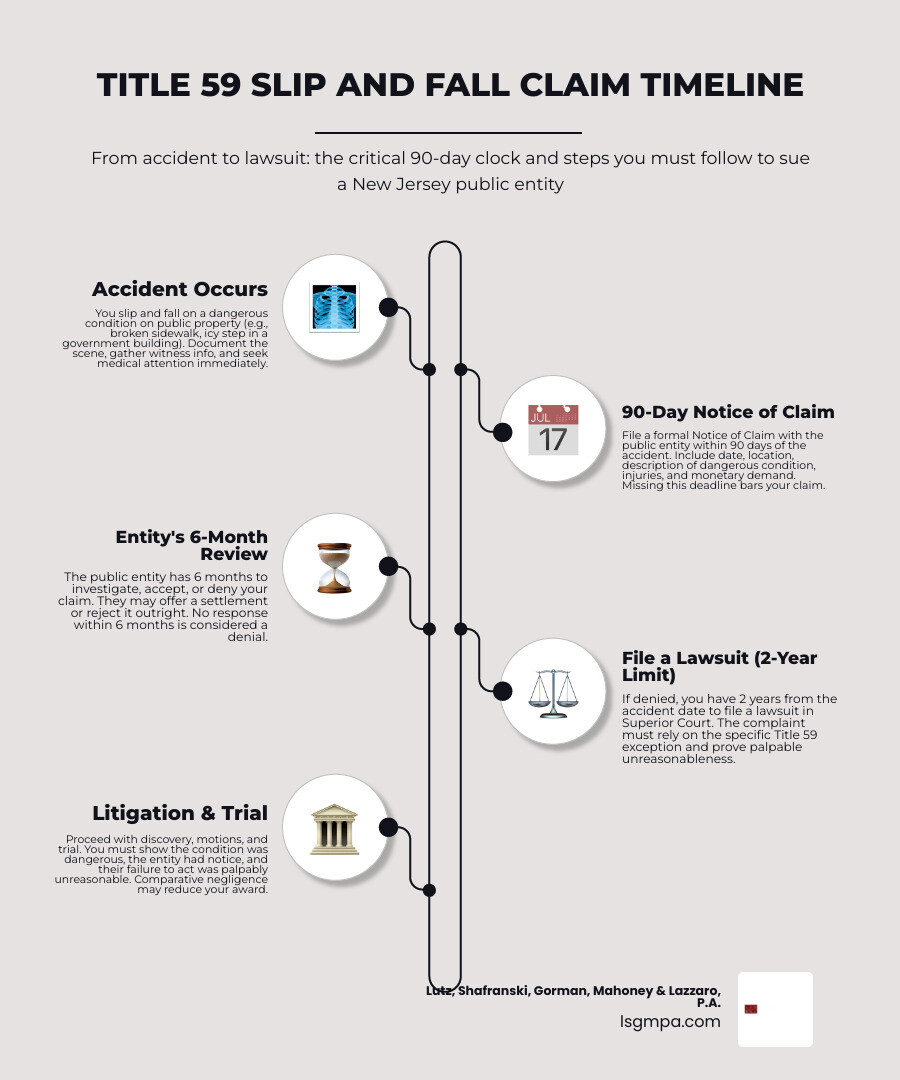
If you remember only one thing from this guide, let it be this: the 90-day clock is ticking from the moment you hit the ground.
In a standard New Jersey personal injury lawsuit against a private individual or business, you have a two-year statute of limitations to file a lawsuit. Under Title 59, however, N.J.S.A. 59:8-8 slashes your initial window to take action down to just 90 days.
Within 90 days of your slip and fall, you must present a formal, written Notice of Claim to the specific public entity responsible for the property. If you slip on a sidewalk outside a school in New Brunswick, you must file the notice with the Board of Education and the City of New Brunswick. If you file it with the wrong department or miss the deadline, your claim is dead before it even starts.
| Feature | Standard NJ Slip and Fall (Private Property) | Title 59 Slip and Fall (Public Property) |
|---|---|---|
| Initial Notice Deadline | No strict statutory notice deadline (though prompt notice is recommended) | 90 Days from the date of the accident |
| Statute of Limitations | 2 Years to file a lawsuit | 2 Years to file a lawsuit (but barred if 90-day notice is missed) |
| Standard of Proof | Ordinary Negligence (reasonable care) | High Standard (Palpably Unreasonable conduct) |
| Damage Limitations | No statutory verbal threshold for pain and suffering | Strict verbal threshold (must prove permanent loss of bodily function) |
Under N.J.S.A. 59:8-9, there is a small window of hope if you miss the 90-day deadline. You can petition a judge to allow you to file a “Notice of Late Claim” up to one year after the accident. However, the court will only grant this under extraordinary circumstances.
“I didn’t know the law,” “I was busy recovering,” or “I couldn’t find a lawyer” are almost never accepted by New Jersey judges as extraordinary circumstances. Typically, you must prove you were physically or mentally incapacitated to the point where it was impossible to file the claim.
Even if you successfully navigate the 90-day notice requirement and prove the public entity acted in a palpably unreasonable manner, your final financial recovery is still subject to several strict legal rules.
First, New Jersey’s comparative negligence rule (N.J.S.A. 59:9-4) applies. If a jury finds that you were partially at fault for your own fall—perhaps you were wearing inappropriate footwear on a rainy day or ignoring a warning sign—your damages will be reduced by your percentage of fault. If you are found to be more than 50% responsible for the accident, you are barred from recovering any damages at all under New Jersey law.
Second, Title 59 places a strict limitation on recovering damages for pain and suffering. This is often referred to as the verbal threshold. Under N.J.S.A. 59:9-2(d), you cannot recover money for pain and suffering unless you have suffered:
If you suffer a painful sprain that heals completely after a few months of physical therapy, you can recover your out-of-pocket medical bills and lost wages, but you cannot recover damages for your pain and suffering.
Finally, we must look at how Title 59 interacts with other areas of law:
To understand how these overlapping laws affect your specific accident, refer to the Title 59 – CLAIMS AGAINST PUBLIC ENTITIES :: 2013 New Jersey Revised Statutes :: US Codes and Statutes :: US Law :: Justia index to see the complete breakdown of statutory interactions.
Yes, but it is incredibly difficult. As mentioned earlier, public entities enjoy broad weather immunity under N.J.S.A. 59:4-7. If the ice or snow was a purely natural accumulation, the municipality is protected.
However, if the town or city created or exacerbated the hazard through an active, palpably unreasonable decision, you may have a claim. For example, if a municipal water pipe in Perth Amboy was leaking for weeks, causing a massive ice sheet to form across a public sidewalk, and the city ignored repeated warnings to fix it, that is no longer a “natural” weather condition. It is a dangerous condition created by municipal neglect.
Under N.J.S.A. 59:8-4, your Notice of Claim must be highly detailed. A simple letter saying “I fell on your property” is not legally sufficient. To be valid, your notice must include:
In almost all cases, your claim is permanently barred. The public entity will file a motion to dismiss your lawsuit, and the court will grant it. The only exception is if you can successfully file a motion for a late claim within one year under the “extraordinary circumstances” standard, which is an incredibly high legal hurdle. This is why we urge accident victims to contact an attorney immediately after their fall.
A title 59 slip and fall is not a battle you should fight alone. The government has unlimited resources, experienced defense attorneys, and a statutory deck stacked heavily in its favor.
At Lutz, Shafranski, Gorman, Mahoney & Lazzaro, P.A., we provide comprehensive advocacy for serious injury claims. We understand how to investigate municipal records, establish actual or constructive notice, prove palpably unreasonable conduct, and ensure your Notice of Claim is drafted and filed perfectly within the strict 90-day window.
To learn more about finding the right representation for your case, read our guide on How To Choose The Best Slip And Fall Personal Injury Attorney For Your Case.
If you or a loved one has suffered a slip and fall on public property in New Brunswick, Milltown, Perth Amboy, or anywhere else in New Jersey, do not wait for the clock to run out. Contact a dedicated New Brunswick Slip and Fall Lawyer at LSGMPA today for a free, no-obligation consultation. We will help you understand your rights and fight to secure the compensation you deserve.