

 Call Us Today (732) 249-0444
 August 8, 2026

If you’ve been hurt in a crash and need a New Jersey Uber accident attorney, here’s what matters most:
Rideshare services like Uber have become part of everyday life in New Jersey. Millions of trips are completed across the state each year — from Newark to Atlantic City and everywhere in between. But more trips mean more chances for something to go wrong. When a crash happens during an Uber ride, injured victims often face a confusing tangle of insurance policies, corporate legal teams, and medical bills that keep piling up.
The situation is harder than a standard car accident. Who pays? Uber? The driver? Your own insurer? The answer depends on details that most people don’t know to look for — and that’s exactly where things can go wrong without the right legal help.
My name is Frank Lazzaro. As a Supreme Court of New Jersey Certified Civil Trial Attorney with a track record of multiple six- and seven-figure verdicts in personal injury cases, I’ve helped injured clients navigate the exact complexities that come with being a New Jersey Uber accident attorney — from untangling Uber’s layered insurance tiers to fighting back against lowball settlement offers. In the sections below, I’ll walk you through everything you need to know to protect your rights and your recovery.
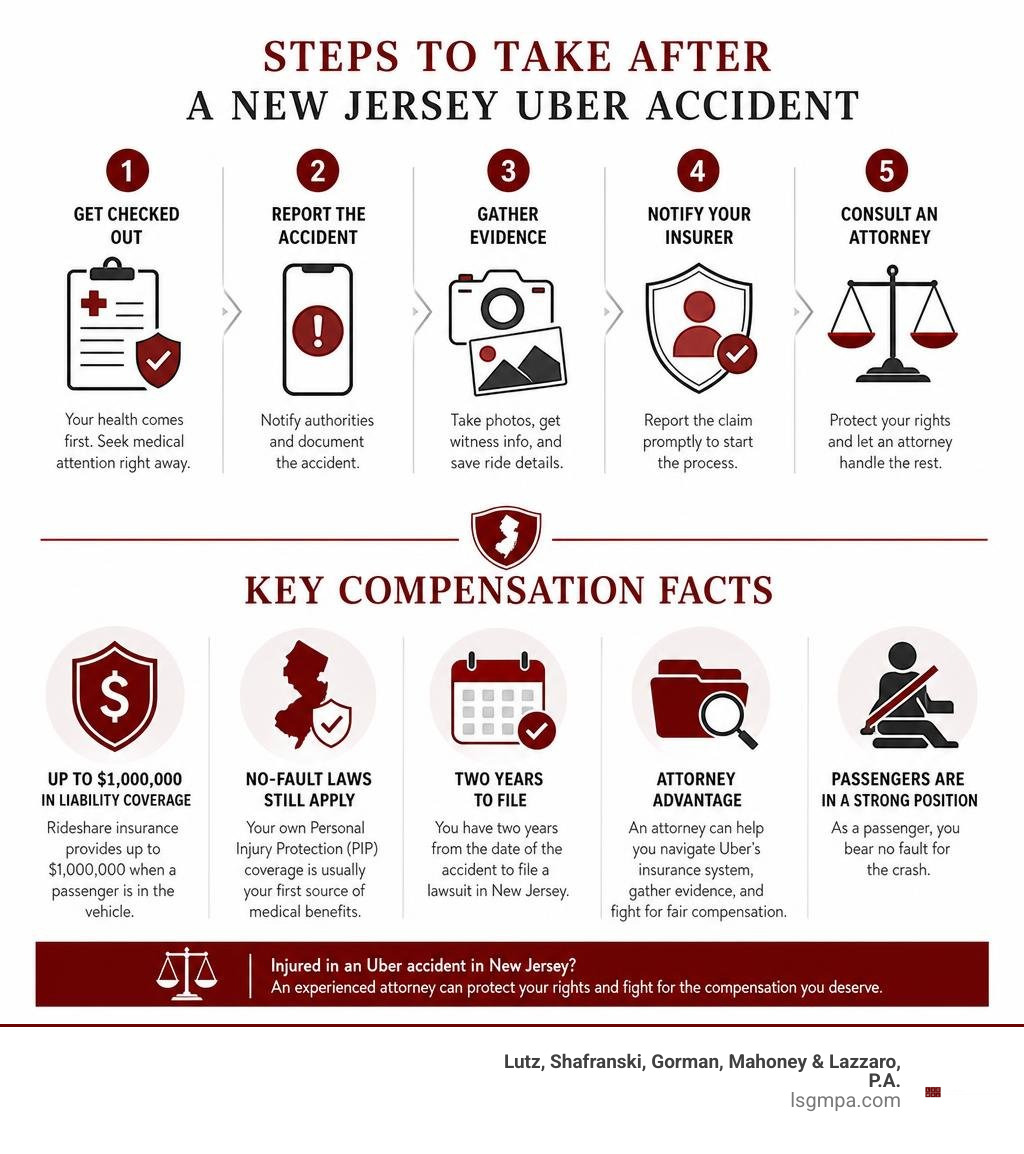
When you step into a standard vehicle, insurance is usually straightforward: the driver who caused the crash has personal auto insurance, and their policy pays for the damage. But with Uber, things get tricky very fast.
Uber drivers use their personal vehicles, but their standard personal auto insurance policies almost always contain a “commercial use exclusion.” This means that as soon as a driver turns on the Uber app to make money, their personal auto policy generally stops covering them.
To bridge this gap, New Jersey law requires Transportation Network Companies (TNCs) like Uber to provide specific levels of insurance coverage. How much coverage is available depends entirely on the driver’s exact status in the app at the precise moment of the crash.
| Driver App Status | Phase / Period | Uber Third-Party Liability Coverage | Uber PIP / First-Party Benefits |
|---|---|---|---|
| App Off | Period 0 | $0 (Driver’s Personal Policy Applies) | None from Uber |
| App On, Waiting for Request | Period 1 | $50,000 / $100,000 bodily injury; $25,000 property damage | Contingent coverage |
| Request Accepted, En Route | Period 2 | Up to $1,000,000 primary commercial coverage | Primary commercial limits apply |
| Passenger in Vehicle | Period 3 | Up to $1,000,000 primary commercial coverage + UM/UIM | Full commercial policy coverage |
To make sense of who pays for your medical bills and property damage, you need to understand how Uber’s insurance tiers work under New Jersey regulations:
Understanding which tier was active requires fast action to secure digital app records before they vanish or are lost in dispute.
New Jersey operates under a “no-fault” auto insurance framework. In plain terms, this means that regardless of who caused the car crash, your primary source for initial medical expense payments is typically your own Personal Injury Protection (PIP) policy (or a policy held by a relative in your household).
However, rideshare crashes complicate standard no-fault benefits:
Navigating these overlapping policies demands a deep understanding of state law. Working with a dedicated New Jersey car accident lawyer guidance professional helps ensure you do not miss critical coverage sources.
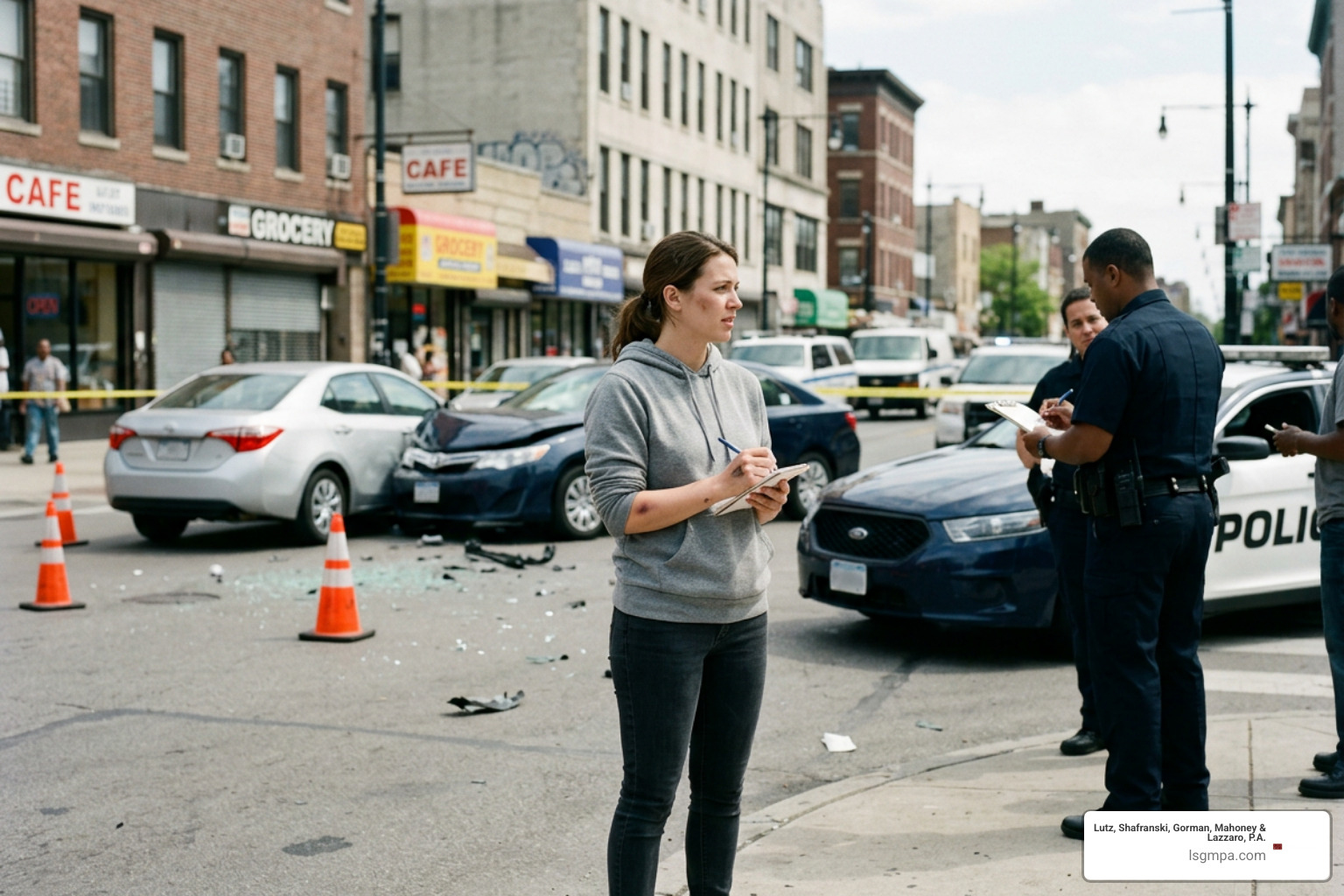
When an Uber crash happens in Middlesex County or anywhere in central New Jersey, taking immediate, deliberate steps helps protect both your health and your legal claim.
If you are physically able to do so, taking these actions at the scene of the accident can safeguard your case:
For property claims involving damage to your personal belongings or vehicle during a crash, consulting an experienced accident property damage lawyer insights resource can clear up confusion regarding replacement values.
Rideshare insurance claims involve large corporations and aggressive claims adjusters whose main goal is to minimize payouts. Having a New Jersey Uber accident attorney on your side levels the playing field.
We assist injury victims by:
If you are comparing local options across Middlesex County, understanding choosing a car accident lawyer in Middletown can guide your selection of an experienced advocate.
Establishing liability in an Uber accident requires demonstrating that one or more parties failed to exercise reasonable care on the road.
Uber drivers face unique job pressures that contribute to motor vehicle collisions. Recent traffic safety studies highlighted by media outlets like The New York Times news on traffic trends show growing concerns around rideshare driver distraction and road safety.
Common causes of Uber crashes include:
When a driver fails to keep focus on the road, the results can be devastating. To protect your recovery rights after a distraction-related incident, review our analysis on distracted driving compensation rights. Similarly, if alcohol played a role in your collision, review our legal breakdown on drunk driving accident claims.
Under New Jersey’s comparative negligence statute (N.J.S.A. 2A:15-5.1), you can recover damages as long as you were not more than 50% at fault for the accident, though your recovery is reduced by your percentage of responsibility. Because passengers almost never share blame, their position under comparative fault rules is exceptionally clear.
If you suffer injuries in a New Jersey Uber accident due to someone else’s negligence, you may pursue several forms of financial recovery:
Economic Damages:
Non-Economic Damages:
Property Loss:
In New Jersey, the statute of limitations for filing a personal injury lawsuit—including rideshare accidents—is generally two years from the date of the crash (N.J.S.A. 2A:14-2).
If you fail to file a lawsuit before this two-year deadline expires, you will almost certainly forfeit your legal right to seek compensation forever. Limited exceptions exist for minors or legally incapacitated individuals, but waiting is never wise. Evidence degrades and witness memories fade quickly over time.
In most situations, Uber classifies its drivers as independent contractors rather than direct employees. Because of this legal distinction, it is often difficult to sue Uber under traditional vicarious liability (holding an employer responsible for an employee’s actions).
However, you can file a claim against Uber’s $1,000,000 commercial insurance policy, which covers the driver’s actions during Periods 2 and 3. Furthermore, in cases involving negligent hiring, retention, or failure to perform background checks, direct corporate negligence claims against Uber may be possible.
As a passenger riding in an Uber, you have virtually zero legal fault for a motor vehicle collision. Whether your Uber driver, another motorist, or a combination of both caused the collision, you have the absolute legal right to pursue full compensation for your injuries from the responsible parties and their insurance policies.
A serious rideshare accident can leave you dealing with physical pain, missed time from work, and mounting medical bills. Dealing with corporate insurance adjusters on your own during recovery is overwhelming.
At Lutz, Shafranski, Gorman, Mahoney & Lazzaro, P.A., our team brings decades of trial experience to your side. We serve clients throughout New Brunswick, Milltown, Perth Amboy, Edison, Woodbridge, Piscataway, East Brunswick, Sayreville, Middlesex, North Brunswick, Highland Park, Monroe, and across Middlesex County, New Jersey.
If you or a family member was injured in a rideshare collision, do not settle for less than you deserve. Contact our team today or consult a dedicated New Brunswick car accident lawyer to schedule a free, confidential consultation. Let us handle the legal battle so you can focus on healing.
