

 Call Us Today (732) 249-0444
 September 26, 2026

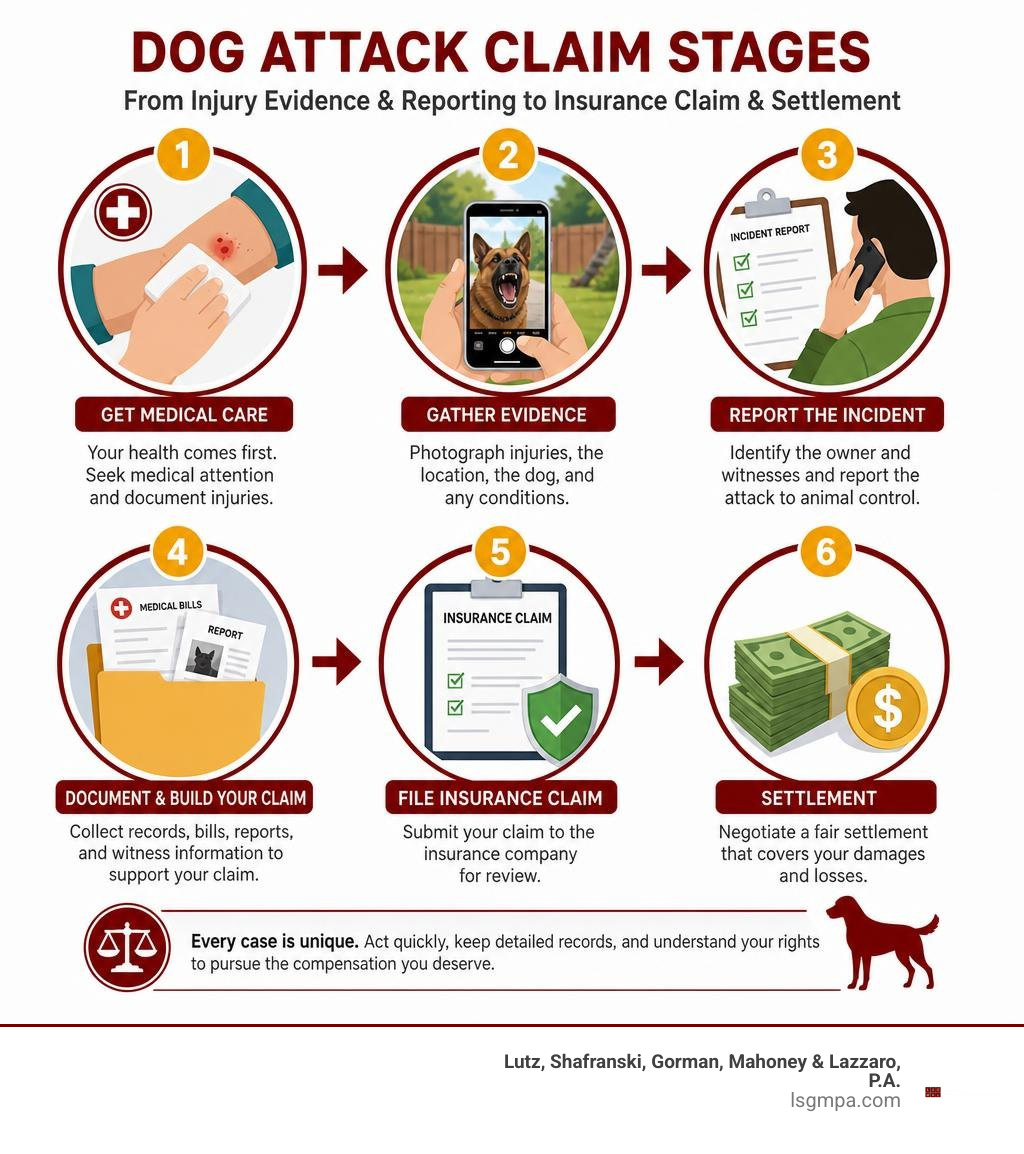
Dog attack law decides who may be responsible for your injuries, what defenses may apply, and what compensation you can seek. If a dog bit or attacked you in New Jersey, preserve evidence right away: get medical care, photograph injuries and the location, identify the owner and witnesses, and report the incident to local animal control.
Many states use strict-liability rules for bites, while others require proof that an owner knew the dog was dangerous or acted carelessly. A dog does not always need a prior bite history for its owner to face civil liability. The facts matter, including whether you were lawfully on the property, whether the dog was provoked, and whether local dangerous-dog rules were violated.
A serious attack can also trigger animal-control proceedings, confinement orders, insurance requirements, and, in some cases, criminal penalties for an owner. Civil claims may cover medical bills, lost income, and pain and suffering, but filing deadlines can be short and vary by state.
I am Frank Lazzaro, a New Jersey Certified Civil Trial Attorney who has secured multiple six- and seven-figure personal injury verdicts and recoveries. My work with dog attack law claims focuses on helping injured people understand liability, document losses, and protect their right to pursue fair compensation.
Similar topics to dog attack law:
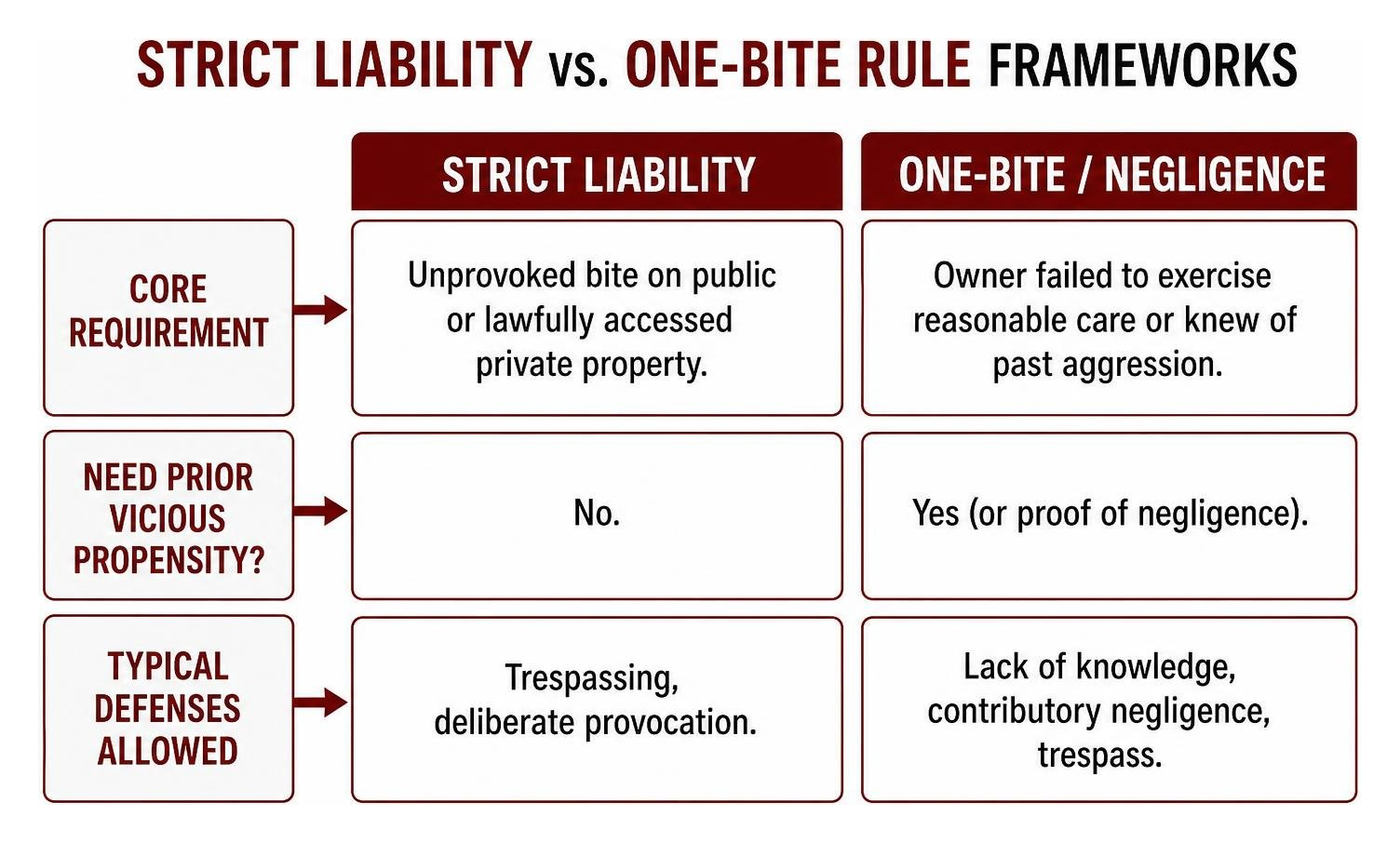
When someone is bitten or mauled by a canine, determining legal responsibility depends heavily on the civil liability standard adopted by the jurisdiction. Across North America, statutory frameworks generally fall into two primary categories: strict liability statutes and common law negligence rules (often referred to as the “one-bite rule”).
In strict liability jurisdictions, a dog owner is held legally accountable for damages when their dog bites someone who is in a public place or lawfully on private property. The injured party does not need to prove that the animal had a history of aggression or that the owner acted carelessly. In contrast, jurisdictions operating under traditional “one-bite” or negligence principles require the victim to demonstrate scienter—meaning the owner knew, or reasonably should have known, of the animal’s vicious propensities.
| Legal Framework | Core Requirement | Need Prior Vicious Propensity? | Typical Defenses Allowed |
|---|---|---|---|
| Strict Liability | Unprovoked bite on public or lawfully accessed private property | No | Trespassing, deliberate provocation |
| One-Bite / Negligence | Owner failed to exercise reasonable care or knew of past aggression | Yes (or proof of negligence) | Lack of knowledge, contributory negligence, trespass |
| Mixed / Tiered Statutes | Strict liability for economic damages, negligence for non-economic | Depends on injury tier | Warning signs, occupational hazard, trespass |
In New Jersey, our statutes establish a strict liability standard under N.J.S.A. 4:19-16. This means that if you are lawfully on private property (such as an invited guest, postal worker, or delivery driver) or in a public space in New Brunswick, Edison, or Woodbridge, the owner is responsible for the resulting harm regardless of the animal’s prior temperament. Other states adopt similar strict civil statutes, such as Chapter 767 Section 01 – 2023 Florida Statutes – The Florida Senate and Chapter 767 Section 04 – 2025 Florida Statutes – The Florida Senate, which hold owners liable for bite damages and injuries inflicted on persons, domestic animals, or livestock.
Different states construct their statutory schemes to balance public safety with owner protections. For example, some jurisdictions limit strict liability to direct bite injuries, requiring victims of knock-downs or scratches to proceed under standard negligence theories.
Other states use tiered recovery frameworks. Under crs_13-21-124, an injured party who suffers serious bodily injury or death while lawfully on public or private property can bring a civil action for economic damages under strict liability, regardless of whether the owner knew the animal was vicious. To recover non-economic damages (such as pain, suffering, and emotional distress), the victim must establish negligence or prior owner knowledge.
Civil liability also extends to scenarios involving multiple dog owners or commercial landlords:
A common misconception among injury victims is that an owner gets a “free pass” if their pet has never bitten anyone before. Under modern strict liability statutes, prior knowledge of aggression is completely unnecessary to establish civil fault.
Even in jurisdictions that require proof of owner awareness, a formal prior bite is rarely the only acceptable evidence. Courts evaluate whether the owner had notice of dangerous behavior through:
In states like Maryland, the law creates a rebuttable presumption that an owner knew or should have known their animal was dangerous whenever it inflicts severe injury or death, shifting the burden onto the owner to prove lack of knowledge. If you are dealing with an aggressive animal incident, consulting a dog bite lawyer can help ensure the necessary municipal records, animal control reports, and witness statements are secured immediately.

While strict liability statutes strongly favor the victim, dog owners are not without legal defenses. When an injury claim or civil lawsuit is filed, insurance companies and defense counsel routinely examine statutory exemptions to reduce or eliminate the owner’s financial exposure.
The most frequent affirmative defenses asserted in canine attack litigation involve unlawful entry, provocation, or warning signage:
Canine attack statutes frequently carve out specific exemptions based on the victim’s occupation or the animal’s official duties:

Beyond private civil lawsuits for damages, an unprovoked canine attack often triggers administrative proceedings initiated by local municipal health departments or animal control agencies.
When an animal inflicts severe injury on a human, service animal, or domestic pet, animal control officers can impound the animal and petition the municipal court to declare the animal “potentially dangerous” or “dangerous.”
In New York, administrative proceedings under Agriculture and Markets Law require a hearing before a municipal judge within five days of a formal complaint, following at least two days of written notice to the owner. The complainant must establish by clear and convincing evidence that the animal poses an imminent threat or attacked without justification. If a judge orders euthanasia, the owner is afforded a mandatory 30-day window to file an appeal, during which time a stay prevents the animal’s destruction.
Administrative evaluations frequently incorporate behavioral classifications, such as the Dunbar Bite Scale. Attacks scoring at higher severity levels (involving deep punctures, repeated bites, or flesh tears) significantly increase the likelihood of formal court restrictions or destruction mandates.
Once an animal is adjudicated as dangerous, courts possess statutory authority to issue mandatory compliance orders. These requirements commonly include:
When an animal inflicts fatal or severe disfiguring injuries, or repeats violent attacks after a prior dangerous determination, courts can order humane euthanasia at the owner’s expense.
Owners who violate court-mandated control measures face escalating criminal and civil penalties:
Breed-Specific Legislation (BSL) refers to statutes or municipal ordinances that ban or impose strict restrictions on specific canine breeds deemed inherently dangerous—most commonly Pit Bull Terriers, Staffordshire Bull Terriers, Rottweilers, and Wolf Hybrids.
While Ontario’s Dog Owners’ Liability Act strictly prohibits pit bulls and places the burden of proof squarely on the owner to disprove breed allegations, the legislative trend across many U.S. jurisdictions has shifted toward state-level preemption. States like Florida have enacted statutory provisions prohibiting local municipalities from enacting breed-, weight-, or size-specific ordinances. In New Jersey and Maryland, state statutory frameworks regulate animals based entirely on individual behavior, provocation, and bite history rather than breed designation, though certain local housing authorities and municipalities may maintain specific property-use restrictions.
A severe canine attack causes substantial financial hardship alongside physical and psychological trauma. Securing full legal recovery requires prompt medical documentation and adherence to statutory claim procedures.
Canine bites carry an elevated risk of infection, deep tissue tearing, permanent nerve impairment, and disfiguring scarring. Seeking immediate emergency medical care is critical not only for health and rabies prevention, but also to build the foundation of your legal claim. Understanding how to identify and treat common dog bite injuries safely ensures that bite depth, puncture wounds, and structural trauma are properly documented by attending medical staff.
Through a civil personal injury claim, an injured victim can recover economic and non-economic damages, including:
Most civil recoveries are paid through the dog owner’s homeowners or renters insurance policy, or through commercial general liability policies if the incident occurred on business property.
Every state imposes a strict deadline, known as the statute of limitations, within which a personal injury lawsuit must be formally filed:
Missing the applicable statutory deadline permanently bars you from seeking financial recovery in court.
Establishing a solid claim requires prompt investigation. Key evidentiary steps include requesting certified animal control bite reports, securing municipal licensing and rabies registration documents, collecting photographic evidence of the injuries and the property layout, interviewing eyewitnesses, and obtaining homeowners insurance policy information.
While statutory definitions vary by state, an animal is generally classified as a dangerous dog if it:
Under New York and Florida statutes, “serious physical injury” or “severe injury” is specifically defined as physical trauma resulting in broken bones, multiple bite punctures, or severe disfiguring lacerations requiring multiple sutures or reconstructive cosmetic surgery.
Yes. While standard first-time bite claims are handled as civil matters through insurance settlements, owners face criminal prosecution if an attack involves reckless conduct, gross negligence, or intentional violations of prior dangerous dog confinement orders.
Penalties range from misdemeanor criminal sentences (up to 90 days in New York or Class 1 misdemeanor charges in Virginia) to severe felony indictments. In Florida, an owner whose previously adjudicated dangerous dog inflicts severe injury or death commits a second-degree felony, which carries substantial prison sentences.
Comparative negligence (also called comparative fault) reduces a victim’s financial recovery if their own careless or provocative behavior contributed to the incident.
In a pure comparative fault system, if a court determines a victim’s damages total $100,000 but assigns 20% fault to the victim for reaching over a marked fence, the recoverable award is reduced by 20% to $80,000. Under modified comparative fault rules (used in New Jersey), a claimant can recover damages as long as their share of fault is not greater than the defendant’s (50% or 51% bar rule). If the victim’s fault exceeds that threshold, they are barred from financial recovery.
Understanding the complexities of canine attack statutes is essential after suffering an unexpected, traumatic bite injury. Strict liability laws exist to protect innocent victims and ensure animal owners remain accountable for the actions of their pets. However, navigating insurance adjusters, comparative fault defenses, and municipal hearing records requires dedicated legal guidance.
At Lutz, Shafranski, Gorman, Mahoney & Lazzaro, P.A., we provide comprehensive personal injury advocacy for individuals and families across New Brunswick, Milltown, Perth Amboy, Edison, Woodbridge, Piscataway, East Brunswick, Sayreville, Middlesex, North Brunswick, Highland Park, Monroe, and throughout Middlesex County, New Jersey. If you or a loved one has suffered injuries in an attack, contact our legal team today for a comprehensive evaluation of your claim and protect your right to full financial recovery.