

 Call Us Today (732) 249-0444
 October 10, 2026

Product liability law is the area of law that holds manufacturers, distributors, and sellers legally responsible when a defective product causes injury or harm.
Here is a quick overview of how it works:
If you were injured by a defective product in New Jersey, you do not need to prove the manufacturer was careless. Under strict liability, the defect itself is enough.
Products injure millions of people every year — through faulty machinery, contaminated food, dangerous drugs, and poorly designed consumer goods. Yet many injured people do not realize they have legal rights simply because they assumed the injury was their own fault, or that suing a large corporation is too complicated.
It is not. The law is designed to protect you.
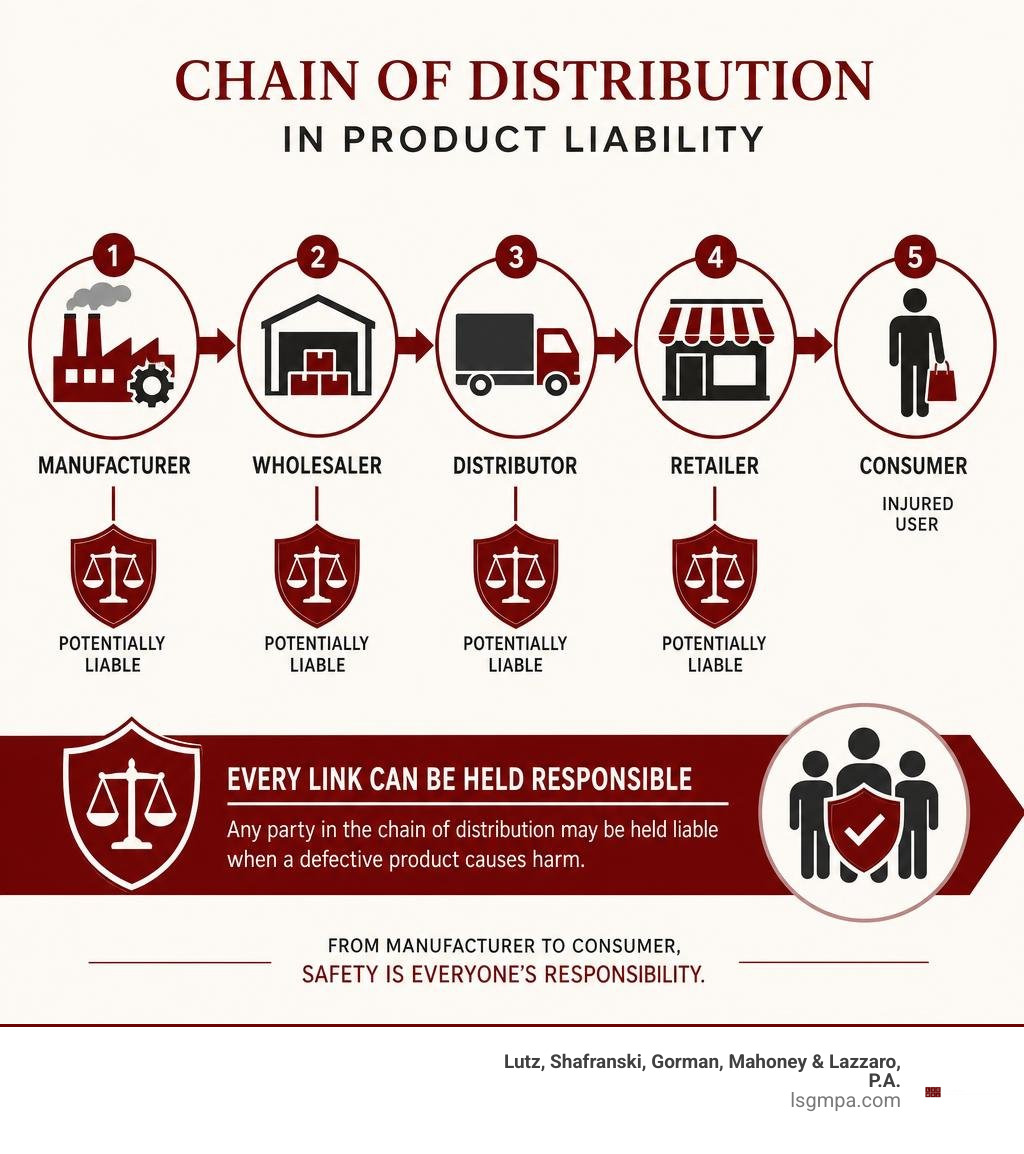
Product liability is rooted in tort law, and it imposes legal responsibility on every link in the chain that brought a dangerous product to your hands. That can include a factory overseas, a warehouse in another state, and the store right down the street.
I’m Frank Lazzaro, a Certified Civil Trial Attorney certified by the Supreme Court of New Jersey — one of roughly 2% of attorneys to hold that distinction — with extensive experience handling product liability law cases and obtaining multi-million dollar verdicts and settlements for injured clients. In the sections below, I’ll walk you through exactly what qualifies as a defective product under U.S. law and what your options are if you’ve been hurt.
To understand modern product liability law, we have to take a quick trip back in time. For centuries, the governing legal rule for buyers and sellers was caveat emptor—a Latin phrase meaning “let the buyer beware.” Under this ancient doctrine, the entire burden of inspecting a product for safety fell squarely on the consumer. If you bought a horse carriage with a cracked axle and it collapsed on your way home, that was your problem.
Compounding this harsh rule was the doctrine of privity of contract. This rule dictated that you could only file a lawsuit against someone if you had a direct contractual relationship with them. In practice, if you bought a product from a local general store, you could not sue the manufacturer who actually built the defective item because you did not buy it directly from them.
This protective shield for manufacturers began to shatter in 1916 with the landmark New York Court of Appeals case MacPherson v. Buick Motor Co. In this case, the court effectively abolished the privity defense for negligence claims. Judge Benjamin Cardozo famously ruled that if a product is reasonably certain to place life and limb in peril when negligently made, it is a thing of danger, and the manufacturer owes a duty of care to anyone who might foreseeably use it—regardless of who actually sold it to them. This decision is widely recognized as the official birth of modern product safety litigation.
The next massive evolutionary leap occurred in 1963 with the California Supreme Court decision in Greenman v. Yuba Power Products, Inc. Here, the court established the doctrine of strict liability in tort for product defects. The court recognized that consumers are powerless to protect themselves against sophisticated, mass-produced items, and that the financial burden of injuries should be borne by the manufacturers who put those products on the market, rather than the injured individuals.
Shortly thereafter, the American Law Institute published the Restatement (Second) of Torts Section 402A, which formalized strict liability nationwide. Almost every state, including New Jersey, rapidly adopted this framework. To learn more about how these core doctrines evolved, you can read this Historical overview of products liability.
Not all product failures are the same. Under the law, a product can be defective in one of three distinct ways. Identifying the exact nature of the defect is the very first step we take when building a claim, as it dictates the type of evidence and expert testimony we will need to present.
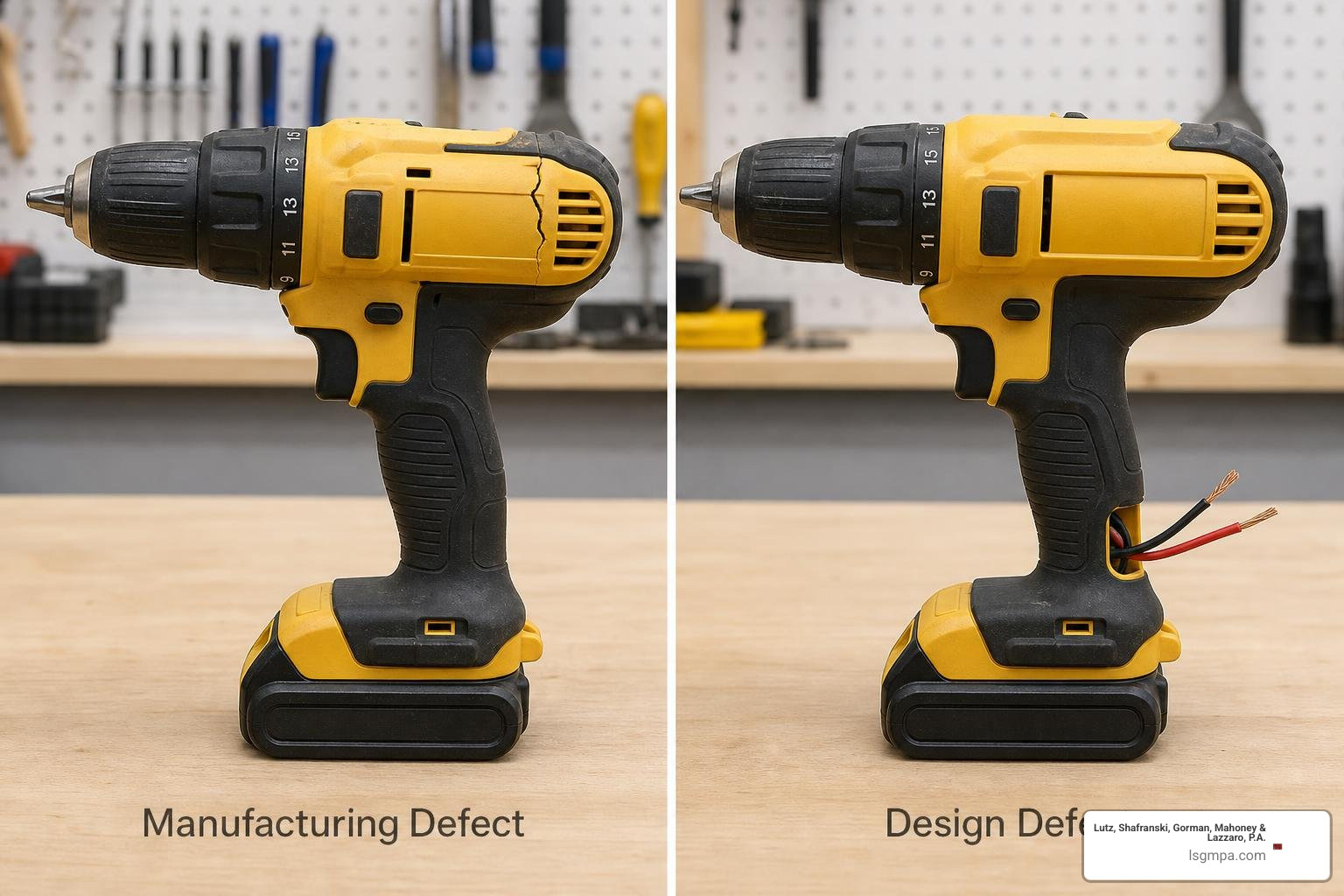
A design defect means the product was built exactly as intended, but the underlying blueprint or plan was inherently dangerous. In other words, every single unit rolling off the assembly line shares the exact same safety flaw. Examples of design defects include:
To determine if a design is legally defective, courts generally use one of two tests:
Unlike design flaws, a manufacturing defect is a one-off error. The design itself may be perfectly safe, but something went wrong on the factory floor or during assembly, causing this specific unit (or a specific batch) to deviate from the manufacturer’s own design specifications.
Examples of manufacturing defects include:
To prove a manufacturing defect, we do not need to dissect the engineering choices of the manufacturer. Instead, we simply compare the failed product to identical, correctly manufactured units to show the dangerous deviation. For a deeper look into the legal nuances of these distinctions, check out this Detailed analysis of product liability.
Even if a product is perfectly designed and flawlessly manufactured, it can still be legally defective if the manufacturer fails to provide adequate instructions or warn consumers about non-obvious, hidden dangers. These are known as marketing defects or “failure to warn” claims.
Examples of marketing defects include:
In failure-to-warn cases, courts apply a legal doctrine known as the heeding presumption. This doctrine presumes that if the manufacturer had provided an adequate warning, the consumer would have read and followed it. This shifts the burden of proof to the defendant to show that the plaintiff would have ignored the warning anyway.
Some of the most common defective products that lead to these claims include:
When we file a product liability lawsuit on your behalf, we typically assert multiple legal theories to maximize your chances of a successful recovery. The three primary pillars of product safety litigation are negligence, strict liability, and breach of warranty.
| Legal Theory | What Must Be Proven? | Focus of the Case | Common Defenses |
|---|---|---|---|
| Strict Liability | The product was defective, the defect existed when sold, and it caused injury. | The safety of the product itself. | Misuse, material alteration, statute of repose. |
| Negligence | The manufacturer owed a duty of care, breached that duty, and caused harm. | The conduct and carelessness of the manufacturer. | Comparative negligence, state-of-the-art design. |
| Breach of Warranty | The product failed to meet express claims or implied standards of fitness. | Contractual and commercial promises (UCC). | Lack of notice, warranty disclaimers. |
The most critical distinction to understand in product liability law is the difference between strict liability and negligence.
In a standard negligence case, the focus is entirely on the defendant’s behavior. We must prove that the manufacturer’s conduct fell below a reasonable standard of care—for example, that they rushed testing, skipped quality control steps, or ignored safety complaints.
Under strict liability, however, the manufacturer’s conduct is completely irrelevant. It does not matter if the manufacturer exercised the highest degree of care, used the most advanced technology, and ran a pristine factory. If the product was defective when it left their hands and that defect caused your injury, they are legally liable. This powerful consumer protection doctrine levels the playing field, making it significantly easier for injured individuals to hold multi-billion-dollar corporations accountable.
Breach of warranty claims are governed by contract law and the Uniform Commercial Code (UCC), which has been adopted by all states except Louisiana. There are three types of warranties:
Filing a successful product liability claim requires building a rock-solid, evidence-based case. To establish a prima facie (legally sufficient) case, we must prove four key elements:
If we successfully prove these elements, you are entitled to recover compensatory damages. These are split into two categories:
In rare cases where a manufacturer’s conduct was exceptionally egregious, fraudulent, or maliciously indifferent to public safety, we may also pursue punitive damages to punish the wrongdoer and deter similar behavior in the future.
However, we must also navigate several complex legal hurdles and defense strategies:
Navigating the aftermath of an injury caused by a defective product can leave you with many questions. Here are some of the most common questions we hear from clients in New Brunswick, Milltown, and Perth Amboy.
These are two entirely different types of legal deadlines that can completely bar your right to file a lawsuit:
Generally, yes, because they are part of the chain of distribution. However, many states, including New Jersey, have enacted “innocent seller” statutes. Under the NJPLA, a product seller can be dismissed from a strict liability lawsuit if they file an affidavit identifying the actual manufacturer.
However, a retailer can still be held fully liable if:
If you played a role in causing your own accident—such as ignoring a minor warning or using a product while distracted—New Jersey’s modified comparative negligence law will apply. Under this rule, your percentage of fault will be assessed by a jury:
Understanding how fault is shared is critical in all personal injury cases, whether you are dealing with a defective commercial light or looking for more info about slip and fall liability.
When a defective product disrupts your life, you shouldn’t have to carry the financial burden of a corporation’s mistake. At Lutz, Shafranski, Gorman, Mahoney & Lazzaro, P.A., we have spent decades standing up to major manufacturers, distributors, and insurance companies on behalf of injury victims across New Jersey.
Our firm provides comprehensive, compassionate advocacy for serious injury claims. We will handle the complex engineering experts, the mountain of corporate documents, and the aggressive defense lawyers so you can focus entirely on your physical recovery.
If you or a loved one has been injured by a defective product in New Brunswick, Milltown, Perth Amboy, or anywhere else in New Jersey, do not wait until the two-year deadline passes. Contact an experienced New Brunswick Product Liability Lawyer at our firm today for a free, no-obligation consultation. We only get paid if we successfully recover compensation for you.