

 Call Us Today (732) 249-0444
 August 6, 2026

When someone suffers a catastrophic injury, life turns upside down in seconds. While any accident is upsetting, a catastrophic injury lawsuit involves consequences that are far broader, longer-lasting, and more financially devastating than a standard personal injury claim.
A standard personal injury claim might involve a broken wrist from a fall or a whiplash injury from a minor rear-end fender bender. While painful and inconvenient, these injuries typically heal within months, allowing the injured person to return to work, resume hobbies, and live without permanent physical limitations.
Catastrophic injuries are fundamentally different. Under New Jersey personal injury law, a catastrophic injury is one that results in permanent, life-altering disability or loss of physical function. These include:
In a catastrophic injury lawsuit in Milltown NJ, the financial damages sought extend far beyond immediate medical bills. They must cover round-the-clock home nursing care, home accessibility modifications (such as wheelchair ramps and widened doorways), specialized vehicles, loss of lifelong earning capacity, and decades of physical pain and emotional suffering.
Because catastrophic injury claims involve substantial monetary values, defense attorneys and insurance adjusters fight them aggressively. Securing fair compensation requires building an airtight evidentiary foundation. Critical evidence includes:
When a serious accident involves a public entity in Milltown—such as a municipal borough truck, a Middlesex County road crew, a public school vehicle, or hazardous conditions on public property—the rules of the game change entirely.
Public entities in New Jersey enjoy statutory protections under the New Jersey Tort Claims Act (TCA), found at N.J.S.A. 59:1-1 et seq. Under the TCA, government immunity is the rule, and liability is the exception.
To recover non-economic damages (such as pain and suffering) from a New Jersey government body or public employee, a plaintiff must meet a strict statutory threshold defined under N.J.S.A. 59:9-2(d). You must prove through objective medical evidence that you have suffered a permanent loss of a bodily function that is substantial.
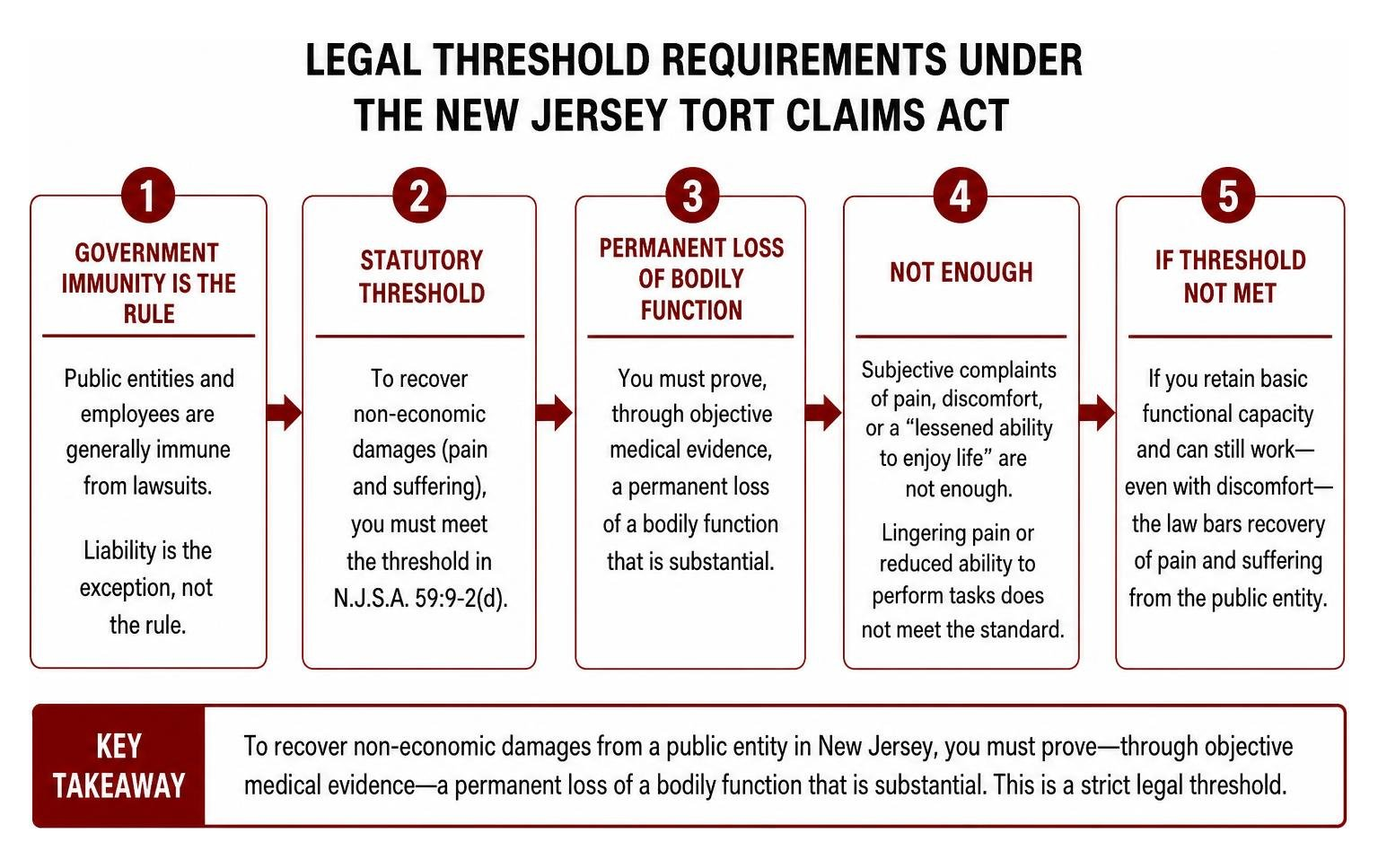
This standard is notoriously tough. Subjective complaints of chronic pain or a “lessened ability” to enjoy life are simply not enough.
A clear example of how strictly New Jersey courts enforce this rule can be seen in the court opinion Schreiber v. NJ Dept of Treasury. In this case, an appellate court affirmed that lingering pain or a reduced ability to perform everyday tasks does not satisfy the statutory threshold without objective physical evidence proving a substantial permanent physical loss. If an accident victim retains their basic functional capacity and can still work—even if doing so causes discomfort—the law bars them from recovering pain and suffering damages from the public entity.
Pursuing a government entity requires immediate action. Unlike standard personal injury lawsuits, which generally have a two-year statute of limitations in New Jersey, TCA claims require a formal Notice of Tort Claim to be served on the correct public entity within 90 days of the injury.
Failure to file this notice within 90 days usually forfeits your right to bring a lawsuit forever.
Our team works quickly to identify every municipal, county, or state entity involved, draft the mandatory TCA notice, and gather the necessary objective medical evidence—such as MRIs, CT scans, and nerve conduction studies—to meet the strict permanent loss threshold.
Many catastrophic accidents in Milltown do not involve just one at-fault party. They often stem from a chain of events involving multiple negligent individuals, private contractors, and property owners. Managing these claims requires a detailed understanding of how liability is allocated under New Jersey law.
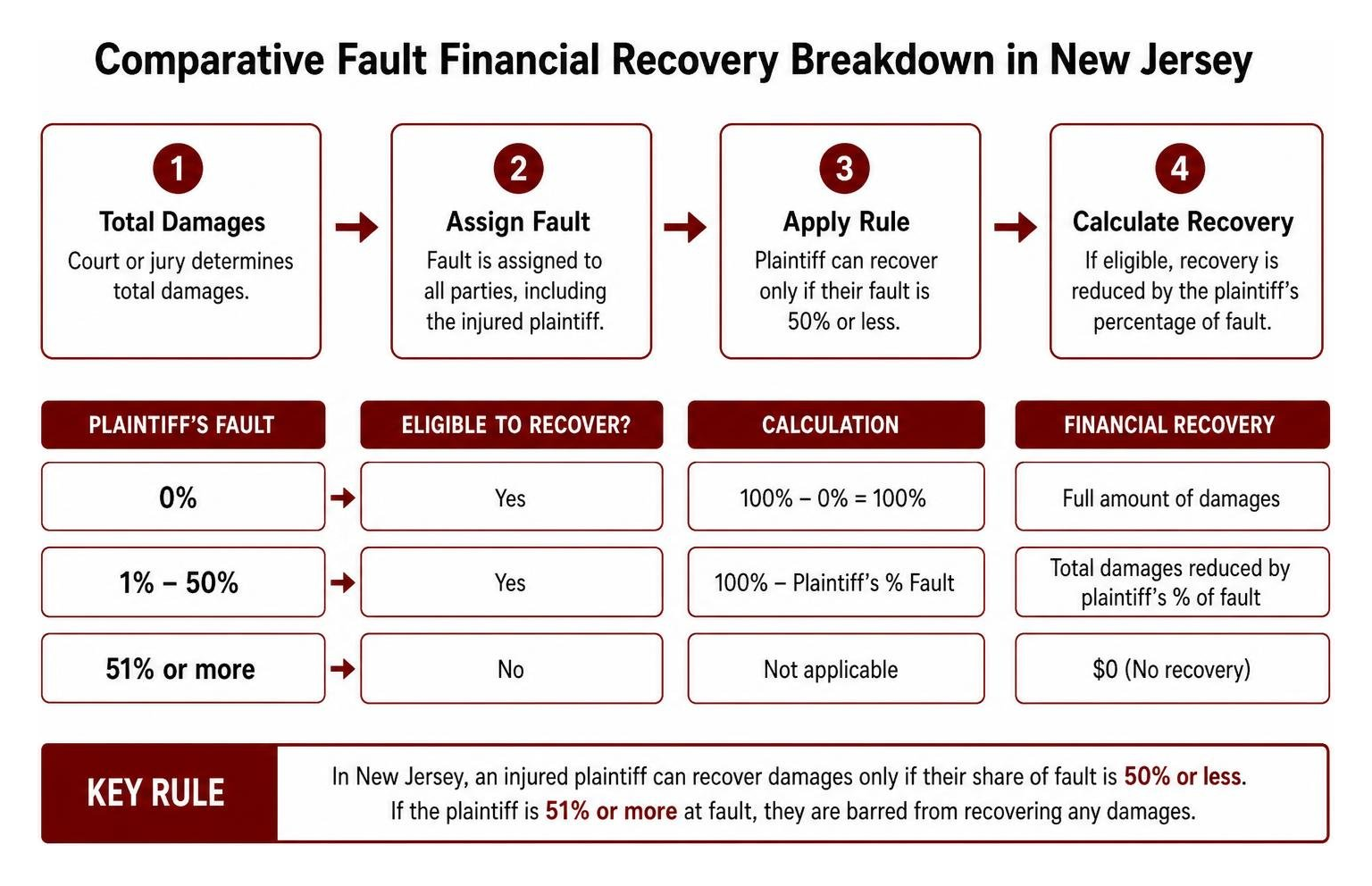
New Jersey follows a modified comparative negligence rule (N.J.S.A. 2A:15-5.1). Under this law, an injured victim can recover financial compensation as long as their share of responsibility for the accident is 50% or less. However, any financial recovery is reduced in direct proportion to the victim’s percentage of fault.
If a plaintiff is found to be 51% or more at fault, they are completely barred from recovering any damages from the other parties.
Here is a look at how comparative fault affects financial recovery in a major injury claim:
| Scenario | Total Evaluated Damages | Plaintiff Fault % | Defendant Fault % | Final Recovery Amount |
|---|---|---|---|---|
| Full Defendant Liability | $2,000,000 | 0% | 100% | $2,000,000 |
| Minor Plaintiff Fault | $2,000,000 | 10% | 90% | $1,800,000 |
| Moderate Plaintiff Fault | $2,000,000 | 20% | 80% | $1,600,000 |
| Equal Fault | $2,000,000 | 50% | 50% | $1,000,000 |
| Barred Recovery Threshold | $2,000,000 | 51% | 49% | $0 (Recovery Barred) |
Because even a small percentage shift in fault can mean hundreds of thousands of dollars in a catastrophic claim, defense lawyers work tirelessly to assign blame to the victim. We combat these strategies by compiling hard evidence—such as electronic module data and eyewitness testimony—to keep the fault where it belongs.
In complex accidents—such as a construction collapse, a multi-vehicle highway crash on Route 18 near Milltown, or an industrial incident—there may be several responsible defendants.
Under New Jersey’s Comparative Negligence Act, joint and several liability applies differently depending on each defendant’s percentage of fault:
Balancing claims against property owners, general contractors, equipment manufacturers, and municipal drivers requires meticulous legal strategy so that no viable source of insurance coverage is overlooked.
Catastrophic injuries are not always caused by sudden violent impacts like car crashes or falls. They can also result from environmental contamination and exposure to hazardous industrial chemicals over time.
A prime local example of major environmental risks in Middlesex County involves the former industrial site at 2 Ford Avenue in Milltown. During unpermitted building demolition activities at this historic site, contractors overturned electrical transformers containing hundreds of gallons of oil laced with carcinogenic polychlorinated biphenyls (PCBs).
The toxic transformer oil leaked into local storm drains and migrated directly into Mill Pond and Lawrence Brook—vital public waterways running through Milltown.
Exposure to PCBs presents severe, catastrophic health hazards, including:
The state designated Milltown as an overburdened community under New Jersey Environmental Justice laws, highlighting the community impact of hazardous industrial negligence.
When hazardous chemical releases harm human health or real property, victims and the state have powerful legal remedies under the New Jersey Spill Compensation and Control Act (N.J.S.A. 58:10-23.11 et seq.).
As illustrated in the State of NJ v. SB Milltown Verified Complaint, the Spill Act imposes strict, joint, and several liability on any person or corporate entity that discharges hazardous substances or owns contaminated property.
Key legal remedies and features under the Spill Act include:
When individuals suffer chemical exposure injuries or systemic health conditions due to commercial dumping, environmental toxic tort litigation allows victims to hold responsible developers and parent companies accountable for long-term care and damages.
New Jersey operates under a modified comparative fault rule with a 50% bar threshold. You are eligible to receive compensation for your catastrophic injuries as long as you are determined to be 50% or less responsible for the incident.
However, your financial compensation is reduced by your exact percentage of fault. For instance, if a jury determines your total lifelong damages are $1,000,000, but finds you were 20% responsible because you were speeding slightly, your final payout will be reduced by 20% to $800,000. If you are found to be 51% responsible, you cannot recover any money. Insurance carriers frequently attempt to exaggerate plaintiff fault to cross that 51% threshold, which is why having an experienced trial attorney is essential.
Suing a public entity—such as the Borough of Milltown, a local school district, or Middlesex County—requires satisfying strict legal prerequisites under the New Jersey Tort Claims Act:
Selecting legal representation for a life-changing injury is one of the most critical decisions you will make. When evaluating potential attorneys, consider these key factors:
A catastrophic injury changes life in an instant, bringing physical challenges, emotional turmoil, and overwhelming financial burdens. Navigating medical treatments while confronting insurance adjusters, comparative fault defenses, or complex government immunities is far too much to handle alone.
At Lutz, Shafranski, Gorman, Mahoney & Lazzaro, P.A., we bring deep legal expertise, firm resources, and relentless dedication to every client we represent. We understand what is at stake for you and your family, and we fight tirelessly to recover the maximum financial compensation required for your lifelong care, income replacement, and peace of mind.
If you or a loved one has suffered a severe, life-altering injury due to someone else’s negligence, speak with an experienced New Brunswick Catastrophic Injury Lawyer today. Contact us now for a free, no-obligation consultation—we’ve got your back every step of the way.
