

 Call Us Today (732) 249-0444
 October 3, 2026

A wrongful death claim is a civil lawsuit brought when a person’s death is caused by the negligent, reckless, or deliberate wrongful act of another. In the eyes of the law, a wrongful death claim is essentially a personal injury lawsuit that the deceased person is no longer able to bring themselves. Instead, the claim is pursued on behalf of the surviving family members and the deceased’s estate to seek financial compensation for the resulting harm.
It is important to understand that a civil wrongful death lawsuit is entirely separate from criminal prosecution. While a criminal case (such as for vehicular homicide or murder) seeks to punish the wrongdoer with jail time or probation, a civil wrongful death claim focuses solely on securing financial compensation and accountability for the survivors. Because they are separate proceedings, a civil claim can succeed even if the defendant is acquitted in criminal court, thanks to the lower burden of proof in civil cases (“a preponderance of the evidence” versus “beyond a reasonable doubt”).
Under New Jersey wrongful death statutes (specifically the New Jersey Wrongful Death Act, N.J.S.A. 2A:31-1 et seq.), a claim can be filed whenever a death is caused by a wrongful act, neglect, or default that would have entitled the injured person to file a personal injury lawsuit had they survived.
While many family members grieve the loss of a loved one, not everyone has the legal standing to file a lawsuit. In New Jersey, the law is very specific about who can initiate the legal process and who is entitled to receive the proceeds.
First, the lawsuit must be filed by the personal representative (also known as the executor or administrator) of the deceased person’s estate.
Although the personal representative physically files the lawsuit, they do so on behalf of the “real parties in interest”—the statutory beneficiaries. Under New Jersey law, the recovery is distributed to surviving family members who were financially dependent on the deceased at the time of death, or who would be entitled to inherit under intestate laws. This typically includes:
If the deceased had no surviving spouse, children, parents, or siblings, the law looks to more distant relatives who can demonstrate financial dependence on the deceased.
When a fatal accident occurs, families often do not realize that New Jersey law actually allows for two separate and distinct legal claims: a Wrongful Death Claim and a Survival Action (pursued under the New Jersey Survival Act, N.J.S.A. 2A:15-3). Understanding the difference between these two claims is critical for maximizing your family’s financial recovery.
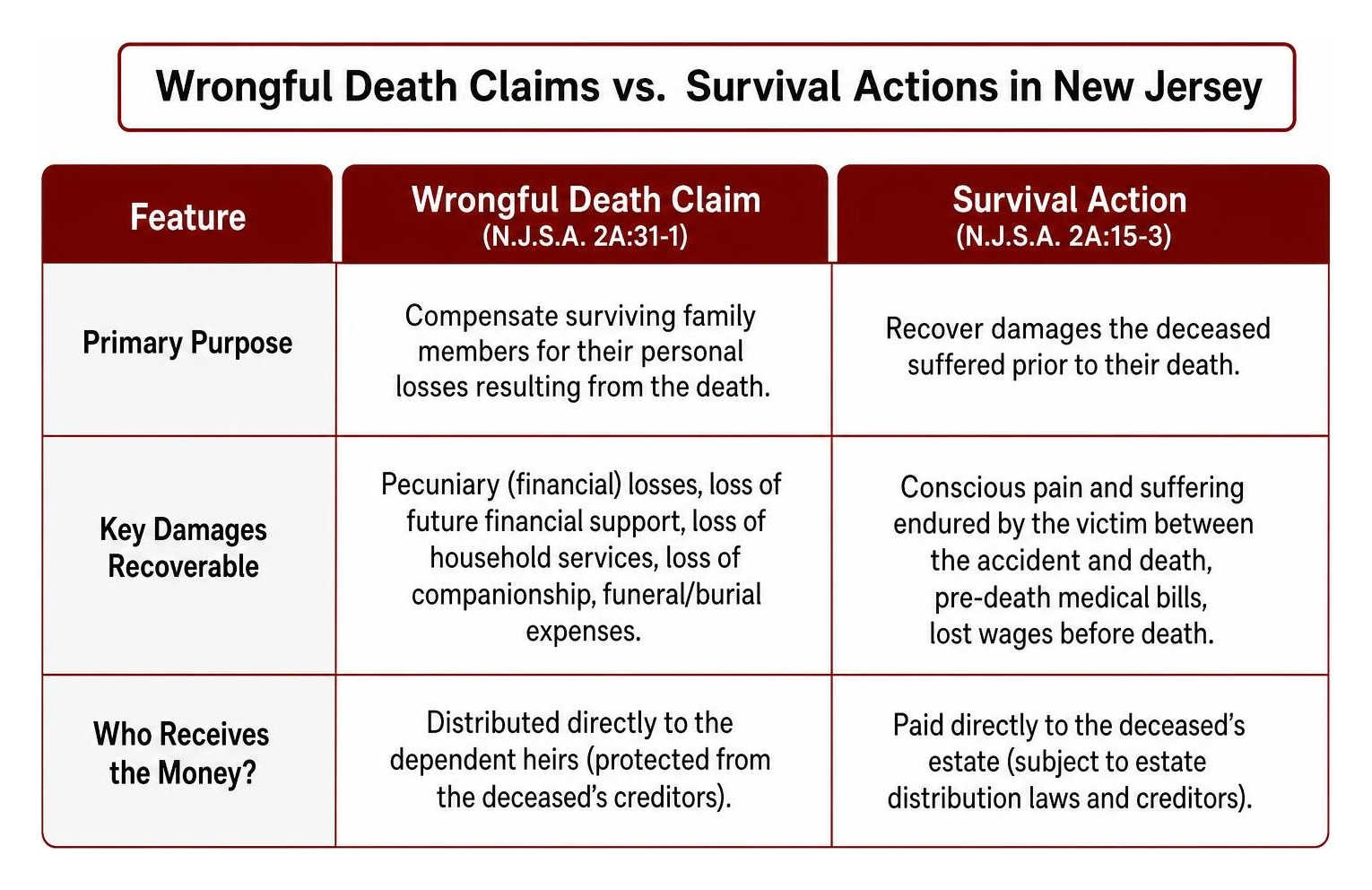
| Feature | Wrongful Death Claim (N.J.S.A. 2A:31-1) | Survival Action (N.J.S.A. 2A:15-3) |
|---|---|---|
| Primary Purpose | Compensate surviving family members for their personal losses resulting from the death. | Recover damages the deceased suffered prior to their death. |
| Key Damages Recoverable | Pecuniary (financial) losses, loss of future financial support, loss of household services, loss of companionship, funeral/burial expenses. | Conscious pain and suffering endured by the victim between the accident and death, pre-death medical bills, lost wages before death. |
| Who Receives the Money? | Distributed directly to the dependent heirs (protected from the deceased’s creditors). | Paid directly to the deceased’s estate (subject to estate distribution laws and creditors). |
| Filing Party | Personal representative on behalf of the dependent heirs. | Executor or administrator on behalf of the estate. |
To illustrate the difference, consider a scenario where a pedestrian is struck by a commercial vehicle, survives in the hospital for three days in severe pain, and then passes away.

Fatal accidents can happen anywhere, but they are almost always rooted in some form of human negligence. When a person or corporation fails to act with reasonable care, the consequences can be fatal. As personal injury lawyers serving New Brunswick NJ, Milltown NJ, and Perth Amboy NJ, we see several recurring causes of wrongful death actions.
Motor vehicle accidents are among the most common catalysts for wrongful death claims in New Jersey. According to state statistics, New Jersey reported a total of 502 fatal accidents resulting in 524 deaths in 2021. These tragedies are frequently caused by:
Beyond the roadway, preventable deaths frequently occur in medical facilities and on poorly maintained properties:

To win a wrongful death lawsuit in New Jersey, your legal team must prove that the defendant’s negligence directly caused your loved one’s death. This requires establishing four essential legal elements:
Proving these four elements in court requires a meticulous and exhaustive investigation. Experienced wrongful death lawsuit lawyers do not rely on police reports alone. We build a bulletproof case by partnering with highly specialized experts:
New Jersey’s Wrongful Death Act is strictly focused on compensating survivors for their financial, or pecuniary, losses. Unlike some states that allow families to recover direct damages for their own emotional grief and mental suffering within a wrongful death action, New Jersey law measures the value of the claim based on practical, economic metrics.
However, this does not mean compensation is limited only to lost wages. A comprehensive claim includes several categories of recoverable damages:
Once a wrongful death settlement or jury verdict is secured, the recovered funds must be distributed among the surviving heirs. In New Jersey, these funds are distributed based on the level of financial dependency each family member had on the deceased, rather than a flat, equal split.
The court will evaluate the specific needs of the survivors to ensure that those who relied most heavily on the deceased for financial support are prioritized:
Importantly, because wrongful death proceeds are for the exclusive benefit of the heirs, creditors of the deceased cannot access these funds to pay off the deceased’s outstanding personal debts.
Navigating a wrongful death claim while trying to process devastating grief is an overwhelming burden. Attempting to negotiate with insurance adjusters—who are actively looking for ways to minimize payouts and protect their company’s bottom line—is a recipe for further heartache.
A 2014 Insurance Research Council study revealed that claimants who work with an experienced personal injury attorney recover an average of 3.5 times more in damages than those who attempt to handle claims on their own.
When choosing legal representation, you should look for a firm with deep, specialized experience in wrongful death litigation. A general practice lawyer may not have the resources, expert network, or trial experience required to handle these complex, high-stakes claims.
At Lutz, Shafranski, Gorman, Mahoney & Lazzaro, P.A., we provide:
In New Jersey, there is a strict two-year statute of limitations for filing a wrongful death claim. This means your family must file the lawsuit within two years of the date of your loved one’s passing. If you miss this deadline, your right to seek justice and compensation will be permanently barred.
While two years may seem like a long time, building a strong wrongful death case requires immediate action. Evidence must be preserved, accident scenes must be analyzed before they change, and witness memories fade quickly.
There are very few exceptions to this rule. While some medical malpractice errors may qualify for “tolling” (pausing the clock) under the discovery rule if the fatal error was not immediately discoverable, you should never assume an exception applies without consulting an attorney.
While every case is unique, a typical wrongful death lawsuit follows a structured timeline:
A criminal case is brought by the state or government to punish a person for breaking the law; it can result in prison time but does not provide financial compensation to the victim’s family. A civil wrongful death claim is brought by the family’s legal representative to seek financial damages for their losses. The civil claim has a lower burden of proof and can proceed completely independently of any criminal charges.
Yes. New Jersey follows a modified comparative negligence system (with a 51% fault threshold). This means your family can still recover damages as long as your loved one was less than 51% responsible for the accident. However, the final compensation award will be reduced by their percentage of fault. For example, if a jury awards $1,000,000 in damages but finds the deceased was 10% at fault for speeding, the final recovery will be reduced by 10% to $900,000.
Hiring our firm costs your family nothing out of pocket. We work on a contingency fee basis, meaning our fees are a set percentage (typically between 33% and 40% depending on court rules) of the final recovery we secure for you. If we do not win your case, you owe us absolutely nothing for our time or legal services.
Losing a loved one is a life-altering tragedy, but you do not have to carry the financial and legal burdens alone. At Lutz, Shafranski, Gorman, Mahoney & Lazzaro, P.A., we have spent decades standing beside families in New Brunswick, Milltown, Perth Amboy, and throughout New Jersey during their darkest moments. We are committed to holding negligent parties accountable and securing the comprehensive compensation your family needs to move forward.
If you are ready to explore your legal options in a supportive, pressure-free environment, Contact a New Brunswick Wrongful Death Lawyer at Lutz, Shafranski, Gorman, Mahoney & Lazzaro, P.A. today for a free, compassionate, and completely confidential case evaluation.