

 Call Us Today (732) 249-0444
 June 30, 2026

Hiring an automobile property damage lawyer is often the fastest way to get fair compensation after a crash — especially when an insurance company is lowballing your repair estimate, disputing liability, or dragging its feet on your claim.
Here is when you need one, and what they can do for you:
After a crash in New Jersey, you are already dealing with medical bills, missed work, and stress. The last thing you need is an insurance company deciding what your property is worth — on their terms.
Insurance companies are not on your side. They use automated tools designed to produce low estimates, and they count on you accepting the first offer.
That is where legal representation changes the outcome.
I’m Frank Lazzaro, a Certified Civil Trial Attorney certified by the Supreme Court of New Jersey, with a track record of six and seven-figure recoveries for injured clients — including those facing automobile property damage lawyer disputes where insurers refused to pay what was owed. If you are dealing with a wrecked car and an uncooperative insurance company, the sections below will walk you through exactly what your rights are and how to protect them.
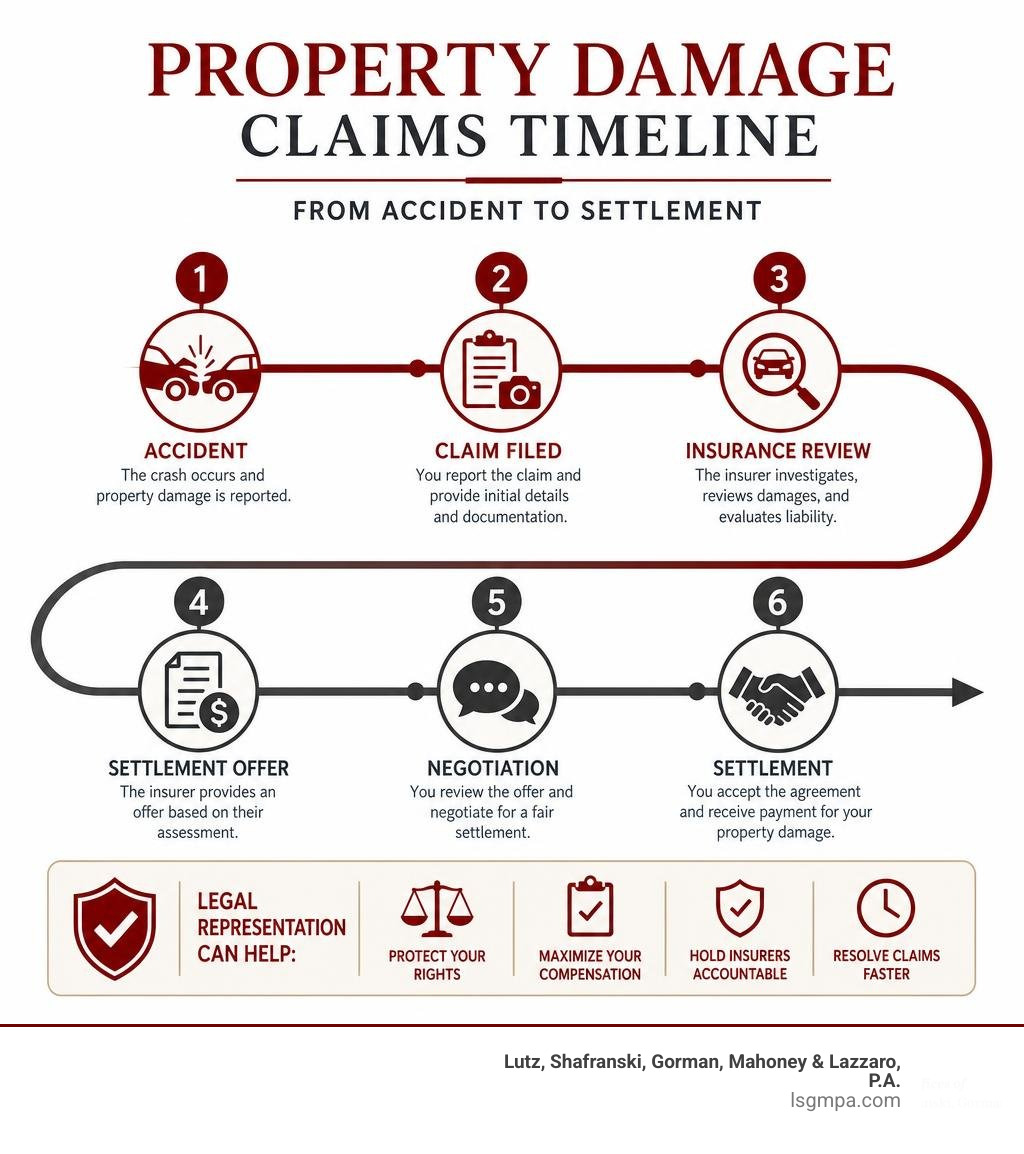
When you are involved in a car accident, your immediate focus is naturally on physical safety and medical care. However, once the dust settles, the reality of your damaged vehicle and lost personal belongings sets in. In New Jersey, property damage claims are evaluated separately from personal injury claims, even though they stem from the same accident.
A comprehensive property damage claim should cover far more than just a basic body shop bill. Depending on the circumstances of your crash, you may be entitled to recover compensation for:
Navigating these claims requires a firm understanding of state-specific laws. For instance, New Jersey operates under a modified comparative fault system. Under this rule, you can recover property damage compensation from the other driver as long as you are not more than 50% at fault for the accident. However, your recovery will be reduced by your percentage of fault. If you are deemed 20% responsible for a collision on Route 18, your $10,000 property damage payout will be reduced to $8,000. For a general overview of required auto coverages in New Jersey, you can review the New Jersey Department of Banking and Insurance auto insurance guide.
Furthermore, the state-by-state landscape of property damage laws varies significantly. While the statute of limitations for personal injury in New Jersey is two years, the statute of limitations for filing a property damage lawsuit is six years. This is much more generous than other states, though waiting too long can lead to lost evidence, faded witness memories, and increased resistance from insurance adjusters.
To illustrate how state laws differ, consider the table below:
| State | Property Damage Statute of Limitations | Diminished Value Recoverable? | Minimum Liability Limits |
|---|---|---|---|
| New Jersey | 6 Years | Yes (primarily against third parties) | $5,000 (standard policy minimum) |
| California | 3 Years | Yes (resale value loss typically 10-25%) | $5,000 (minimum limit) |
| Georgia | 4 Years | Yes (recoverable even from own insurer) | $25,000 (minimum limit) |
| Indiana | 2 Years | Yes (established under Wiese-GMC) | $25,000 (minimum limit) |
If you are dealing with a complex claim in our area, seeking guidance from a qualified local attorney can help clarify your options.
If your vehicle looks like a crumpled soda can after an accident on the New Jersey Turnpike, the insurance company will likely declare it a total loss. But how is this determined, and what are your rights?
In many states, a vehicle is officially deemed a total loss when the estimated repair costs approach a specific percentage-often 70% to 80%-of its actual cash value (ACV). While some states mandate a strict statutory threshold (such as 75%), New Jersey insurers typically evaluate whether the cost of repairs plus the salvage value of the vehicle exceeds the vehicle’s pre-accident fair market value.
Once your car is declared a total loss, you are entitled to its actual cash value (ACV) immediately prior to the crash. Unfortunately, insurance companies rarely volunteer a fair number. Instead, they use proprietary vehicle valuation software (such as CCC Intelligent Solutions or Mitchell) that frequently generates lowball estimates by comparing your vehicle to subpar “comparables” that may have higher mileage, fewer options, or pre-existing damage.
As a vehicle owner, you have the right to:
Have you ever tried to buy a used car, run a CarFax report, and saw it was in a major accident? If you are like most buyers, you either walked away or demanded a massive discount.
This loss of resale value is known as diminished value. Even if a highly skilled technician uses original equipment manufacturer (OEM) parts and restores your car to pristine visual condition, its market value drops simply because it now has an accident history. This drop typically ranges from 10% to 25% of the vehicle’s pre-accident resale value.
New Jersey law recognizes your right to recover diminished value, but there is a catch: you must generally pursue this claim against the at-fault driver’s insurance company (a third-party claim). Pursuing a diminished value claim against your own collision coverage (a first-party claim) is rarely allowed under standard New Jersey policy language unless specifically written into the contract.
To successfully secure diminished value compensation, you must present concrete evidence. Simply printing out a generic online estimate won’t cut it. You will need a professional, independent appraisal that details the vehicle’s pre-accident value, the cost and quality of the repairs, and its post-repair market value. If you need assistance with property valuation disputes, consulting with a knowledgeable legal professional can provide valuable direction.
Many minor fender-benders can be resolved directly through your insurance company without legal intervention. However, property damage claims can quickly spiral into administrative nightmares.

You should strongly consider hiring an automobile property damage lawyer if you encounter any of the following scenarios:
If you are dealing with a combination of vehicle damage and physical injuries, reaching out to an experienced team like Lutz, Shafranski, Gorman, Mahoney & Lazzaro, P.A. ensures you have comprehensive advocacy. We handle the heavy lifting so you can focus on recovering.
Insurance adjusters are trained to save their employers money. They use a variety of strategies to minimize payouts, but an experienced attorney knows how to counter them.
When an insurer behaves unreasonably, a lawyer can threaten a bad faith lawsuit, which forces the insurance company to take your claim seriously or face steep penalties under state law. New Jersey consumers can also review complaint options through the New Jersey Division of Consumer Affairs, although legal guidance is often important when a claim involves injuries, disputed liability, or a significant loss. If you are facing these issues in the Middlesex County area, speaking with a dedicated legal advocate can give you the leverage you need.
Every state, county, and municipality has its own unique legal quirks. In New Jersey, navigating the intersection of no-fault PIP coverage (which only handles medical bills) and property damage liability requires local legal knowledge.
A local attorney based in New Brunswick, Milltown, or Perth Amboy understands how local courts operate. For claims under $15,000, we can utilize the New Jersey Special Civil Part, which offers a streamlined process for resolving property disputes without the years of delay associated with the Law Division. Furthermore, local attorneys have established relationships with trusted independent auto appraisers and accident reconstruction experts in the area, ensuring your case is backed by solid evidence.
What you do in the minutes and days following a car accident can make or break your property damage claim. To protect your rights and ensure you receive every penny you deserve, follow these steps:
If the insurance company presents an offer that doesn’t cover your actual losses, you must be prepared to challenge it with objective, documented facts.
Here is a checklist of the essential evidence you should collect:
If you are looking for local support in Perth Amboy or New Brunswick, consulting with a qualified car accident lawyer can help you organize this evidence effectively.
If liability is clear and the damage is straightforward, a property damage claim can be resolved in as little as two to four weeks. However, if the insurance company disputes who caused the accident, or if your vehicle is declared a total loss and you disagree on its valuation, the negotiation process can drag on for several months. If litigation becomes necessary to force a fair payout, resolving the claim through the court system can take anywhere from six months to over a year.
Yes. In New Jersey, property damage and personal injury claims are treated as separate entities. Insurance companies usually assign different adjusters to handle each claim. You can resolve and settle your vehicle repair or total loss claim quickly so you can get back on the road, while keeping your personal injury claim open.
Important Warning: Be incredibly careful when signing any settlement release documents from the insurance company. Ensure the paperwork explicitly states that you are only releasing your property damage claims, and not waiving your right to pursue compensation for physical injuries, medical bills, or pain and suffering.
While New Jersey requires drivers to carry liability insurance, many motorists operate vehicles illegally without coverage, or carry the bare minimum. If you are hit by an uninsured driver, you have a few options:
Dealing with a wrecked car is stressful enough without having to fight an insurance company that is trying to underpay your claim. Whether you are disputing a total loss valuation, fighting for OEM parts, or trying to recover the diminished value of your repaired vehicle, you have legal rights.
At Lutz, Shafranski, Gorman, Mahoney & Lazzaro, P.A., we provide comprehensive advocacy for accident victims across New Jersey, including New Brunswick, Milltown, and Perth Amboy. We understand how insurance companies operate, and we know how to hold them accountable. If you have been injured in an accident and are facing an uphill battle over your vehicle, do not let the insurance company dictate what your property is worth.
Contact us today at Lutz, Shafranski, Gorman, Mahoney & Lazzaro, P.A. for a free consultation, or connect directly with our New Brunswick Car Accident Lawyer team to learn how we can help you get your life—and your car—back on track.
